The words you choose in professional and personal communication say a lot about you. Repeating the same phrase like “as previously mentioned” over and over can make your writing feel robotic, cold, or even passive-aggressive.
Using a wider range of expressions helps you communicate with more clarity, warmth, and confidence. This guide gives you smarter alternatives so your writing always hits the right tone.
“As previously mentioned” is a phrase used to refer back to something you already said or wrote. It signals to the reader that you are connecting new information to something covered earlier.
People use it to avoid restating something fully, to reinforce a point, or to remind someone of an earlier agreement. It works in both spoken and written communication.
When Should You Use “As Previously Mentioned”?
In professional settings like formal reports, business emails, or presentations, the phrase can be useful. It keeps documents organized and shows that ideas are connected.
That said, in casual conversations, daily emails, or messages to friends, it often sounds stiff or even impatient. Choosing the right alternative for the right situation makes a real difference.
Is “As Previously Mentioned” Professional or Polite?
It depends entirely on how you use it. The phrase is not rude on its own, but it can carry an edge when the context is tense.
Pros:
Clear and direct
Works well in formal writing
Keeps long documents organized
Signals you have covered this point before
Cons:
Can sound passive-aggressive in emails
Feels cold in casual settings
Overused in workplace communication
Sometimes reads as impatient or dismissive
Grammar and Correct Usage
Used correctly, “as previously mentioned” is grammatically sound. Here is what to know:
It is grammatically correct in both formal and informal writing
Always use it to refer back to something said earlier, not something coming up next
It should be followed by a comma when it opens a sentence: “As previously mentioned, the deadline is Friday.”
Avoid using it multiple times in the same email or document; it starts to feel repetitive fast
In speech, it can sound stiff; natural conversation rarely calls for it
Formal version: “As previously mentioned, the contract requires two signatures.”
Casual version: “Like I said, meet me at noon.”
Common Mistakes When Using “As Previously Mentioned”
Overusing it in one document or email thread, which makes it lose meaning
Using it aggressively when following up on ignored messages, which can come across as passive-aggressive
Applying it in casual conversation where it sounds out of place and unnecessarily formal
Placing it mid-sentence without a comma, which breaks the flow: “The deadline as previously mentioned is Friday” should be “As previously mentioned, the deadline is Friday”
Using it to talk down to someone, as in reminding them of something they clearly forgot in a way that feels condescending
How to Respond to “As Previously Mentioned”
When someone uses this phrase with you, they are signaling something they said before. Here are five natural ways to respond:
1. “Thanks for the reminder.”
Meaning: You acknowledge the point without conflict
Best use: Email or meeting follow-up
Example: “As previously mentioned, the report is due Monday.” / “Thanks for the reminder, I will have it ready.”
2. “Got it, I will keep that in mind.”
Meaning: You confirm you heard and understood
Best use: Casual work conversations
Example: “As previously mentioned, we need three quotes.” / “Got it, I will keep that in mind.”
3. “Right, just wanted to double-check.”
Meaning: You soften the repetition and explain why you asked again
Best use: When you genuinely needed clarification
Example: “As previously mentioned, approvals go through Sarah.” / “Right, just wanted to double-check the process.”
4. “Apologies, I must have missed that.”
Meaning: You take responsibility without drama
Best use: When you actually did miss it
Example: “As previously mentioned, the venue changed.” / “Apologies, I must have missed that update.”
5. “Understood, let me revisit my notes.”
Meaning: You show you are taking it seriously
Best use: Formal or professional settings
Example: “As previously mentioned, this falls under clause four.” / “Understood, let me revisit my notes on that.”
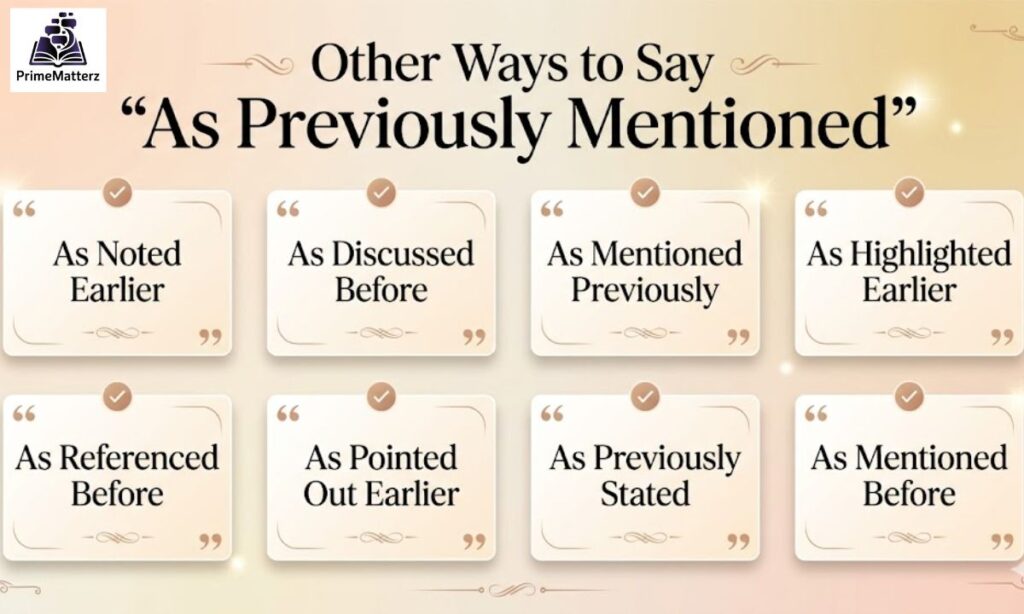
15+ Other Ways to Say “As Previously Mentioned”
As I Noted Earlier
Meaning: A softer, more personal way to refer back to something you said. It carries a slightly warmer tone than the original phrase and feels less robotic.
Example: Person A: “What about the budget?” / Person B: “As I noted earlier, we capped it at $5,000 for Q3.”
Best Use: Professional emails and formal conversations
Worst Use: Casual text messages where it feels out of place
Tone: Professional, Neutral
Like I Said
Meaning: A casual, direct way to reinforce a point you already made. It signals mild emphasis without sounding formal.
Example: Person A: “Do we really need to book early?” / Person B: “Like I said, the venue fills up fast in December.”
Best Use: Casual conversation, friendly emails
Worst Use: Formal reports or business presentations
Tone: Casual, Friendly
To Reiterate
Meaning: A confident, clear way to restate your point. It works well when you want to make sure something important was not missed.
Example: Person A: “So the meeting is optional?” / Person B: “To reiterate, attendance is required for all team leads.”
Best Use: Presentations, formal announcements, business emails
Worst Use: Casual small talk where it sounds overly stiff
Tone: Formal, Direct, Professional
As Discussed
Meaning: Short and clean. Works best after a meeting or conversation where both parties agreed on something.
Example: Person A: “When does the project start?” / Person B: “As discussed, we kick off on the 15th.”
Best Use: Follow-up emails after meetings or calls
Worst Use: When nothing was formally discussed; it can confuse the reader
Tone: Neutral, Professional
As You May Recall
Meaning: A gentle way to prompt someone’s memory. It is softer than “as previously mentioned” and assumes good faith.
Example: Person A: “What was the original plan?” / Person B: “As you may recall, we agreed to split the costs evenly.”
Best Use: Professional emails when you want to remind without sounding pushy
Worst Use: Situations where you are clearly frustrated; the softness gets lost
Tone: Polite, Warm, Professional
Going Back to What I Said
Meaning: A conversational way to circle back to an earlier point. It sounds natural in spoken settings and informal writing.
Example: Person A: “Why is this taking so long?” / Person B: “Going back to what I said earlier, the vendor pushed the timeline.”
Best Use: Team discussions, casual emails, verbal conversations
Worst Use: Formal documents or academic writing
Tone: Casual, Friendly, Conversational
Building on That Point
Meaning: This phrase does double duty. It refers back to something said and also moves the conversation forward. It shows momentum.
Example: Person A: “So marketing needs more support?” / Person B: “Building on that point, I think we should double the content budget.”
Best Use: Meetings, presentations, strategy sessions
Worst Use: Simple email reminders where no new idea is being added
Tone: Professional, Confident, Forward-looking
As Outlined Above
Meaning: Refers to content that appears earlier in the same document or email. Works best in writing rather than conversation.
Example: Person A: “What are the steps?” / Person B: “As outlined above, start with the intake form before scheduling.”
Best Use: Reports, formal emails, long documents
Worst Use: Spoken conversations where there is no physical “above”
Tone: Formal, Academic, Structured
Referring Back to
Meaning: A flexible phrase that works in both formal and informal settings. It gently redirects the conversation to an earlier point.
Example: Person A: “Is there a process for this?” / Person B: “Referring back to our conversation last week, yes, we have a clear workflow.”
Best Use: Emails and verbal follow-ups after previous discussions
Worst Use: Very casual texting where it still sounds too structured
Tone: Neutral, Professional
As I Mentioned Before
Meaning: A natural, friendly alternative that does not carry the passive-aggressive edge that “as previously mentioned” sometimes does.
Example: Person A: “Can you remind me of the login?” / Person B: “As I mentioned before, it is in the shared drive under Admin.”
Best Use: Everyday professional and casual communication
Worst Use: Legal or highly formal documents where precision matters more
Tone: Friendly, Warm, Neutral
Following Up on What Was Said
Meaning: Acknowledges a previous point and signals you are continuing that thread. Feels active and engaged rather than repetitive.
Example: Person A: “Did we ever decide on colors?” / Person B: “Following up on what was said in Tuesday’s call, we went with navy and white.”
Best Use: Email follow-ups, project check-ins
Worst Use: Quick verbal exchanges where it feels overly formal
Tone: Professional, Collaborative
As Per Our Earlier Conversation
Meaning: Commonly used in business emails to refer to a phone call, meeting, or previous email thread. It sounds professional and organized.
Example: Person A: “What documents do I need?” / Person B: “As per our earlier conversation, you will need your ID and a signed form.”
Best Use: Client communication, professional follow-ups
Worst Use: Internal casual emails where it can sound overly stiff
Tone: Formal, Business-like
As I’ve Already Noted
Meaning: Adds a personal touch. It reminds the other person of something you said without sounding dismissive or frustrated.
Example: Person A: “What time does it close?” / Person B: “As I’ve already noted, the office closes at 5 PM on Fridays.”
Best Use: Polite reminders in emails or verbal conversations
Worst Use: When said with frustration, it can still land badly
Tone: Neutral, Polite, Slightly Assertive
In Line with What Was Discussed
Meaning: A collaborative phrase that ties back to an agreement or shared decision. It suggests teamwork rather than correction.
Example: Person A: “Are we still going with option two?” / Person B: “Yes, in line with what was discussed, we are moving forward with that.”
Best Use: Team meetings, project updates, collaborative emails
Worst Use: Solo decisions or contexts where no group discussion happened
Tone: Professional, Collaborative, Warm
Just to Circle Back
Meaning: Popular in modern workplace communication. It is conversational and signals you are revisiting something without making it feel like a correction.
Example: Person A: “Are we still on for the 3 PM call?” / Person B: “Just to circle back, we moved that to 4 PM yesterday.”
Best Use: Slack messages, team emails, quick verbal updates
Worst Use: Formal reports or academic writing where it is too casual
Tone: Casual, Friendly, Modern
As Touched on Earlier
Meaning: A gentle, low-key way to refer to a point you briefly made before. It works well when the original mention was light and you are now going deeper.
Example: Person A: “Tell me more about the risk factor.” / Person B: “As touched on earlier, the main concern is the supply chain delay.”
Best Use: Presentations, interviews, longer written pieces
Worst Use: Quick text conversations where it sounds over-prepared
Tone: Professional, Thoughtful, Measured
Formal vs Informal Alternatives Table
Formal Alternatives
Informal Alternatives
As outlined above
Like I said
To reiterate
Just to circle back
As per our earlier conversation
Going back to what I said
As indicated earlier
As I mentioned before
As noted in the previous section
Referring back to
In line with what was discussed
As touched on earlier
As referenced before
Following up on what was said
Aforementioned
You may remember
As highlighted earlier
Like we talked about
As per my previous communication
Just a quick reminder
Which Alternative Should You Choose?
The right phrase depends entirely on who you are talking to and where.
At work or with your manager: Go with “as discussed,” “to reiterate,” or “as per our earlier conversation.” These are clear, professional, and not passive-aggressive.
In a business email to a client: “As I noted earlier” or “in line with what was discussed” works well. Both are warm enough to feel human and professional enough to feel credible.
With a customer: “Just to circle back” or “as you may recall” keeps things friendly and non-threatening. Customers respond better to soft phrasing.
With a friend or family member: “Like I said” or “going back to what I mentioned” is all you need. Keep it natural and simple.
On social media or in casual content: “Just to circle back” or “like I said before” fits the tone without sounding like a corporate memo.
Frequently Asked Questions
Is “as previously mentioned” rude?
It is not inherently rude, but it can come across as passive-aggressive in emails, especially in a tense or repeated-follow-up context.
What is the best formal alternative for academic writing?
“As outlined above” is the cleanest option because it is concise and keeps your word count tight.
Is there a difference between “as previously mentioned” and “as mentioned previously”?
No, these two phrases mean exactly the same thing and can be used interchangeably in any context.
Which phrase should I avoid in professional emails?
Avoid “per my last email” paired with “as previously mentioned” in the same thread; together they can feel pointed and impatient.
Can I use “to reiterate” in casual conversation?
Technically yes, but it sounds heavy in casual settings; “like I said” or “just to circle back” will always feel more natural.
Final Thoughts
The phrase “as previously mentioned” is not broken, but it has limits, and those limits matter more than most people realize. Choosing the right alternative for the right setting makes your communication feel thoughtful, clear, and human, which is exactly what every good conversation needs.