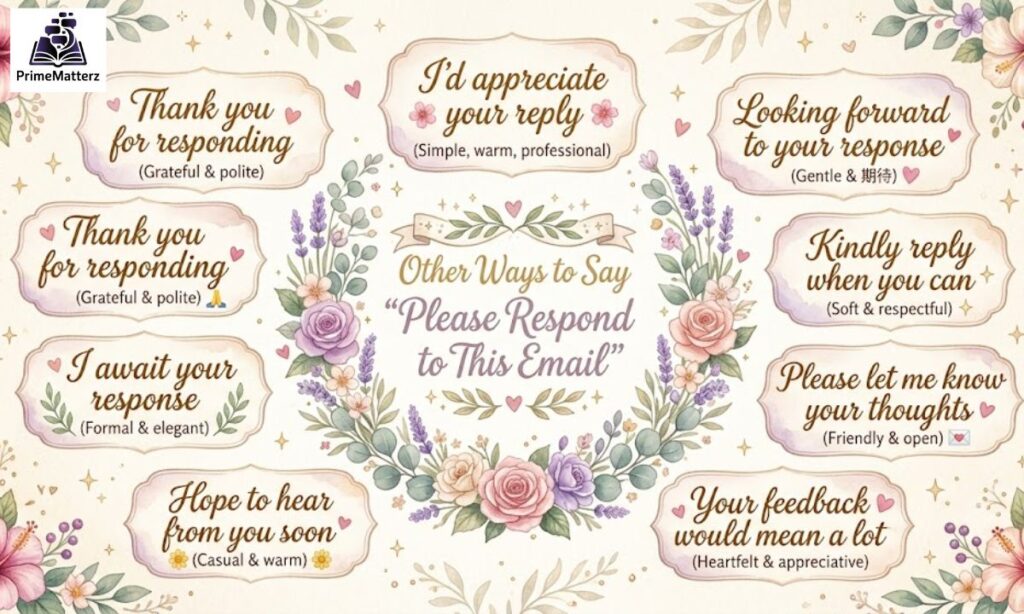
15+ Other Ways to Say “Please Respond to This Email”
Hayat
June 12, 2026No comments
The way you ask for a reply says more than you think. A clunky or too-blunt closing line can make a professional email feel pushy — or worse, easy to ignore. Knowing how to ask someone to respond, in the right tone for the right situation, is one of the simplest ways to improve your communication and actually get the reply you need.
“Please respond to this email” is a direct request asking someone to reply to your message. It signals that you need a response and that the conversation is not complete.
People use it in professional settings when they want to make sure their email does not get buried or forgotten. It sets a clear expectation without being aggressive — though the tone can vary depending on how and where it is placed.
When Should You Use “Please Respond to This Email”?
This phrase works best in professional emails where you need confirmation, feedback, approval, or a decision. It is clear and leaves no room for ambiguity about what you expect next.
It is less suited for casual conversations, texts, or messages to close friends where it can come across as demanding. For those settings, something lighter like “let me know your thoughts” or “get back to me when you can” fits much better.
Is “Please Respond to This Email” Professional or Polite?
It is professional — but only just. The phrase is grammatically correct and widely understood, but it can feel abrupt depending on context.
Pros:
Clear and direct — leaves no confusion about what you need
Appropriate for follow-up emails and deadline-driven requests
Works in most formal workplace settings
Easy to understand for non-native English speakers
Can be softened easily with a few added words
Cons:
Can sound blunt or impatient without extra context
“Please respond” alone may feel like a command rather than a request
Not ideal for senior executives or clients who expect a warmer tone
Overusing it in every email makes it lose impact
In some cultures, this level of directness can feel rude
Grammar and Correct Usage of “Please Respond to This Email”
Is it grammatically correct? Yes — “please respond to this email” is a standard imperative sentence with a polite marker (“please”).
Correct structure: “Please” + verb (“respond”) + object (“to this email”). Example: “Please respond to this email by Friday.”
Common mistake: Writing “please revert” instead of “please respond” — “revert” means to return to a previous state, not to reply. This is a widespread error in some regions.
Another common mistake: “Please do respond to this email” — technically correct but sounds stiff and slightly aggressive.
Formal version:“I would appreciate your response to this email at your earliest convenience.”
Informal version:“Please get back to me on this when you can.”
Adding a deadline makes it stronger:“Please respond to this email by end of day Thursday.”
Common Mistakes When Using “Please Respond to This Email”
Using it in every email: Ending every message with “please respond” trains people to ignore it. Save it for when you genuinely need a reply.
No context for urgency: Saying “please respond” without explaining why creates friction. Always give the person a reason to prioritize.
Tone mismatch: Using it with close colleagues or friends sounds oddly formal and can create unnecessary tension.
All caps or exclamation points: Writing “PLEASE RESPOND ASAP!!!” reads as panicked or aggressive and damages your professional image.
Placing it mid-email: This line belongs at the end, as a closing action — not buried in the middle of a paragraph where it gets lost.
Forgetting to include a deadline: “Please respond” without a timeframe gives the reader no sense of priority.
How to Respond When Someone Says “Please Respond to This Email”
Sometimes you receive this phrase and need to reply promptly. Here are five natural ways to respond:
1. “Thank you for following up — here is my response.” Meaning: Acknowledges their request professionally and gets straight to the point. Best Use: Workplace emails, client communication. Example: “Thank you for following up — here is my response to the questions you raised.”
2. “Apologies for the delay — please see my thoughts below.” Meaning: Addresses the late reply and redirects to the content. Best Use: When you are responding later than expected. Example: “Apologies for the delay — please see my thoughts below on the project timeline.”
3. “Got it — I will have a full response to you by [date].” Meaning: Buys time professionally without leaving someone hanging. Best Use: When you need more time to respond properly. Example: “Got it — I will have a full response to you by end of day Friday.”
4. “Confirmed — I have reviewed everything and my feedback is below.” Meaning: Shows you acted on their request quickly and thoroughly. Best Use: Approval chains, document reviews, project feedback. Example: “Confirmed — I have reviewed the proposal and my feedback is below.”
5. “Thanks for the nudge — here is where things stand.” Meaning: Light and casual, acknowledges the follow-up without being stiff. Best Use: With colleagues you know well. Example: “Thanks for the nudge — here is where things stand on the budget review.”
15+ Other Ways to Say “Please Respond to This Email”
I Would Appreciate Your Response
Meaning: Polite and warm. It frames your request as a preference rather than a demand, which makes the recipient feel respected rather than pressured. Example:
Person A: “I sent over the revised contract last Tuesday.”
Person B: “I would appreciate your response so we can move forward.”
Best Use: Formal emails to clients, managers, or senior contacts. Worst Use: Quick internal Slack-style messages — too formal for that setting. Tone: Formal, Respectful, Professional
Kindly Reply to This Email
Meaning: A gentle, formal alternative commonly used in professional correspondence. “Kindly” softens the request and adds a layer of courtesy. Example:
Person A: “We need your approval before the project can proceed.”
Person B: “Kindly reply to this email with your decision by Wednesday.”
Best Use: Formal workplace emails, vendor communication, HR correspondence. Worst Use: Texts or messages to friends — sounds out of place. Tone: Formal, Polite, Professional
Please Get Back to Me on This
Meaning: Casual and conversational. It asks for a reply without any formality. Works when the relationship is already established and relaxed. Example:
Person A: “I just need a quick yes or no on the venue booking.”
Person B: “Please get back to me on this before noon tomorrow.”
Best Use: Colleagues, teammates, or anyone you work with regularly. Worst Use: Emails to clients you are meeting for the first time. Tone: Casual, Friendly, Direct
Looking Forward to Your Reply
Meaning: Optimistic and professional. It expresses anticipation rather than demand, making the email feel more collaborative and less transactional. Example:
Person A: “I have sent the full proposal for your review.”
Person B: “Looking forward to your reply and any feedback you have.”
Best Use: Proposals, follow-ups, job applications, partnership outreach. Worst Use: Urgent requests where you need a fast turnaround — too soft for that. Tone: Warm, Professional, Optimistic
Please Respond at Your Earliest Convenience
Meaning: Classic professional phrasing that asks for a timely reply while respecting the other person’s schedule. It signals urgency without applying pressure. Example:
Person A: “The board needs a decision before the end of the quarter.”
Person B: “Please respond at your earliest convenience so I can pass this along.”
Best Use: Senior executives, government contacts, external clients. Worst Use: Urgent same-day requests — “earliest convenience” implies flexibility you may not have. Tone: Formal, Respectful, Professional
Your Prompt Response Would Be Appreciated
Meaning: Politely signals that speed matters. It is a step up in urgency from “at your earliest convenience” but still keeps a respectful tone. Example:
Person A: “We are waiting on your sign-off before publishing the report.”
Person B: “Your prompt response would be appreciated — our deadline is tomorrow.”
Best Use: Project deadlines, approval requests, time-sensitive decisions. Worst Use: Low-priority emails where urgency is not genuine. Tone: Professional, Polite, Mildly Urgent
Please Let Me Know Your Thoughts
Meaning: Open-ended and collaborative. It invites input rather than just asking for a reply. Works well when you want honest feedback or discussion. Example:
Person A: “I have attached the updated marketing strategy for review.”
Person B: “Please let me know your thoughts when you get a chance.”
Best Use: Creative reviews, strategy discussions, collaborative projects. Worst Use: Yes/no decision requests — “your thoughts” is too vague for binary answers. Tone: Collaborative, Friendly, Semi-Professional
I Await Your Response
Meaning: Formal and slightly old-fashioned, but still used in official or legal correspondence. It creates a sense of gravity and seriousness. Example:
Person A: “The contract has been forwarded to your legal team for review.”
Person B: “I await your response before proceeding further.”
Best Use: Legal, government, or highly formal professional correspondence. Worst Use: Day-to-day office emails — it sounds stiff in casual settings. Tone: Formal, Official, Serious
Could You Please Confirm Receipt?
Meaning: Specific and practical. It does not just ask for a reply — it asks the person to acknowledge they received your message. Useful when delivery matters. Example:
Person A: “I have sent the updated files to your inbox.”
Person B: “Could you please confirm receipt so I know they came through?”
Best Use: File transfers, important documents, action-required emails. Worst Use: Casual back-and-forth emails — asking for receipt confirmation for small things feels over-the-top. Tone: Professional, Practical, Neutral
Please Share Your Feedback
Meaning: Specifically asks for evaluation or opinion rather than a general reply. It signals you value their perspective and are open to input. Example:
Person A: “The design team has finished the first draft of the landing page.”
Person B: “Please share your feedback so we can move to the next round.”
Best Use: Design reviews, written drafts, presentations, pitches. Worst Use: Emails requiring a simple yes/no decision — feedback is too broad. Tone: Collaborative, Open, Professional
Let Me Know When You Have a Moment
Meaning: Relaxed and low-pressure. It removes urgency entirely and lets the other person respond on their own schedule — best used when the matter is not time-sensitive. Example:
Person A: “I sent over some ideas for the team offsite. No rush on this one.”
Person B: “Let me know when you have a moment to look it over.”
Best Use: Non-urgent follow-ups, idea sharing, informal check-ins. Worst Use: Anything with a real deadline — this phrase signals zero urgency. Tone: Casual, Warm, Low-Pressure
Please Provide an Update at Your Earliest Opportunity
Meaning: Asking for a status update rather than a decision or approval. Slightly more formal than “let me know how things are going” and more specific. Example:
Person A: “We have not heard back from the vendor since last week.”
Person B: “Please provide an update at your earliest opportunity so we can plan accordingly.”
Best Use: Project management, vendor follow-ups, status checks on ongoing work. Worst Use: First-time outreach — asking for an “update” implies an existing conversation. Tone: Professional, Direct, Formal
I Would Be Grateful for Your Reply
Meaning: Warm and gracious. The word “grateful” adds genuine appreciation to the request, making the recipient feel like their response matters. Example:
Person A: “I have applied for the mentorship program and submitted all materials.”
Person B: “I would be grateful for your reply regarding next steps.”
Best Use: Job applications, mentorship requests, favor asks, first-time outreach. Worst Use: Routine internal emails — “grateful” is a strong word; save it for when you mean it. Tone: Warm, Formal, Sincere
Please Confirm by [Date/Time]
Meaning: The most direct and actionable option on this list. It replaces vague request language with a specific deadline, which increases response rates significantly. Example:
Person A: “We need to finalize the guest list for the conference.”
Person B: “Please confirm by Thursday at 3:00 pm so we can send the invitations.”
Best Use: Any email where timing matters — approvals, bookings, decisions, RSVPs. Worst Use: Open-ended conversations where a deadline would feel controlling. Tone: Direct, Professional, Actionable
Your Input Is Needed to Move Forward
Meaning: Frames the request around impact — the project or task literally cannot proceed without their response. It creates natural urgency without sounding aggressive. Example:
Person A: “The development team is waiting on final specs before they begin.”
Person B: “Your input is needed to move forward — can you review by end of week?”
Best Use: Cross-team coordination, approval chains, project dependencies. Worst Use: Simple information requests where the urgency framing would feel exaggerated. Tone: Professional, Urgent, Collaborative
Formal vs Informal Alternatives
Formal Alternatives
Informal Alternatives
I would appreciate your response
Please get back to me on this
Please respond at your earliest convenience
Let me know when you have a moment
Kindly reply to this email
Let me know your thoughts
Your prompt response would be appreciated
Get back to me as soon as you can
I await your response
Just checking you got this
Please confirm by [date]
Any update on this?
I would be grateful for your reply
Can you drop me a quick reply?
Your input is needed to move forward
Ping me when you have a second
Please provide an update at your earliest opportunity
Let me know either way
Could you please confirm receipt?
Did you get a chance to look at this?
Which Alternative Should You Choose?
Workplace / general colleague: “Please get back to me on this” or “let me know your thoughts” — friendly but clear.
Email to a manager: “I would appreciate your response” or “your prompt response would be appreciated” — respectful and professional without being stiff.
Email to a client: “Please respond at your earliest convenience” or “I would be grateful for your reply” — warm, formal, and client-appropriate.
Customer service context: “Please confirm by [date]” or “your input is needed to move forward” — clear, action-driven, and practical.
Close friend or family: “Let me know when you have a moment” or “get back to me when you can” — casual and zero pressure.
Social media or DMs: “Let me know your thoughts” or “drop me a reply when you get this” — short, natural, fits the platform.
Frequently Asked Questions
Is “please respond to this email” grammatically correct?
Yes — it is a standard polite imperative sentence that is grammatically correct in all formal and informal contexts.
What is the most professional way to ask for a reply?
“I would appreciate your response at your earliest convenience” is widely considered the most professional option.
How long should I wait before following up on an email?
Wait 2 to 3 business days for internal contacts and 3 to 5 business days for external clients or vendors.
Is “please revert” the same as “please respond”?
No — “revert” means to return to a previous state; the correct word when asking for a reply is “respond” or “reply.”
Does adding a deadline make an email more effective?
Yes — emails with a specific deadline like “please confirm by Thursday” consistently get faster responses than open-ended requests.
Final Thoughts
Asking for a reply is something most professionals do every day — but the phrasing matters more than people realize. The right words can make someone want to respond quickly, while the wrong ones can make your email easy to skip.
Choose the phrase that matches your relationship, your urgency, and your tone, and you will get better results every time.