25 Other Ways to Say “According To” in Academic and Professional Communication
Hayat
August 10, 2026No comments
Repeating the same phrase to introduce a source makes writing feel mechanical, even when the information itself is solid. Readers notice patterns, and “according to” is one of the most overused phrases in essays, articles, and reports.
Choosing the right alternative can show exactly how you know something, whether it’s a quote, a study, a rule, or just something you heard secondhand. This guide covers 25 other ways to say “according to” so your writing sounds sharper and more precise.
“According to” introduces where a piece of information comes from. It tells the reader that a claim isn’t your own opinion but something sourced from a person, document, or dataset.
It’s commonly used before naming a person (“according to the manager”), a document (“according to the report”), or a general source (“according to research”). The phrase itself doesn’t judge the quality of the source. It just signals attribution.
Is It Professional?
Yes, “according to” is fully professional and works in academic papers, news articles, and business reports. It’s neutral, clear, and widely accepted in formal writing.
The issue isn’t professionalism; it’s repetition. Using it five times in one page makes even strong research sound flat. Rotating between precise alternatives keeps formal writing readable without losing accuracy.
Grammar and Correct Usage
“According to” is followed by a noun or noun phrase, never a full clause on its own. You’d write “according to the study,” not “according to that the study found. If you want to introduce a full sentence, a verb-based phrase like “as stated by” or “as reported by” works better, since these naturally connect to a quote or paraphrased statement.
It’s also worth remembering that “according to” doesn’t verify a source. Writing “according to experts” without naming who those experts are weakens your credibility, no matter which synonym you choose instead.
When to Use It
Use “according to” when you’re directly attributing information to a specific, named source, whether that’s a person, a report, or a dataset. It works well in research papers, journalism, and formal summaries where clarity matters more than style.
It’s also useful when you want a neutral, low-drama way to introduce a claim without implying agreement or disagreement with it.
When Not to Use It
Avoid it when you’re quoting someone directly, since “in the words of” or quotation marks work better for exact language. It also feels repetitive if used more than once or twice on the same page.
Skip it when the source is vague or unnamed. Saying “according to some people” adds a citation-style phrase without actually providing a real source, which can make writing look less credible, not more.
25 Better Alternatives
Each phrase below includes its meaning, a short example exchange, and guidance on where it fits best.
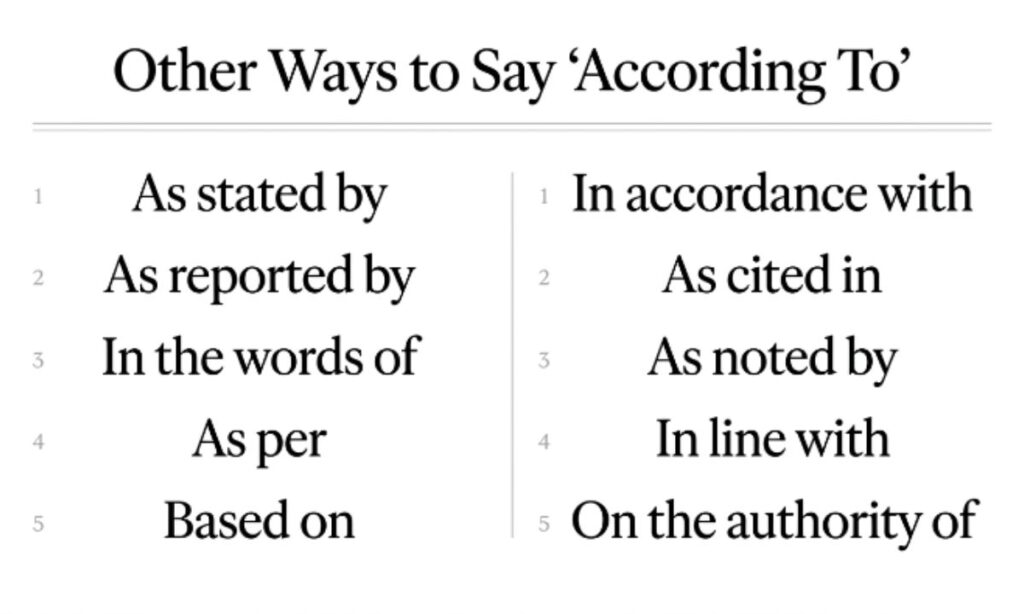
1. As Per
Meaning: A formal way to reference an existing agreement, instruction, or established rule. It works best when pointing back to something already documented or agreed upon.
Example Conversation:
Person A: “Can we adjust the delivery date?”
Person B: “As per our contract, changes need two weeks’ notice.”
Best Use: Contracts, business emails. Worst Use: Casual conversation. Tone: Formal, procedural. Quick Tip: Pair it with a specific document, not a vague reference.
2. In Accordance With
Meaning: Signals strict compliance with a law, policy, or standard. It carries more weight than “as per,” often appearing in legal or regulatory writing.
Example Conversation:
Person A: “Why did the company update its privacy policy?”
Person B: “In accordance with new data protection laws.”
Best Use: Legal documents, compliance reports. Worst Use: Personal messages. Tone: Formal, legalistic. Quick Tip: Reserve it for rules, not opinions or general reports.
3. Based On
Meaning: Connects a conclusion, decision, or recommendation to evidence, data, or observation. It emphasizes reasoning rather than direct quotation.
Example Conversation:
Person A: “Why did you choose this marketing strategy?”
Person B: “Based on last quarter’s sales data, this approach performed best.”
Best Use: Data analysis, recommendations. Worst Use: Quoting a person directly. Tone: Analytical, neutral. Quick Tip: Follow it with concrete evidence, not a vague impression.
4. As Reported By
Meaning: Attributes information to a news outlet, journalist, or formal report. It highlights that the claim came through structured reporting, not casual conversation.
Example Conversation:
Person A: “Did the merger actually happen?”
Person B: “As reported by Reuters, the deal closed this morning.”
Best Use: Journalism, news summaries. Worst Use: Academic citations. Tone: Journalistic, neutral. Quick Tip: Always name the actual outlet, not just “the news.”
5. As Stated By
Meaning: Introduces a specific person’s claim or statement, often used before a paraphrased or summarized quote. It keeps focus on who said it.
Example Conversation:
Person A: “What’s the CEO’s position on remote work?”
Person B: “As stated by the CEO, hybrid work is here to stay.”
Best Use: Business updates, interviews. Worst Use: Anonymous sources. Tone: Direct, formal. Quick Tip: Use for named individuals, not vague groups.
6. In The Words Of
Meaning: Introduces a direct quote, preserving the speaker’s exact phrasing. It highlights the value of their specific language, not just the idea behind it.
Example Conversation:
Person A: “How did she describe the project’s failure?”
Person B: “In the words of the director, it was ‘a lesson we needed.'”
Best Use: Direct quotations, speeches. Worst Use: Paraphrased summaries. Tone: Respectful, formal. Quick Tip: Only use it when quoting exact wording.
7. As Mentioned By
Meaning: Refers back to something someone said earlier, often in a meeting or discussion. It acknowledges their contribution while continuing the conversation.
Example Conversation:
Person A: “Should we revisit the budget concerns?”
Person B: “As mentioned by Sarah earlier, we’re already over on printing costs.”
Best Use: Meeting notes, group discussions. Worst Use: First-time citations. Tone: Conversational, professional. Quick Tip: Best used for callbacks, not new information.
8. As Noted By
Meaning: Similar to “as mentioned by,” but leans slightly more formal and often applies to written observations rather than spoken comments.
Example Conversation:
Person A: “Did anyone flag the error in the report?”
Person B: “Yes, as noted by the auditor in section three.”
Best Use: Reports, audits, reviews. Worst Use: Casual chats. Tone: Formal, precise. Quick Tip: Point to a specific section or page when possible.
9. As Cited In
Meaning: Points to information found within a specific written source, such as a book, article, or study. It’s especially useful for written, not spoken, attribution.
Example Conversation:
Person A: “Where did you find that statistic?”
Person B: “As cited in the 2023 health report.”
Best Use: Research papers, essays. Worst Use: Spoken conversation. Tone: Academic, formal. Quick Tip: Always pair with a full citation elsewhere in the text.
10. As Stated In
Meaning: Refers to written content within a document, contract, or article, rather than something a person said aloud. It’s document-specific.
Example Conversation:
Person A: “Is remote work allowed under our policy?”
Person B: “As stated in the handbook, yes, up to three days a week.”
Best Use: Policy references, contracts. Worst Use: Verbal claims. Tone: Formal, factual. Quick Tip: Name the exact document title when you can.
11. By The Account Of
Meaning: Attributes information to someone’s personal testimony or firsthand experience. It works well for eyewitness or historical narratives.
Example Conversation:
Person A: “How do we know what happened during the storm?”
Person B: “By the account of several residents, the flooding started at midnight.”
Best Use: Historical writing, testimonies. Worst Use: Statistical data. Tone: Narrative, formal. Quick Tip: Best for firsthand experience, not secondhand rumor.
12. On The Authority Of
Meaning: Grounds a claim in an expert, official body, or credible institution. It emphasizes that the source has recognized standing on the topic.
Example Conversation:
Person A: “Can we trust this medical advice?”
Person B: “It comes on the authority of the national health board.”
Best Use: Expert or institutional claims. Worst Use: Casual opinions. Tone: Elevated, formal. Quick Tip: Reserve for genuinely authoritative sources.
13. In Line With
Meaning: Shows that an action, decision, or claim matches an existing standard, value, or pattern. It’s often used for consistency rather than direct citation.
Example Conversation:
Person A: “Why did we raise prices this year?”
Person B: “In line with rising material costs across the industry.”
Best Use: Business strategy, trend analysis. Worst Use: Direct quotations. Tone: Professional, analytical. Quick Tip: Use when comparing to a broader pattern, not a single source.
14. Following
Meaning: A concise way to connect an action or result to prior advice, data, or guidance. It works well when brevity matters.
Example Conversation:
Person A: “Why did the team change the process?”
Person B: “Following feedback from last month’s review.”
Best Use: Short updates, summaries. Worst Use: Formal legal writing. Tone: Neutral, concise. Quick Tip: Keep the source close by so it stays clear what you’re following.
15. Citing
Meaning: Formally identifies a source, often used to support a claim with credible evidence and avoid plagiarism. It’s common in structured academic writing.
Example Conversation:
Person A: “How do you support that argument?”
Person B: “By citing three peer-reviewed studies from the past five years.”
Best Use: Academic essays, research. Worst Use: Everyday conversation. Tone: Formal, academic. Quick Tip: Always follow proper citation format for the source type.
16. Referencing
Meaning: Similar to citing, but slightly broader, since it can mean alluding to earlier material without a full formal citation. It fits both academic and general writing.
Example Conversation:
Person A: “Does this essay connect to your earlier point?”
Person B: “Yes, referencing the argument from paragraph two.”
Best Use: Essays, presentations. Worst Use: Legal documentation. Tone: Academic, flexible. Quick Tip: Use for connecting ideas, not proving facts.
17. From
Meaning: A short, flexible way to mark a source, though it depends heavily on context to stay clear. It works best when the source is obvious from the sentence.
Example Conversation:
Person A: “Where did this quote come from?”
Person B: “From an interview she gave last spring.”
Meaning: Signals secondhand or unverified information, making clear the speaker isn’t certain. It avoids presenting a claim as confirmed fact.
Example Conversation:
Person A: “Is the restaurant closing down?”
Person B: “From what I’ve heard, yes, but nothing’s official yet.”
Best Use: Casual conversation, rumors. Worst Use: Formal reports or academic writing. Tone: Informal, cautious. Quick Tip: Never use this phrase to support a serious claim.
19. As Indicated By
Meaning: Points to evidence, data, or a signal that suggests a conclusion, without stating it as absolute fact. It leaves room for interpretation.
Example Conversation:
Person A: “Is customer satisfaction improving?”
Person B: “As indicated by the latest survey, yes, slightly.”
Best Use: Data-driven writing, surveys. Worst Use: Direct quotations. Tone: Analytical, cautious. Quick Tip: Pair with a specific data point for credibility.
20. As Outlined In
Meaning: Refers to structured information laid out in a document, plan, or guideline. It works well for procedural or instructional content.
Example Conversation:
Person A: “What’s the process for requesting time off?”
Person B: “As outlined in the employee handbook, section five.”
Best Use: Procedures, guidelines. Worst Use: Personal opinions. Tone: Formal, structured. Quick Tip: Best when the source has clear steps or sections.
21. As Shown By
Meaning: Connects a claim to visible proof, such as a chart, test result, or demonstration. It emphasizes that the evidence can be seen or verified.
Example Conversation:
Person A: “How do we know the new design works better?”
Person B: “As shown by the usability tests, load times dropped significantly.”
Best Use: Research, product testing. Worst Use: Vague or anecdotal claims. Tone: Evidence-based, formal. Quick Tip: Only use it when there’s visual or measurable proof.
22. As Confirmed By
Meaning: Indicates that a claim has been officially verified by a person or authority, not just suggested or reported. It adds a layer of certainty.
Example Conversation:
Person A: “Is the flight actually delayed?”
Person B: “As confirmed by the airline, it’s pushed back two hours.”
Best Use: Official updates, verified facts. Worst Use: Unverified rumors. Tone: Formal, certain. Quick Tip: Use only when confirmation genuinely happened.
23. Per
Meaning: A shortened, brisk version of “as per,” common in emails and quick professional exchanges. It sounds efficient rather than warm.
Example Conversation:
Person A: “When is the report due?”
Person B: “Per the schedule, it’s due Friday at noon.”
Best Use: Quick emails, internal notes. Worst Use: Formal essays. Tone: Brisk, professional. Quick Tip: Use sparingly, since it can sound curt in longer writing.
24. Going By
Meaning: A casual way to base a statement on visible signs or general impressions, rather than confirmed facts. It works well in relaxed conversation.
Example Conversation:
Person A: “Do you think the meeting went well?”
Person B: “Going by everyone’s reaction, I’d say yes.”
Best Use: Casual conversation, informal writing. Worst Use: Legal or academic writing. Tone: Casual, observational. Quick Tip: Keep it for impressions, not verified facts.
25. As Suggested By
Meaning: Introduces a claim that leans toward implication rather than certainty, often based on patterns or indirect evidence. It’s softer than “as shown by.”
Example Conversation:
Person A: “Why do we think the campaign underperformed?”
Person B: “As suggested by the click-through rates, timing was the issue.”
Best Use: Analysis, hypotheses. Worst Use: Confirmed facts. Tone: Analytical, tentative. Quick Tip: Use when evidence points to a conclusion but doesn’t fully prove it.
Common Mistakes
Using “according to” repeatedly across a single page instead of rotating between precise alternatives.
Writing vague attributions like “according to experts” without naming a real, specific source.
Confusing quotation phrases like “in the words of” with paraphrase phrases like “as stated by.”
Using compliance language such as “in accordance with” for general reporting instead of actual rules or policies.
Choosing casual phrases like “from what I’ve heard” in formal or academic writing, which weakens credibility.
Comparison Table
Phrase
Tone
Best For
Formality Level
As Per
Formal, procedural
Contracts, instructions
High
Based On
Analytical
Data, recommendations
Medium-High
As Reported By
Journalistic
News summaries
Medium-High
In The Words Of
Respectful
Direct quotes
High
Citing
Academic
Research papers
High
From What I’ve Heard
Informal
Casual conversation
Low
Going By
Casual
Everyday impressions
Low
As Confirmed By
Certain, formal
Verified updates
High
Frequently Asked Questions
What is another way to say “according to” in an essay?
“As stated by,” “as cited in,” or “based on” all work well in academic essays depending on the type of source.
Is “as per” the same as “according to”?
They’re close in meaning, but “as per” leans more formal and usually refers to an existing agreement or instruction.
When should I use “based on” instead of “according to”?
Use “based on” when you’re describing a conclusion drawn from evidence or data, rather than directly attributing a statement to someone.
What’s the difference between “as reported by” and “as stated by”?
“As reported by” usually points to a news source, while “as stated by” points to a specific person’s claim.
Is “from what I’ve heard” appropriate in academic writing?
No, it signals unverified information and should be avoided in formal or academic contexts.
Final Thoughts
Every alternative to “according to” carries its own shade of meaning, from certainty to hearsay. Picking the right one shows readers exactly how solid your source really is. Once you know these options, your writing will sound more precise and far less repetitive.