15+ Better Ways to Say “Please See Below” in an Email
Hayat
June 05, 2026No comments
The words you use to direct someone’s attention in an email say more than you think. “Please see below” gets the job done, but it is overused, a little cold, and can make even a well-written email feel like a form letter.
Swapping it for a fresher alternative takes two seconds and immediately changes how your message reads — more human, more intentional, and easier to act on. Whether you write professional emails every day or just occasionally, having better phrases ready is a small habit that pays off.
“Please see below” is a transition phrase used in emails, documents, and messages to point the reader toward information that appears further down the page. It signals that important content follows — a list, an explanation, an attachment, or a set of instructions. It is polite and functional, which is why it became so common in business writing.
The problem is that it has become almost meaningless through overuse. People skim past it without processing it. It can also sound passive or bureaucratic, especially in workplaces that value clear, direct communication. That is where alternatives help — not just for variety, but for actual clarity and tone.
When Should You Use “Please See Below”?
This phrase fits best when you are directing a reader to a specific section of an email that contains detailed or structured information — like a numbered list, a table, a policy, or a set of next steps. It works in formal contexts, client-facing updates, and any email where you need to make the layout clear before the reader scrolls.
That said, it does not work well in short emails where there is nothing much below it. If your email has one or two lines after the phrase, it sounds redundant. It also feels out of place in warm, conversational messages to colleagues or teammates. In those cases, something more direct or friendly will land better.
Is “Please See Below” Professional or Polite?
Yes, it is both. But “professional” and “effective” are not the same thing. A phrase can be perfectly acceptable and still fail to engage the reader.
Pros
Clear and universally understood in professional settings
Polite without requiring extra effort
Safe and appropriate for formal correspondence
Works across industries and email types
Signals to the reader that more information follows
Cons
Overused to the point of feeling robotic
Can make emails feel like templates rather than personal communication
Adds little value when the reader can already see the information below
Sounds passive — it tells rather than guides
May feel outdated in modern, plain-language workplaces
15+ Other Ways to Say “Please See Below”
1. Please Refer to the Information Below
Meaning: A polished, slightly elevated version of the original phrase
Why It Works: The word “refer” implies that the information is worth checking carefully, not just glancing at. It raises the perceived importance of what follows.
Example:
Person A: “Can you share the meeting agenda?”
Person B: “Please refer to the information below for the full agenda.”
Best Use: Formal client emails, policy documents, reports sent to senior management
Worst Use: Quick internal messages where this level of formality feels out of place
Tone: Formal, Respectful, Professional
Replaceability Tip: Use this when the content below is detailed or structured and you want the reader to engage with it carefully.
2. Kindly Review the Details Below
Meaning: A polite request to look at and process the information that follows
Why It Works: “Kindly” softens the instruction, and “review” implies more active engagement than simply “see.” It is a small but effective upgrade.
Example:
Person A: “I’ve sent the contract over.”
Person B: “Kindly review the details below and let me know if anything needs adjusting.”
Best Use: Contract review emails, proposal follow-ups, customer service correspondence
Worst Use: Very casual team emails where this level of formality sounds stiff
Tone: Formal, Courteous, Professional
Replaceability Tip: Swap this in anywhere you need to signal that action or feedback is expected after reading.
3. You’ll Find the Details Below
Meaning: A clear, direct way to point the reader toward the relevant information
Why It Works: It sounds like a real person wrote it. The phrase guides rather than commands, which feels friendlier without losing professionalism.
Example:
Person A: “Where can I find the pricing breakdown?”
Person B: “You’ll find the details below, including a line-by-line breakdown of costs.”
Best Use: Internal emails, client updates, onboarding materials
Worst Use: Very formal legal or executive correspondence where casual phrasing may not fit
Tone: Semi-formal, Friendly, Clear
Replaceability Tip: This is one of the most versatile alternatives on this list. It works in almost any standard business email.
4. The Details Are Listed Below
Meaning: A neutral, no-frills way to point the reader to specific information
Why It Works: It is clean and direct. There is no padding, no softening — just a clear signal that the list or content below is what they need.
Example:
Person A: “What are the requirements for the application?”
Person B: “The details are listed below in order of priority.”
Best Use: Emails with bullet points, numbered lists, or structured tables that follow immediately
Worst Use: Emails where tone and warmth matter more than brevity
Tone: Neutral, Direct, Efficient
Replaceability Tip: Use this when the content below is a list or structured format and you want to set that expectation.
5. I’ve Outlined the Key Points Below
Meaning: Signals that the writer has already organized and summarized the relevant information
Why It Works: It tells the reader two things at once — the content is below, and it has already been structured for them. That saves mental effort and shows consideration.
Example:
Person A: “Can you summarize where things stand?”
Person B: “I’ve outlined the key points below so you can quickly get up to speed.”
Best Use: Status updates, project summaries, meeting follow-ups
Worst Use: Simple emails with one or two items below — “outlined” implies more structure than exists
Tone: Professional, Organized, Helpful
Replaceability Tip: Great for emails where you want to show you have done the thinking so the reader does not have to.
6. See the Information Below
Meaning: A shorter, more direct alternative that gets straight to the point
Why It Works: Removing “please” makes the phrase slightly more confident without sounding rude. It reads faster and feels less like a form email.
Example:
Person A: “What time does the call start?”
Person B: “See the information below for the full schedule.”
Best Use: Internal updates, quick informational emails, FAQ responses
Worst Use: High-stakes external emails where the more polite “please” version fits better
Tone: Neutral, Direct, Semi-formal
Replaceability Tip: Use this when speed and brevity are the priority and the reader already knows you well enough to not need extra polish.
7. I’ve Included the Details Below
Meaning: A warm, personal way to point to information that follows
Why It Works: The “I’ve” makes it personal. It tells the reader you prepared this for them specifically, which builds a small sense of care and intention.
Example:
Person A: “Could you share the event details with me?”
Person B: “I’ve included the details below, including the address and parking info.”
Best Use: Client-facing emails, event communications, follow-up notes after a meeting
Worst Use: Very short emails where there is barely anything below to reference
Tone: Friendly, Warm, Professional
Replaceability Tip: This is a great default for most everyday business emails — it is professional enough for clients but warm enough for colleagues.
8. Take a Look Below
Meaning: A casual, conversational phrase that invites the reader to scroll down
Why It Works: It sounds like something you would actually say out loud. That naturalness makes it more engaging in settings where the relationship is established.
Example:
Person A: “Did you get the updated version?”
Person B: “Take a look below — I’ve made the revisions we discussed.”
Best Use: Internal team emails, messages to colleagues, creative or startup environments
Worst Use: Formal external correspondence with clients, senior executives, or legal contexts
Tone: Casual, Friendly, Approachable
Replaceability Tip: Use this when you want the email to feel like a conversation, not a document.
9. Please See the Information That Follows
Meaning: A formal, slightly elevated phrase that signals structured content ahead
Why It Works: The phrase “that follows” adds a sense of deliberate flow, as if the information is part of a formal presentation or document. It suits contexts where the writing tone is already elevated.
Example:
Person A: “We need the terms and conditions for this partnership.”
Person B: “Please see the information that follows for the full terms.”
Best Use: Legal correspondence, academic emails, formal government or policy communications
Worst Use: Everyday internal emails where this level of formality creates distance
Tone: Formal, Official, Structured
Replaceability Tip: Reserve this for emails where the overall tone is already formal and you want consistency.
10. Below Is a Summary of What You Need to Know
Meaning: A reader-focused phrase that promises a useful, curated summary
Why It Works: It puts the reader’s needs front and center. Instead of just pointing to content, it tells them the content was filtered with their time in mind. That is a more considerate frame.
Example:
Person A: “There is a lot going on with this project.”
Person B: “Below is a summary of what you need to know before tomorrow’s meeting.”
Best Use: Project updates, briefing emails, onboarding documents
Worst Use: Emails where the content below is not actually a summary — avoid overpromising what follows
Tone: Professional, Helpful, Reader-focused
Replaceability Tip: Ideal when you want to show you have done the work of distilling information down for the reader.
11. The Relevant Information Is Below
Meaning: A clean, neutral phrase that signals only the necessary information follows
Why It Works: The word “relevant” does quiet work here. It implies you have thought about what the reader needs and only included what matters. That builds trust.
Example:
Person A: “I don’t need all the background — just what applies to me.”
Person B: “The relevant information is below, filtered to your specific situation.”
Best Use: Longer emails where you want to reassure the reader they do not need to read everything
Worst Use: Short emails where “relevant” adds little meaning
Tone: Neutral, Professional, Considerate
Replaceability Tip: Use this when you have trimmed or tailored the content below specifically for the recipient.
12. For Your Reference, Here Are the Details
Meaning: A helpful, low-pressure way to share supporting information
Why It Works: “For your reference” signals that this is useful information to keep handy, not necessarily something requiring immediate action. It takes pressure off the reader.
Example:
Person A: “I might need those specs later.”
Person B: “For your reference, here are the details whenever you need them.”
Best Use: Sharing documents, specs, or background information the reader may consult later
Worst Use: Time-sensitive emails where action is required immediately — this phrasing is too passive for urgency
Tone: Helpful, Professional, Low-pressure
Replaceability Tip: Great for emails where you are sharing information proactively rather than responding to a specific request.
13. Please Find the Details Below
Meaning: A formal transitional phrase directing the reader to the content that follows
Why It Works: It is a close cousin of “please see below” but slightly warmer because “find” suggests discovery. It remains widely accepted in formal settings.
Example:
Person A: “Could you send over the invoice details?”
Person B: “Please find the details below for your records.”
Best Use: Client-facing emails, financial correspondence, formal business communications
Worst Use: Casual internal notes where “find” sounds oddly formal
Tone: Formal, Polite, Standard
Replaceability Tip: This is a safe upgrade from “please see below” in any formal setting — widely understood and professionally appropriate.
14. Here’s Everything You Need
Meaning: A confident, complete-sounding way to introduce the content below
Why It Works: It sounds helpful and decisive. The reader feels like they are getting a complete package, not just a pointer to more reading.
Example:
Person A: “I’m not sure what forms I need to fill out.”
Person B: “Here’s everything you need — I’ve listed the forms, deadlines, and instructions below.”
Best Use: Onboarding emails, how-to messages, comprehensive response emails
Worst Use: Emails where the content below is genuinely incomplete or awaiting further input
Tone: Friendly, Confident, Helpful
Replaceability Tip: Use this when you want the reader to feel taken care of and that no follow-up questions should be necessary.
15. Below Are the Key Details
Meaning: A concise, direct phrase that introduces a structured or prioritized list
Why It Works: “Key” implies the information is important without being alarmist. It helps readers prioritize attention without extra explanation.
Example:
Person A: “What do I need to bring to the interview?”
Person B: “Below are the key details, including location, time, and what to prepare.”
Best Use: Briefing emails, event or meeting prep, client onboarding notes
Worst Use: Emails where the content below is exhaustive rather than selective — only use “key” if you actually filtered the information
Tone: Professional, Clear, Direct
Replaceability Tip: Works best when the content below is genuinely a highlight or shortlist, not a full data dump.
16. I’ve Laid Out the Information Below
Meaning: A thoughtful phrase that shows the writer organized the content with the reader in mind
Why It Works: “Laid out” implies care and structure. It tells the reader you have thought about how to present this, which signals professionalism.
Example:
Person A: “Can you walk me through the next steps?”
Person B: “I’ve laid out the information below in the order you’ll need to follow them.”
Best Use: Process emails, instructional content, step-by-step guidance
Worst Use: Short emails with only a sentence or two below
Tone: Professional, Organized, Attentive
Replaceability Tip: Use this when the structure of the information below is as important as the content itself.
17. Check Out the Details Below
Meaning: A casual, energetic way to direct someone’s attention downward
Why It Works: It is light and easy to read. In the right context, it feels like a colleague pointing something out rather than a formal directive.
Example:
Person A: “Any updates on the campaign results?”
Person B: “Check out the details below — the numbers are looking really good.”
Best Use: Internal team emails, newsletter content, casual professional updates
Worst Use: Emails to clients, senior leadership, or anyone where a casual tone could seem unprofessional
Tone: Casual, Upbeat, Friendly
Replaceability Tip: A good choice when you want the reader to feel engaged rather than obligated.
18. You Will Find Further Details Below
Meaning: A formal, measured phrase pointing to additional information that follows
Why It Works: “Further” signals that there is more than what has already been shared. It is useful when the email body introduces a topic and the content below expands on it.
Example:
Person A: “I understand the proposal is ready.”
Person B: “You will find further details below, including the timeline and budget breakdown.”
Best Use: Formal business proposals, legal notices, structured reports
Worst Use: Short emails where “further” implies depth that does not exist
Tone: Formal, Structured, Professional
Replaceability Tip: Use this when the content below genuinely adds to something already stated in the email body.
19. The Following Information May Be Helpful
Meaning: A gentle, low-pressure phrase that presents the content as useful rather than mandatory
Why It Works: It removes any sense of obligation. The reader feels invited rather than instructed, which can make them more receptive — especially in emails where the tone needs to be supportive or advisory.
Example:
Person A: “I’m not sure how to handle the reimbursement process.”
Person B: “The following information may be helpful as you work through the steps.”
Best Use: Support emails, HR communications, guidance notes, FAQ responses
Worst Use: Urgent action items where you need the reader to engage with the content immediately
Tone: Supportive, Gentle, Helpful
Replaceability Tip: Ideal for advisory or informational emails where you want to support rather than direct.
20. Here Is a Quick Overview
Meaning: Introduces a short, digestible summary of the key content below
Why It Works: “Quick” tells the reader this will not take much of their time. That small reassurance increases the chance they actually read it.
Example:
Person A: “Can you catch me up before the call?”
Person B: “Here is a quick overview so you have everything you need going in.”
Best Use: Pre-meeting emails, briefing notes, status updates for busy readers
Worst Use: Long, detailed emails where “quick” overpromises brevity
Tone: Professional, Considerate, Efficient
Replaceability Tip: Use this when the reader is busy and you want to signal you have done the heavy lifting for them.
How Tone Changes Everything in Email Phrasing
The phrase you pick is not just about formality — it is about relationship. Writing to a CEO you have never met is different from writing to a colleague you see on video calls every week. The same information can feel cold or warm depending on the opener you choose.
A simple rule: the more you know the person, the more conversational you can be. “You’ll find the details below” works in most contexts.
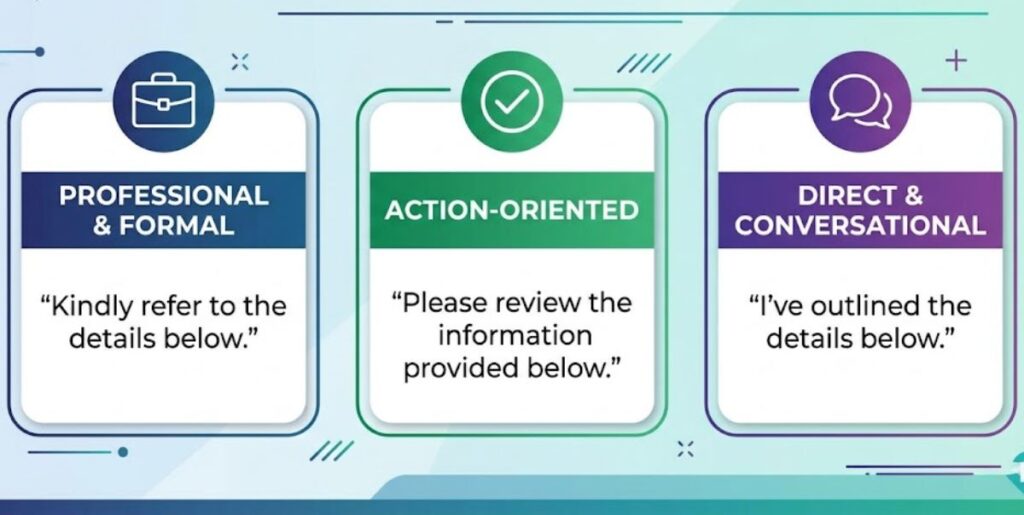
“Take a look below” works when you are friendly with the recipient. “Kindly refer to the information below” is better when the email is going somewhere official or external.
Pay attention to the rest of your email too. If your sign-off is “Best,” then “take a look below” probably fits. If you are writing “Yours sincerely,” stick to something more formal.
Quick Reference: Choosing the Right Phrase by Situation
Different email situations call for different approaches, and picking the wrong phrase for the context is just as noticeable as a typo.
For formal client emails or external correspondence, go with “Please refer to the information below,” “Kindly review the details below,” or “Please find the details below.” These are safe, polished, and appropriate across industries.
For internal team emails or friendly colleague messages, “You’ll find the details below,” “I’ve included the details below,” or “Here’s everything you need” will feel much more natural. For very casual settings, “Take a look below” or “Check out the details below” work well.
For support, HR, or advisory emails where the tone should feel warm and low-pressure, try “The following information may be helpful” or “Here is a quick overview.” Both invite the reader without instructing them.
Frequently Asked Questions
What is the most professional alternative to “please see below”?
“Please refer to the information below” or “Kindly review the details below” are both strong formal alternatives suitable for most professional email settings.
Is it okay to say “see below” without “please”?
Yes — in internal emails or messages to colleagues you know well, dropping “please” sounds more direct and natural without being rude.
What phrase works best for a client-facing email?
“You’ll find the details below” or “I’ve included the details below” both strike the right balance of warmth and professionalism for client correspondence.
Can I use “check out the details below” in a work email?
Yes, but only in casual or internal settings — it is too informal for emails going to senior stakeholders, new clients, or formal business partners.
Why should I avoid using “please see below” repeatedly?
Using the same phrase too often makes your emails feel like templates, which can reduce engagement and make your communication seem impersonal over time.
Final Thoughts
None of these phrases will single-handedly make your emails better, but the right one in the right context will. The goal is not to sound impressive — it is to sound clear, considerate, and easy to work with.
Swap “please see below” for whichever alternative fits your reader, your relationship, and what you are actually asking them to do. That small adjustment, made consistently, is what separates forgettable emails from ones people actually respond to.