Most people type “hope all is well” without thinking twice. But is it actually helping your emails — or quietly hurting them? This guide breaks down exactly what the phrase means, when to use it, when to ditch it, and what to say instead. Whether you write to clients, colleagues, or managers, the right opener sets the tone for everything that follows.
What Does “Hope All Is Well” Mean?
“Hope all is well” is a polite, general greeting used to show care before getting to the main point of a message. It signals goodwill without asking anything specific. It is one of the most common email openers in the English language for a reason — it is safe, neutral, and universally understood.
- It means: “I hope life is going smoothly for you right now”
- It is used as an opener in emails, messages, and letters
- It works in both professional and casual settings
- It does not require the reader to respond to the greeting itself
Is “Hope All Is Well” Grammatically Correct?
Yes — the phrase is grammatically correct. The word “all” is treated as a singular noun here, so the correct form is “all is well,” not “all are well.”
- ✅ “Hope all is well” — correct
- ✅ “I hope all is well with you” — correct
- ✅ “I hope all’s well” — correct informal contraction
- ⚠️ “Hope all is good” — grammatically fine but more casual and less warm
- ❌ “Hope all are well” — incorrect grammar
Key rule: “All is well” follows the same structure as “everything is well” — singular verb, always.
“All Is Well” vs. “All Is Good” — What Is the Difference?
Both versions are used, but they carry slightly different feelings. Choosing the right one depends on your tone and audience.
- “All is well” — more empathetic, warmer, slightly more formal
- “All is good” — casual, relaxed, closer to everyday spoken English
- “All is well with you” — adds a personal touch, directed specifically at the reader
- “All is well on my end” — used as a response to confirm things are fine on your side
In professional writing, “all is well” is the stronger choice. In a text to a friend, “all is good” feels more natural.
Formal or Informal? How to Read the Tone
“Hope all is well” sits in a neutral-to-formal zone. It is not stiff like “I trust this message finds you in good health,” but it is not casual like “Hey, hope you’re good!”
- Formal settings: Suitable for client emails, business correspondence, first-time outreach
- Neutral settings: Works in most professional follow-up emails
- Informal settings: Can feel slightly stiff in messages between close colleagues
- Cold outreach: Risky — it can feel impersonal to someone who does not know you yet
When to Use “Hope All Is Well”
This phrase earns its place in the right situations. Use it when you want to be polite without being overly familiar.
- Following up after a previous conversation or meeting
- Reaching out after a gap in communication
- Sending a professional email that does not require urgency
- Writing to someone you have a respectful but not close relationship with
- Starting a message to a client before sharing news or updates
When to Avoid “Hope All Is Well”
This is where most people go wrong. The phrase sounds hollow when it does not fit the moment.
- Avoid in cold emails — it signals that the message is templated, not personal
- Avoid in urgent messages — it delays the main point unnecessarily
- Avoid if you send it to the same person daily — it becomes invisible
- Avoid when something serious has happened — it can come across as tone-deaf
- Avoid in short replies — if your message is two sentences, the opener takes up too much space
20+ Other Ways to Say “Hope All Is Well”
Formal Alternatives
These work well in business emails, client communication, and professional correspondence.
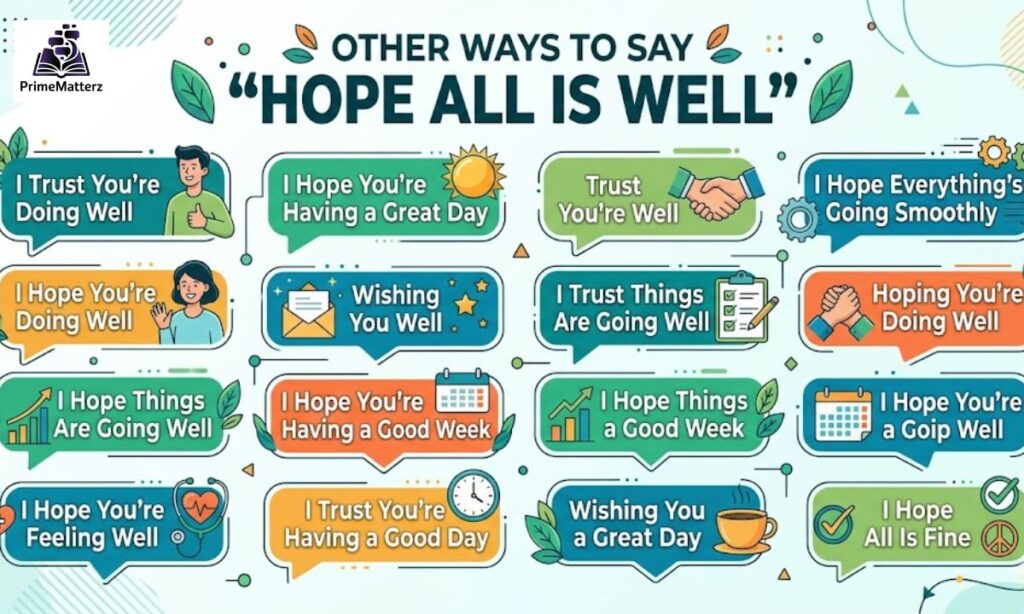
- “I hope you are doing well”
- “I trust you are doing well”
- “I hope this message finds you well”
- “It’s a pleasure connecting with you again”
- “I hope you are having a productive week”
Neutral / Standard Business Alternatives
Safe, professional, and widely accepted across industries.
- “I hope everything is going well on your end”
- “I hope all is going smoothly”
- “Hope your week is off to a good start”
- “I hope things are going well for you”
- “Hope you’re keeping well”
Warm and Friendly Alternatives
Use these when you have an existing relationship or want to sound more personable.
- “Hope you’re having a great day”
- “Great to connect with you again”
- “I hope you’re doing awesome”
- “Hope all is well in [city/location]” — adds a personal geographical touch
- “It’s always good to hear from you”
Specific and Deliberate Alternatives (Best for 2026)
These are the strongest openers right now. They show the reader you are paying attention — not just filling space.
- “Following up on our conversation last week about [topic]”
- “Thanks for your quick reply on [project name]”
- “I appreciated your feedback on [X] — I wanted to follow up”
- “Great to hear your update on [topic] — here’s where things stand on my end”
- “Thanks for your time on our call yesterday”
These work because they make the reader feel seen. They reference something real, which immediately separates your message from a hundred generic ones.
Before and After: Generic vs. Better Email Openers
Here is what the difference looks like in practice.
Generic opener:
“Hope all is well. I wanted to check in about the project deadline.”
Better opener:
“Following up on our call last Tuesday — wanted to confirm the deadline for the project before end of week.”
Generic opener:
“Hope you’re well. Can you send me the file?”
Better opener:
“Thanks for your help on the report. Could you send over the final file by Thursday?”
Generic opener:
“Hope all is well with you. I have an update to share.”
Better opener:
“I have an update on [project name] I wanted to get to you before Friday’s review.”
The difference is specificity. Specific openers show effort. Generic ones fill space.
How to Respond When Someone Says “Hope All Is Well”
Many people do not know how to reply to this phrase naturally. Here are ready-to-use responses.
- Professional: “Thank you — doing well here. Moving forward with [X], here’s the update you needed.”
- Warm: “All’s well on my end, thanks! Hope you’re having a great week too.”
- Direct: “Thanks for checking in — I’m ready to move ahead on [topic].”
- Simple: “All is well, thanks! How about you?”
- When replying briefly: Just acknowledge it with “Thanks!” and go straight to the main point — that is perfectly acceptable.
You do not have to match the same energy. If the email is professional, keep your response focused and brief.
Why More Professionals Are Moving Away from Generic Openers
There is a growing conversation in professional communication about the cost of hollow openers. It is not that “hope all is well” is bad — it is that it has lost meaning from overuse.
- Every templated email starts with it — so it no longer stands out
- Cold outreach using generic openers has lower engagement
- People skim emails quickly — a strong first line keeps them reading
- Specific openers signal respect for the reader’s time
- In 2026, deliberate and direct communication is valued more than polite filler
The trend is not to be blunt — it is to be intentional. You can still be warm and professional while dropping the autopilot opener.
Quick Decision Guide: Which Opener Should You Use?
Use this as a reference when you are unsure which version fits.
Want safe and polite? → “I hope you are doing well” or “Hope all is well”
Want more formal? → “I trust you are doing well” or “I hope this message finds you well”
Want more warm? → “Hope you’re having a great day” or “Great to connect again”
Writing to someone you know? → Reference something specific from your last interaction
Cold outreach? → Skip the opener entirely and lead with value
Urgent message? → Get to the point in the first sentence — no opener needed
Common Mistakes to Avoid
Small errors in email openers can quietly undermine your professionalism.
Using it in every single email — it stops registering after a while
Pairing it with a harsh request — “Hope all is well, I need this by noon today” creates a jarring contrast
Using it with someone going through something difficult — check context before sending
Spelling or grammar errors — “Hope all are well” or “all is good” in a very formal setting can look careless
Using it after an urgent subject line — the tone mismatch confuses the reader
“Hope All Is Well With You and Your Family” — Is It Too Much?
Adding “and your family” extends the warmth but can also feel intrusive if you do not actually know the person well.
- ✅ Use it with long-term clients, partners, or contacts where you have a personal rapport
- ✅ Use it during the holidays or after a known event in their life
- ⚠️ Avoid it with new contacts or formal business relationships — it can feel presumptuous
- ⚠️ Avoid it in very short emails — the warmth feels mismatched with a two-line message
Using “Hope All Is Well” in Different Contexts
The same phrase lands differently depending on where it appears.
- Client emails: Appropriate as a polite opener before delivering news or updates
- Internal team messages: Often unnecessary — get to the point
- Job applications: Avoid — lead with your value, not filler
- Follow-up emails: Works well when reaching out after a gap
- Thank-you messages: Can feel redundant — the thank you itself is the opening
Frequently Asked Questions
What does “Hope all is well” mean in an email?
It means the sender wishes the recipient is doing fine and uses it as a polite, neutral email opener before the main message.
Is it grammatically correct to say “Hope all is well”?
Yes — “all is well” uses the correct singular verb form, and the full phrase is grammatically sound.
What is a more professional way to say “Hope all is well”?
Try “I trust you are doing well” or “I hope this message finds you well” for a more formal tone.
Should I use “Hope all is well” in a cold email?
No — cold emails perform better with a specific, value-focused opener that shows you know who you are writing to.
How do I respond to “Hope all is well” professionally?
Say “Thank you — doing well here,” then move directly to the purpose of the email without dwelling on the opener.
Final Thoughts
“Hope all is well” is not a bad phrase — it is just an overused one. When every email starts the same way, none of them stand out. The goal is not to sound different for its own sake, but to show the person you are writing to that you actually thought about them before you hit send.
Use specific openers when you can, save the generic ones for when you genuinely need a neutral tone, and you will immediately write better emails than most people around you.