The words you choose after someone says “thank you” say a lot about you. A well-chosen response feels warm, confident, and real. A lazy one feels like you are just going through the motions.
Whether you are writing a work email, helping a customer, or texting a friend, knowing other ways to say “you are most welcome” helps you connect better, sound more natural, and leave a lasting impression.
“You are most welcome” is a warm, polished way to respond when someone expresses gratitude. The word “most” adds emphasis, making the phrase feel more sincere than a plain “you’re welcome.” It tells the other person that helping them was genuinely not a problem — and that they should never feel awkward asking again.
People use this phrase in everyday conversations, professional emails, customer service exchanges, and formal letters. It works across situations because it manages to sound both polite and personal at the same time. That said, it can sometimes feel a little stiff in very casual conversations, which is exactly why having alternatives is useful.
When Should You Use “You Are Most Welcome”?
This phrase works well in professional settings where you want to sound courteous without being too stiff. If a client thanks you for a report, if a colleague appreciates your feedback, or if your manager thanks you for stepping up, “you are most welcome” fits perfectly. It signals that you were happy to help and that the relationship matters to you.
In everyday life, you can use it with friends and family too, though it might feel a little formal depending on the moment. For casual texts or quick chats, a lighter alternative often works better. Knowing when to dial the warmth up or down is what makes communication feel natural rather than rehearsed.
Is “You Are Most Welcome” Professional or Polite?
It is both, but with some nuance. Here is a quick breakdown:
Pros
Sounds warm, genuine, and considerate
Works well in both spoken and written communication
Appropriate across many professional contexts
Adds sincerity without sounding over the top
Easy for non-native English speakers to understand
Cons
Can sound slightly formal in very casual conversations
May feel repetitive if used too often in the same conversation
Some people find it old-fashioned compared to shorter phrases
Does not always translate naturally across cultures
15+ Other Ways to Say “You Are Most Welcome”
1. It’s My Pleasure
Meaning: Helping you was genuinely enjoyable for me.
Why It Works: This phrase adds a touch of elegance. It tells the other person that you did not just tolerate helping them — you actually enjoyed it. That feeling comes through clearly, and it builds goodwill.
Example: Person A: “Thank you so much for sorting that out for me.” Person B: “It’s my pleasure.”
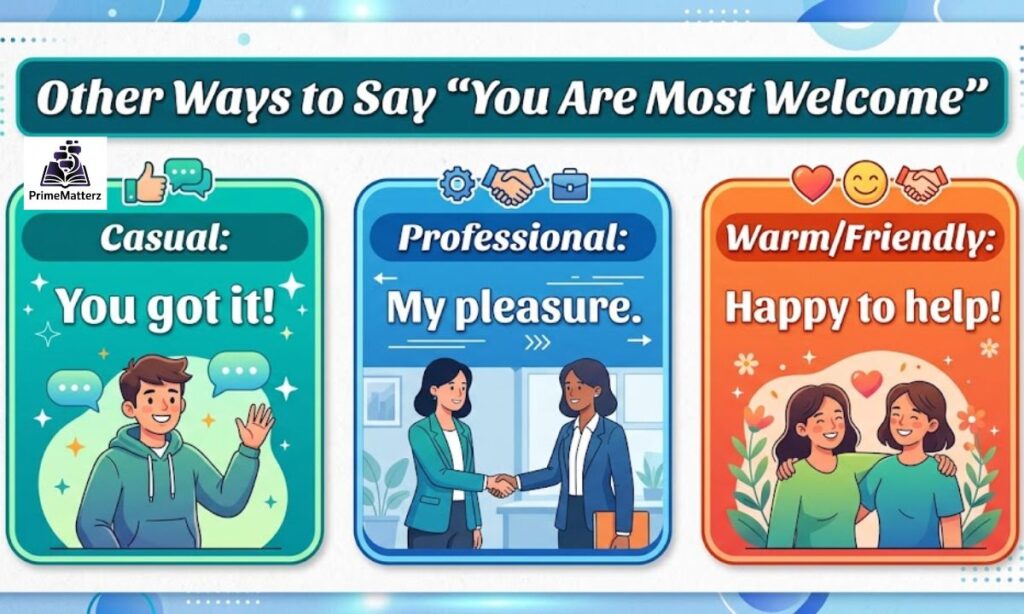
Best Use: Professional settings, customer service, formal emails. Worst Use: Very casual texts where it can feel stiff. Tone: Formal, warm, polished.
2. Happy to Help
Meaning: I was genuinely glad to assist you.
Why It Works: This one is friendly and approachable without being too casual. It reassures the other person that they were not a burden, which matters more than people realise. It keeps the door open for future requests too.
Example: Person A: “Thanks for walking me through the process.” Person B: “Happy to help anytime.”
Best Use: Work emails, customer support, colleagues. Worst Use: Very formal business correspondence where brevity is expected. Tone: Friendly, professional, warm.
3. Of Course
Meaning: Helping you was the obvious and natural thing to do.
Why It Works: Short and confident. “Of course” implies that you never hesitated, which makes the other person feel valued. It is understated, which is sometimes more powerful than an elaborate response.
Example: Person A: “Thank you for covering for me today.” Person B: “Of course — no worries at all.”
Best Use: Close colleagues, friends, casual professional settings. Worst Use: Very formal written communication — it can read as too breezy. Tone: Casual, confident, warm.
4. Anytime
Meaning: You can count on me whenever you need help again.
Why It Works: “Anytime” is an open invitation. It is short, reassuring, and generous. It signals that you are not just being polite — you actually mean it and are available if they need you again.
Example: Person A: “I really appreciate you helping with my presentation.” Person B: “Anytime. Just let me know.”
Best Use: Friends, close colleagues, repeat customers. Worst Use: One-time formal interactions where the offer sounds hollow. Tone: Casual, generous, friendly.
5. Glad I Could Help
Meaning: I’m relieved and pleased that my help made a difference.
Why It Works: This phrase shows that you cared about the outcome, not just the act of helping. It is personal without being dramatic. It works especially well when someone was stuck and you helped them get unstuck.
Example: Person A: “Thank you, I was really struggling with that.” Person B: “Glad I could help. Feel free to reach out again.”
Best Use: Problem-solving contexts, technical support, mentoring. Worst Use: Small or trivial favors where it sounds exaggerated. Tone: Warm, sincere, professional.
6. Don’t Mention It
Meaning: The help was so small, it does not deserve thanks.
Why It Works: This phrase puts the other person at ease. It downplays your effort in a generous way, suggesting that helping was genuinely no big deal. It is particularly useful when you do not want someone to feel they owe you anything.
Example: Person A: “Thanks for forwarding that email.” Person B: “Don’t mention it.”
Best Use: Small favors, friendly environments, casual settings. Worst Use: Situations where real effort was involved — it may seem like you are dismissing their appreciation. Tone: Casual, humble, easygoing.
7. No Problem at All
Meaning: Your request caused me no inconvenience whatsoever.
Why It Works: This phrase reassures the person that they did not put you out. It is especially useful in customer service or when someone seemed hesitant to ask for help. The added “at all” makes it feel more emphatic and genuine.
Example: Person A: “Sorry for the trouble and thank you.” Person B: “No problem at all — that’s what I’m here for.”
Best Use: Customer service, support roles, helpful colleagues. Worst Use: Very formal corporate emails where it sounds too casual. Tone: Reassuring, casual, professional.
8. It Was Nothing
Meaning: What I did required very little effort on my part.
Why It Works: It is a gentle, humble response that removes any sense of debt. When someone feels they owe you something, “it was nothing” frees them from that feeling. Use it for small favors where playing down the effort feels honest.
Example: Person A: “Thank you for picking up my calls when I was out.” Person B: “It was nothing, really.”
Best Use: Minor favors, casual settings, team environments. Worst Use: Significant tasks where minimising the effort may seem dishonest. Tone: Humble, relaxed, friendly.
9. The Pleasure Was All Mine
Meaning: I got just as much out of helping you as you did.
Why It Works: This is a more refined and expressive version of “it’s my pleasure.” It adds a personal touch that makes the other person feel genuinely valued. It works especially well in situations where a relationship matters, not just a transaction.
Example: Person A: “Thank you for joining us at the event.” Person B: “The pleasure was all mine — it was a wonderful evening.”
Best Use: Formal occasions, networking, client relationships. Worst Use: Everyday quick exchanges — it can sound theatrical. Tone: Formal, gracious, warm.
10. I’m Here for You
Meaning: You can rely on me, now and in the future.
Why It Works: This goes beyond just acknowledging the thanks. It tells the person they have your support in a deeper sense. It is particularly meaningful in personal relationships or when someone is going through something difficult.
Example: Person A: “I don’t know what I would have done without your help.” Person B: “I’m here for you. Always.”
Best Use: Close friends, family, emotional support situations. Worst Use: Professional or business settings where it may feel too personal. Tone: Warm, personal, caring.
11. It’s What I Do
Meaning: Helping is part of who I am or what my role is.
Why It Works: Confident and natural. This phrase works well for professionals whose job is literally to help — customer service agents, assistants, teachers, and coaches. It communicates competence and commitment without sounding boastful.
Example: Person A: “Thank you for explaining that so clearly.” Person B: “It’s what I do — glad it made sense.”
Best Use: Professional helpers, teachers, service roles. Worst Use: Personal relationships — it can sound cold or transactional. Tone: Confident, professional, warm.
12. I’m Glad It Worked Out
Meaning: I am happy that the situation resolved well.
Why It Works: This response focuses on the outcome rather than just the act of helping. It feels collaborative — like you were both working toward something together. It is especially good when the result mattered, not just the effort.
Example: Person A: “Thank you for your advice — the meeting went really well.” Person B: “I’m glad it worked out.”
Best Use: Situations with a specific positive outcome, mentoring, advice. Worst Use: Very casual quick exchanges where it sounds too reflective. Tone: Warm, genuine, professional.
13. Consider It Done
Meaning: Not only is it welcome, but it was handled without any fuss.
Why It Works: This is a proactive and confident phrase. It is usually said before or during the help, but it can also work as a response to thanks. It conveys reliability and a can-do attitude.
Example: Person A: “Thanks so much for handling that on short notice.” Person B: “Consider it done — anytime.”
Best Use: Work contexts, task-oriented relationships, dependable colleagues. Worst Use: Emotional or personal situations where warmth matters more than efficiency. Tone: Confident, professional, dependable.
14. With Pleasure
Meaning: I did it gladly and would do it again.
Why It Works: Elegant and brief. “With pleasure” has a classic, formal feel without being stuffy. It suits professional correspondence, service contexts, and formal interactions well. It is also widely understood across cultures.
Example: Person A: “Thank you for preparing the report ahead of schedule.” Person B: “With pleasure.”
Best Use: Formal business communication, customer-facing roles, written replies. Worst Use: Very casual conversations with close friends — it can feel odd. Tone: Formal, gracious, professional.
15. Not at All
Meaning: There is absolutely no need to thank me.
Why It Works: Quick and disarming. “Not at all” is a polite way to wave off gratitude, telling the other person that the help was no trouble. It is widely used in British English and works well in both spoken and written form.
Example: Person A: “Sorry to trouble you — and thank you.” Person B: “Not at all, it was no trouble whatsoever.”
Best Use: Polite professional exchanges, British English contexts, customer service. Worst Use: American casual settings where it can sound overly formal. Tone: Polite, calm, professional.
16. Absolutely
Meaning: Of course, without any hesitation.
Why It Works: Short, energetic, and enthusiastic. “Absolutely” works as a one-word response that sounds confident and engaged. It tells the person their thanks landed well and that you were fully on board with helping.
Example: Person A: “Thank you for staying late to help finish the project.” Person B: “Absolutely — we made a great team.”
Best Use: Energetic work environments, collaborative settings, team contexts. Worst Use: Very formal written communication where single-word replies may seem flippant. Tone: Upbeat, confident, team-oriented.
17. Always a Pleasure Working With You
Meaning: This was a good experience, and I enjoy collaborating with you.
Why It Works: This phrase doubles as a compliment. It acknowledges the thanks while also expressing genuine appreciation for the other person. It is great for building professional relationships and wrapping up collaborations on a positive note.
Example: Person A: “Thank you for all your support on this project.” Person B: “Always a pleasure working with you.”
Best Use: Closing emails, end of projects, professional farewells. Worst Use: First-time interactions where it may feel premature. Tone: Warm, professional, relationship-building.
18. Feel Free to Reach Out Anytime
Meaning: The door is open — do not hesitate to come back.
Why It Works: This phrase works well at the end of an exchange. It does not just acknowledge the thanks; it actively invites future contact. It is especially useful in customer service or mentoring situations.
Example: Person A: “Thank you for all your help today.” Person B: “Feel free to reach out anytime — happy to help again.”
Best Use: Customer service, email sign-offs, professional support roles. Worst Use: Quick casual chats where it sounds like a scripted customer service line. Tone: Professional, open, helpful.
Professional Alternatives
Phrase
Formality Level
Best Situation
It’s my pleasure
High
Client emails, formal replies
With pleasure
High
Business correspondence
The pleasure was all mine
High
Formal events, networking
Happy to help
Medium-High
Work emails, colleagues
Glad I could help
Medium
Support roles, mentoring
Always a pleasure working with you
Medium-High
End of projects, closing emails
Not at all
Medium
Polite professional exchanges
Feel free to reach out anytime
Medium
Customer service, sign-offs
Consider it done
Medium
Task-focused work settings
It was my honour
High
Formal, high-respect situations
Casual Alternatives
For texts, social media, and conversations with people you know well, shorter and looser phrases work better:
“No worries” — Breezy and relaxed. Works great for anything low-stakes.
“All good” — Even more casual. Common in everyday texts and chats.
“Of course” — Works with friends without sounding stiff.
“Anytime!” — Enthusiastic and warm. Great for close friends.
“You got it” — Upbeat and confident. Popular in American casual English.
“Don’t even worry about it” — Dismisses the formality entirely. Very friendly.
“No biggie” — Very informal. Best for young, close audiences.
“Sure thing” — Casual but not sloppy. Works for friends and relaxed work cultures.
Email-Friendly Alternatives
Alternative
Best Email Situation
It’s my pleasure
Formal replies to clients or managers
Happy to help
Mid-level professional emails
Glad I could help
After resolving a problem or query
Always a pleasure working with you
Closing a successful project or collaboration
Feel free to reach out anytime
Customer support or advisory emails
Not at all
Polite responses to apologies or minor requests
With pleasure
Formal business emails, especially in service sectors
Of course
Semi-formal emails with trusted colleagues
Thank you for reaching out
When you want to acknowledge both the message and the thanks
I’m happy I could be of assistance
Formal customer-facing emails
How to Choose the Best Alternative
Workplace Communication
Match the company culture — formal industries need formal phrases
Use “happy to help” or “glad I could help” for internal team emails
Use “it’s my pleasure” or “with pleasure” for external or senior-level communication
Avoid slang like “no biggie” in professional settings
Customer Service
Prioritise phrases that sound warm and helpful: “always happy to assist” works well
End with an open door: “feel free to reach out anytime” keeps the relationship open
Avoid overly casual phrases that may reduce trust
Match the customer’s tone — if they are formal, be formal back
Friends and Family
Keep it short and natural: “of course,” “anytime,” or “no worries” land better
Do not overthink it — warmth matters more than precision here
Use humour if that fits your relationship
Avoid overly formal phrases that may come across as cold or weird
Formal Situations
Go with “it’s my pleasure,” “with pleasure,” or “the pleasure was all mine”
Avoid slang or abbreviations entirely
Match the register of the conversation or the letter
When in doubt, “it was my pleasure” rarely fails
Common Mistakes to Avoid
Using the same phrase every time. Saying “you are most welcome” or “no problem” in every reply makes you sound like a bot. Mix it up.
Mismatching tone and context. Saying “no biggie” in a client email or “the pleasure was all mine” to your teenage sibling feels off. Read the room.
Using sarcasm. Some phrases like “oh, it was nothing” can sound passive-aggressive depending on tone. Be aware of how it lands.
Over-apologising instead of responding. “Sorry, it was not a big deal” is not a response to thanks. Keep it positive.
Being too short in formal situations. A one-word “sure” after a genuine thank-you in a professional email can seem dismissive. Add a little warmth.
Repeating the phrase multiple times in one conversation. Once is enough. After that, move on or vary the language.
Ignoring cultural context. “No worries” sounds natural in Australian English but can come across as dismissive in more conservative professional environments.
Frequently Asked Questions
Is “you are most welcome” formal or informal?
It is mostly formal or semi-formal and works well in professional settings, though it is warm enough for personal conversations too.
Is it rude to say “no problem” instead of “you’re welcome”?
No, but some people find it slightly dismissive, especially older generations, so read your audience before using it in formal settings.
Can I use “it’s my pleasure” in an email?
Yes, it is one of the most professional and widely accepted responses to a thank-you in email communication.
What is the most formal way to respond to “thank you”?
“It is my pleasure,” “with pleasure,” or “the pleasure was all mine” are among the most formal and polished responses available.
Is “happy to help” appropriate for business emails?
Yes, it strikes a good balance between professional and warm, making it one of the most versatile phrases for workplace communication.
Final Thoughts
The right response to a “thank you” is a small thing that leaves a lasting impression. Knowing other ways to say “you are most welcome” helps you sound more natural, more thoughtful, and more in tune with the moment.
Whether you are wrapping up a client email or replying to a friend’s text, the phrase you choose says something about who you are. Choose one that actually sounds like you — and you will always get it right.