15+ Other Ways to Say “Thank You for Your Insight”
Hayat
June 08, 2026No comments
The words you choose say a lot about you. Whether you are replying to a manager, following up with a client, or responding to a mentor, using the same phrase every time can make you sound robotic or careless.
Knowing other ways to say “thank you for your insight” helps you sound more natural, more professional, and more thoughtful — no matter the situation. The right words build relationships. The wrong ones can quietly damage them.
“Thank you for your insight” is a polite way to express gratitude when someone shares a smart observation, a helpful perspective, or a piece of knowledge that gave you a clearer understanding of something.
The word “insight” specifically refers to deep understanding — not just information, but meaningful interpretation.
People use this phrase in emails, meetings, performance reviews, and academic settings. It signals respect for the other person’s thinking. It says: what you shared was not just useful, it was genuinely valuable and worth acknowledging.
When Should You Use “Thank You for Your Insight”?
This phrase works well in professional and semi-formal settings. It fits naturally in email replies after a colleague shares feedback, in client communication when a partner offers a useful perspective, or in team meetings when someone makes a particularly sharp observation.
It also works in academic contexts when a professor or advisor helps you see something differently. In casual conversation with friends or family, the phrase can feel a little stiff.
You would not normally say it after a friend gives you advice over coffee. That is exactly why having a range of alternatives helps — so you can match your tone to the moment without overthinking it.
Is “Thank You for Your Insight” Professional or Polite?
It is both — when used in the right context. Here is a quick look at the strengths and limitations:
Pros
Sounds respectful and considered
Works well in formal emails and written communication
Acknowledges not just help, but the quality of the thinking behind it
Appropriate for professional relationships with managers, clients, and advisors
Signals emotional intelligence and awareness
Cons
Can feel overly formal in casual conversation
Repeated use makes it sound like a template
“Insight” (singular) can occasionally sound unnatural depending on context
Does not always fit short or one-line replies
May come across as rehearsed if not paired with a specific reference to what was shared
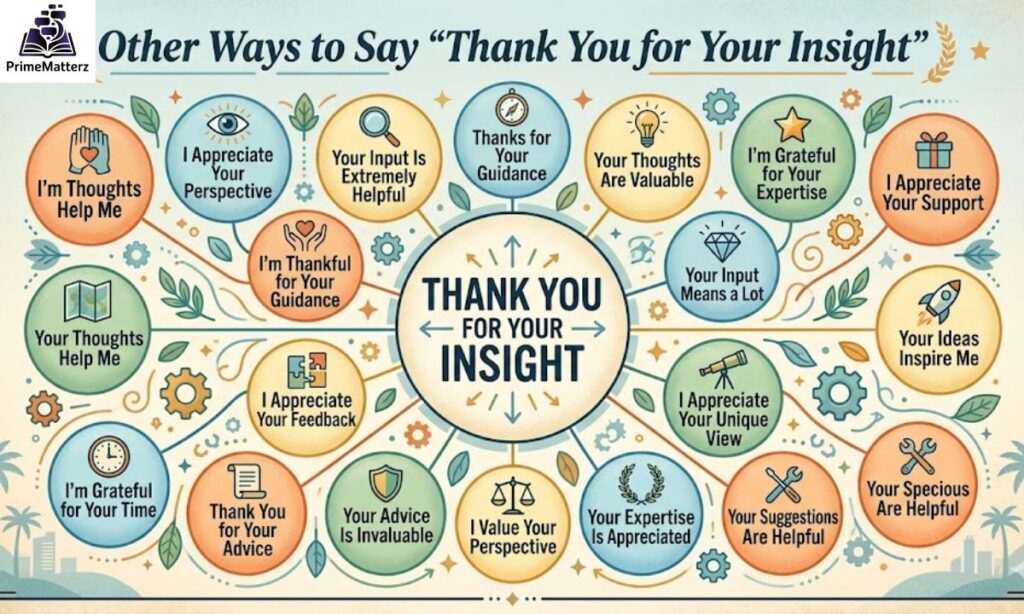
15+ Other Ways to Say “Thank You for Your Insight”
1. “I Really Appreciate Your Perspective”
Meaning: A warm, genuine acknowledgment that the other person’s point of view added value to your thinking.
Why It Works: “Perspective” feels personal. It tells the person you valued how they see things, not just the information itself.
Example:
Person A: “I think the campaign needs a stronger emotional hook before the data.”
Person B: “I really appreciate your perspective — that reframe helps a lot.”
Best Use: Team meetings, creative discussions, feedback sessions
Worst Use: Short one-line email replies where it may feel too long
Tone: Warm, Professional
2. “Thank You for Sharing Your Thoughts”
Meaning: A relaxed, open way to acknowledge that someone took the time to express their views.
Why It Works: It feels conversational and human without being too casual. Works across a wide range of tones.
Example:
Person A: “I just want to flag that the timeline feels rushed based on what I’ve seen.”
Person B: “Thank you for sharing your thoughts — I’ll bring this up with the team.”
Best Use: Emails, team check-ins, one-on-one conversations
Worst Use: Formal executive reports or academic writing
Tone: Friendly, Professional
3. “Your Input Is Greatly Appreciated”
Meaning: A more formal expression of gratitude for someone’s contribution to a conversation or decision.
Why It Works: “Input” covers a broader range than “insight” — it works for opinions, data, suggestions, and feedback equally well.
Example:
Person A: “Here are my notes from the client call with some action items.”
Person B: “Your input is greatly appreciated — I’ll incorporate these into the plan.”
Best Use: Formal emails, project updates, client communication
Worst Use: Casual chats or text messages
Tone: Formal, Respectful
4. “I Value Your Feedback”
Meaning: Direct acknowledgment that the feedback received was worthwhile and will be taken seriously.
Why It Works: Short, clean, and professional. It communicates respect without overcomplicating things.
Example:
Person A: “The report is solid but the conclusion needs to be sharper.”
Person B: “I value your feedback — I’ll revise that section before the deadline.”
Best Use: Performance reviews, writing feedback, project critiques
Worst Use: When the feedback was very brief or generic — the phrase may feel inflated
Tone: Professional, Neutral
5. “That Was Really Helpful — Thank You”
Meaning: A natural, conversational way to say that what someone shared made a real difference.
Why It Works: It is direct and human. No jargon, no stiffness. People respond well to being told they genuinely helped.
Example:
Person A: “I’ve been through this process before — here’s what worked for our team.”
Person B: “That was really helpful — thank you. I feel much more confident going into the meeting.”
Best Use: Everyday professional conversations, follow-up emails after a meeting
Worst Use: Formal written reports or official correspondence
Tone: Casual, Warm
6. “I Appreciate You Taking the Time to Share This”
Meaning: Gratitude that specifically acknowledges the effort the other person made, not just the content of what they shared.
Why It Works: Recognizing effort alongside value makes people feel genuinely seen. It is a small but meaningful distinction.
Example:
Person A: “I put together a detailed walkthrough of the issues I noticed in the process.”
Person B: “I appreciate you taking the time to share this — it gives me a much clearer picture.”
Best Use: Emails following a detailed explanation, mentorship conversations
Worst Use: Quick verbal exchanges where the phrase would feel too long
Tone: Professional, Appreciative
7. “This Gives Me a Lot to Think About”
Meaning: An honest, reflective response that signals the other person’s words had a real impact on your thinking.
Why It Works: It shows engagement. It communicates that you are not just saying thank you out of politeness — their words actually made you stop and think.
Example:
Person A: “I wonder if the product’s core problem is pricing or positioning.”
Person B: “This gives me a lot to think about — I hadn’t considered the positioning angle.”
Best Use: Strategic discussions, brainstorming sessions, mentorship
Worst Use: Situations where you need to signal immediate action — this phrase feels contemplative, not decisive
Tone: Thoughtful, Conversational
8. “Thank You for the Valuable Information”
Meaning: Straightforward gratitude for factual or practical information that was useful.
Why It Works: Works best when what was shared was data, research, or specific knowledge rather than an opinion or point of view.
Example:
Person A: “The new regulation takes effect in March, not June.”
Person B: “Thank you for the valuable information — I’ll update the timeline accordingly.”
Best Use: Research sharing, compliance updates, technical briefings
Worst Use: Creative feedback or opinion-based discussions where “information” feels too clinical
Tone: Formal, Professional
9. “I Found Your Comments Very Enlightening”
Meaning: A more elevated way to say that what someone shared opened your eyes or deepened your understanding.
Why It Works: “Enlightening” signals genuine impact. It is a stronger acknowledgment than a standard thank you and works well when the other person’s contribution was genuinely impressive.
Example:
Person A: “Based on what I’ve seen in this market, the traditional approach rarely works here.”
Person B: “I found your comments very enlightening — this context changes how I’m thinking about the strategy.”
Best Use: Executive-level meetings, academic discussions, expert consultations
Worst Use: Casual team emails — it may sound overcomplimentary in low-stakes settings
Tone: Formal, Respectful
10. “Your Observation Is Spot On”
Meaning: Validation that the person’s point was accurate, well-observed, and appreciated.
Why It Works: It does two things at once — it thanks them and confirms they were right. People respond positively to having their thinking validated.
Example:
Person A: “The onboarding process seems to drop people off at step three.”
Person B: “Your observation is spot on — that’s exactly where we’re seeing the churn.”
Best Use: Data discussions, problem-solving sessions, performance analysis
Worst Use: When you are not actually sure they are right — do not use this phrase to avoid conflict
Tone: Confident, Professional
11. “Thank You for Shedding Light on This”
Meaning: Gratitude for making something clearer or easier to understand — like someone shining a light into a confusing situation.
Why It Works: The phrase is vivid and specific. It tells the person they helped you understand something you were struggling with. That feels meaningful.
Example:
Person A: “The delay is actually on the vendor side, not the internal team.”
Person B: “Thank you for shedding light on this — I’ll redirect my follow-up accordingly.”
Best Use: Problem clarification, misunderstandings being resolved, complex topics
Worst Use: General feedback where nothing was particularly unclear
Tone: Warm, Professional
12. “I Appreciate Your Expertise on This”
Meaning: Gratitude that specifically honors the person’s skill, knowledge, or experience in a given area.
Why It Works: It makes the acknowledgment personal to the individual’s credentials. It shows you recognize not just what they said, but why they were the right person to say it.
Example:
Person A: “From a legal standpoint, that clause creates real exposure.”
Person B: “I appreciate your expertise on this — I’ll flag it for the contract review.”
Best Use: Expert consultations, technical reviews, specialist feedback
Worst Use: Feedback from a colleague on the same level — “expertise” could sound sycophantic if overdone
Tone: Respectful, Professional
13. “That Puts Things in a New Light”
Meaning: A conversational phrase that signals a genuine shift in how you are now seeing a situation.
Why It Works: It is honest, natural, and shows that the other person’s input changed your thinking. That is the highest form of acknowledgment.
Example:
Person A: “The push-back from users might actually be about trust, not the feature itself.”
Person B: “That puts things in a new light — I think we need to revisit the messaging.”
Best Use: Strategy discussions, retrospective meetings, coaching conversations
Worst Use: Formal written communication where something more structured is expected
Tone: Conversational, Reflective
14. “Your Guidance Means a Lot”
Meaning: A warm, personal expression of gratitude for direction, advice, or mentorship received.
Why It Works: “Guidance” implies an ongoing relationship and deeper investment. It is more personal than most alternatives and works well with mentors, managers, or trusted advisors.
Example:
Person A: “Based on what I’ve seen in my career, focusing on relationships before results will serve you well.”
Person B: “Your guidance means a lot — I’ll keep that in mind as I navigate this.”
Best Use: Mentorship, career conversations, long-term working relationships
Worst Use: Client emails or one-time exchanges where it may feel too personal
Tone: Warm, Sincere
15. “Thank You for Your Thoughtful Response”
Meaning: Appreciation for a reply that was considered and detailed, not rushed or surface-level.
Why It Works: It rewards effort and depth. It tells the other person their thoroughness was noticed and valued — which encourages that quality in future communication.
Example:
Person A: “I’ve written up a detailed breakdown of the risks across each scenario.”
Person B: “Thank you for your thoughtful response — this is exactly what the team needed.”
Best Use: Detailed email replies, written feedback, analytical reports
Worst Use: Quick verbal comments or brief suggestions that did not require significant effort
Tone: Professional, Appreciative
16. “I Learned a Lot from What You Shared”
Meaning: A genuine acknowledgment that the other person’s contribution expanded your knowledge or understanding.
Why It Works: It is humble, direct, and human. Saying you learned something is one of the most sincere compliments you can give.
Example:
Person A: “Here’s how we handled a similar situation two years ago — the key was managing expectations early.”
Person B: “I learned a lot from what you shared — I’ll apply that thinking here.”
Best Use: Learning from experienced colleagues, post-training feedback, mentorship follow-ups
Worst Use: Situations where claiming you “learned a lot” from a brief comment would feel exaggerated
Tone: Humble, Warm, Sincere
“Insight” vs. “Insights” — Which One Is Correct?
This is a small grammar point that trips people up more than you would expect. Both forms are correct, but they carry slightly different meanings.
“Thank you for your insight” (singular) refers to one specific observation, idea, or moment of clarity. It feels more deliberate — like you are pointing to one precise thing the person said.
“Thank you for your insights” (plural) refers to multiple observations or a body of thinking. It is broader and works better after a long conversation, a detailed email, or a presentation where several valuable points were made.
A quick rule: if one sharp comment stood out, use the singular. If someone gave you a thorough analysis or covered several angles, the plural fits better.
How to Choose the Right Phrase for the Right Situation
Picking the right phrase comes down to three things: tone, relationship, and context.
For formal emails to clients or executives: Use “I found your comments very enlightening,” “I appreciate your expertise on this,” or “Your input is greatly appreciated.” These signal professionalism without being cold.
For replies to managers or mentors: Try “Your guidance means a lot,” “I appreciate you taking the time to share this,” or “I learned a lot from what you shared.” These acknowledge both the content and the relationship.
For team meetings or colleague conversations: “That puts things in a new light,” “Your observation is spot on,” or “This gives me a lot to think about” all sound natural and engaged without being over the top.
For short one-line replies: “That was really helpful — thank you” or “Thank you for sharing your thoughts” keep things clean and human.
Frequently Asked Questions
What is another way to say thank you for your insight?
You can say “I appreciate your perspective,” “thank you for shedding light on this,” or “your input is greatly appreciated.”
Is “thank you for your insight” formal?
Yes, it leans formal — it works best in professional emails, meetings, and written communication rather than casual conversation.
What is the difference between insight and insights?
“Insight” (singular) refers to one clear observation; “insights” (plural) refers to multiple valuable points across a broader discussion.
What is a professional way to thank someone for advice?
Try “I appreciate your expertise on this” or “your guidance means a lot” — both are professional and personal without being stiff.
Can I say “thank you for your input” in an email?
Yes — “thank you for your input” is professional, versatile, and works well in most formal or semi-formal email contexts.
Final Thoughts
Saying “thank you for your insight” is a perfectly good phrase — but using the same words every time makes your communication feel routine.
The alternatives in this guide give you the flexibility to be more precise, more warm, or more professional depending on who you are talking to and what the moment calls for. Good communication is not about finding the fanciest phrase. It is about choosing the one that actually fits.