The words you choose say a lot about you. Whether you’re writing a work email, guiding a customer, or giving someone the green light in conversation, saying “please proceed” every time can start to feel stiff and repetitive.
Having a few solid alternatives ready helps you sound more natural, match the right tone, and leave a better impression — all without overthinking it.
What Does “Please Proceed” Mean?
“Please proceed” is a polite way to tell someone they can move forward with something. It gives permission, confirms approval, or signals that the next step can begin. You’ll hear it in formal emails, customer service scripts, official instructions, and professional settings.
The word “proceed” comes from Latin and simply means to go forward. Adding “please” softens it and makes it feel more respectful. Most people use this phrase when they want to sound professional without being too casual — but in some situations, it can come across as overly formal or even cold.
When Should You Use “Please Proceed”?
“Please proceed” fits well in formal or semi-formal situations where clarity matters. Think legal documents, business approvals, customer service emails, or official onboarding steps. It works best when you need to sound authoritative but still polite.
That said, it’s not always the right fit. If you’re texting a coworker, chatting with a friend, or writing a casual Slack message, something like “go ahead” or “feel free to continue” will land better. The right phrase depends on your relationship with the person and the setting you’re in.
Is “Please Proceed” Professional or Polite?
Yes — it is both professional and polite. But like most formal phrases, it has trade-offs depending on how and where you use it.
Pros
- Sounds formal and respectful in official communication
- Leaves no room for misinterpretation — the message is clear
- Works well in written formats like email, reports, and SOPs
- Signals authority without sounding rude
- Appropriate for legal, academic, or business settings
Cons
- Can feel cold or robotic in casual conversation
- May come across as overly stiff in team messaging tools
- Doesn’t build warmth or rapport with the other person
- Repeated use can make your writing feel formulaic
- Not always natural when spoken out loud
15+ Other Ways to Say “Please Proceed”
1. Go Ahead
Meaning: A simple, direct way to give someone permission to continue.
Why It Works: It’s warm and natural. People use it in both spoken and written English without thinking twice.
Example:
- Person A: “Can I submit the report now?”
- Person B: “Go ahead.”
Best Use: Casual to semi-formal conversations, team chats, and quick email replies.
Worst Use: Legal documents or formal approval letters.
Tone: Friendly, casual, approachable
2. Feel Free to Continue
Meaning: An invitation to keep going without hesitation.
Why It Works: The phrase “feel free” removes pressure and makes the other person feel comfortable moving forward. It’s polite without being stiff.
Example:
- Person A: “Should I go over the next section?”
- Person B: “Feel free to continue.”
Best Use: Meetings, professional emails, and customer service responses.
Worst Use: Formal legal or regulatory communication where precision matters more than warmth.
Tone: Warm, professional, encouraging
3. You May Proceed
Meaning: A formal way to grant permission to continue.
Why It Works: It carries authority and clarity. There’s no ambiguity — the person knows they have the green light.
Example:
- Person A: “Are we ready to begin the interview?”
- Person B: “You may proceed.”
Best Use: Formal settings like interviews, official hearings, or academic evaluations.
Worst Use: Everyday emails or casual team conversations where it sounds unnecessarily stiff.
Tone: Formal, authoritative, respectful
4. Move Forward
Meaning: To take the next step or continue with a plan or action.
Why It Works: It’s action-oriented and sounds decisive. People use it to show momentum without getting into detail.
Example:
- Person A: “We’ve reviewed the proposal. What’s the verdict?”
- Person B: “Let’s move forward.”
Best Use: Business discussions, project approvals, and management communication.
Worst Use: When a more precise instruction is needed and “moving forward” feels too vague.
Tone: Professional, confident, forward-looking
5. Continue
Meaning: Simply carry on with what you were doing.
Why It Works: It’s short, neutral, and universally understood. No fluff, no confusion.
Example:
- Person A: “Should I keep reading the report aloud?”
- Person B: “Continue.”
Best Use: Instructions, presentations, and step-by-step guidance.
Worst Use: Situations where a warmer, more collaborative tone is needed.
Tone: Neutral, direct, instructional
6. Please Go On
Meaning: An invitation to keep talking or keep moving forward.
Why It Works: It’s attentive and shows you’re engaged. It feels more human than “please proceed” in most situations.
Example:
- Person A: “I was explaining the issue with the file, but I wasn’t sure if you wanted more detail.”
- Person B: “Please go on.”
Best Use: Conversations, meetings, and customer service interactions.
Worst Use: Formal written approvals or technical SOPs.
Tone: Polite, conversational, attentive
7. You’re All Set
Meaning: Everything is ready — the person can move ahead without any issues.
Why It Works: It’s reassuring and efficient. It tells people they have everything they need and there’s nothing holding them back.
Example:
- Person A: “Is the application complete?”
- Person B: “You’re all set. You can submit it now.”
Best Use: Customer service, onboarding, and task completion confirmation.
Worst Use: High-stakes formal communication where a more explicit approval is required.
Tone: Friendly, helpful, casual
8. Carry On
Meaning: Continue doing what you’re doing without interruption.
Why It Works: It’s simple and slightly British in flavor, which gives it a calm, unfussy quality. It signals approval without ceremony.
Example:
- Person A: “I’ll finish the remaining edits now.”
- Person B: “Carry on.”
Best Use: Brief acknowledgments in professional or creative environments.
Worst Use: When you need to show enthusiasm or build rapport — it can sound dismissive.
Tone: Neutral, calm, slightly formal
9. Please Continue
Meaning: A polished way to ask someone to keep going.
Why It Works: It has the politeness of “please proceed” but feels slightly less formal. It’s a safe middle ground for most professional settings.
Example:
- Person A: “Should I walk you through the next section?”
- Person B: “Please continue.”
Best Use: Formal emails, client communication, and structured meetings.
Worst Use: Very casual conversations where it can feel out of place.
Tone: Professional, polite, neutral
10. We’re Good to Go
Meaning: Everything is in order and action can begin.
Why It Works: It’s upbeat and energetic. It signals readiness and confidence in a team-friendly way.
Example:
- Person A: “Has the team confirmed the launch details?”
- Person B: “We’re good to go.”
Best Use: Team communication, project kickoffs, and collaborative environments.
Worst Use: Formal approval letters or communication with clients who expect professional language.
Tone: Casual, enthusiastic, team-oriented
11. You Have the Go-Ahead
Meaning: Official permission has been granted.
Why It Works: It sounds decisive and final. The word “go-ahead” signals that a decision has been made and the path is clear.
Example:
- Person A: “Can we start the renovation work?”
- Person B: “You have the go-ahead.”
Best Use: Project management, workplace approvals, and business decisions.
Worst Use: Customer service or casual email exchanges where it feels too heavy.
Tone: Professional, authoritative, decisive
12. Don’t Let Me Stop You
Meaning: A light way to signal that you have no objection and the person should continue.
Why It Works: It’s a little playful and conversational. It works well when you want to ease any tension around seeking permission.
Example:
- Person A: “I was about to start presenting — is that okay?”
- Person B: “Don’t let me stop you.”
Best Use: Informal team settings, creative environments, and light-hearted conversations.
Worst Use: Client-facing or highly formal communication — it can sound too casual.
Tone: Casual, light-hearted, friendly
13. Proceed as Planned
Meaning: Continue exactly as originally intended, with no changes.
Why It Works: It confirms that the plan is still valid and no deviation is needed. It’s clear and efficient.
Example:
- Person A: “Should we stick with the original schedule?”
- Person B: “Proceed as planned.”
Best Use: Project management, business operations, and team coordination.
Worst Use: When flexibility or discussion is still needed — it can shut down conversation prematurely.
Tone: Professional, confident, instructional
14. Right, Off You Go
Meaning: An informal signal that someone is free to start or continue.
Why It Works: It’s warm and slightly playful. It works well in relaxed professional settings and can make people feel more at ease.
Example:
- Person A: “I think I have everything I need.”
- Person B: “Right, off you go.”
Best Use: Coaching, onboarding, or informal mentoring situations.
Worst Use: Corporate emails or formal client communication.
Tone: Warm, casual, encouraging
15. By All Means
Meaning: Enthusiastic permission to go ahead.
Why It Works: It signals not just approval but genuine encouragement. It adds warmth and welcomes the action.
Example:
- Person A: “Can I share my screen to walk you through the demo?”
- Person B: “By all means.”
Best Use: Professional meetings, polite email replies, and client conversations.
Worst Use: Quick operational approvals where brevity matters more than tone.
Tone: Polite, warm, semi-formal
16. You Can Move Ahead
Meaning: Clear permission to take the next step.
Why It Works: It’s approachable and easy to understand. “Move ahead” feels more modern than “proceed” and works in a variety of contexts.
Example:
- Person A: “Is the background check complete? Can we finalize the hire?”
- Person B: “Yes, you can move ahead.”
Best Use: HR communication, onboarding, and professional email exchanges.
Worst Use: Highly formal legal or regulatory contexts where precision is critical.
Tone: Professional, clear, modern
17. That’s Your Cue
Meaning: This is the moment to act or speak — your turn has arrived.
Why It Works: It’s playful and specific. It signals timing as much as permission, which can be helpful in structured settings like presentations or rehearsals.
Example:
- Person A: “When should I start the slide presentation?”
- Person B: “The intro is done — that’s your cue.”
Best Use: Presentations, training sessions, and creative workflows.
Worst Use: Formal written communication where clarity is more important than flair.
Tone: Casual, vivid, situational
18. Please Move Forward
Meaning: A polite instruction to take the next step.
Why It Works: It strikes a balance between friendly and professional. It’s action-focused and clear without sounding robotic.
Example:
- Person A: “We’ve completed the review stage. What’s next?”
- Person B: “Please move forward with implementation.”
Best Use: Business emails, project coordination, and structured workflows.
Worst Use: When a more detailed direction is needed and “move forward” is too vague.
Tone: Professional, polite, action-oriented
19. The Floor Is Yours
Meaning: You now have full attention and permission to speak or act.
Why It Works: It’s a classic phrase that conveys both respect and invitation. It makes the other person feel in control and acknowledged.
Example:
- Person A: “Am I up to present the findings?”
- Person B: “The floor is yours.”
Best Use: Presentations, meetings, panels, and structured discussions.
Worst Use: Written communication or operational instructions where the phrase feels out of context.
Tone: Respectful, formal, meeting-oriented
20. You’re Cleared to Go
Meaning: Official clearance — nothing is blocking you from moving forward.
Why It Works: It borrows aviation language, which gives it a decisive and authoritative feel. People instinctively understand it as a firm green light.
Example:
- Person A: “Has the compliance team signed off?”
- Person B: “Yes, you’re cleared to go.”
Best Use: Regulated industries, corporate approvals, and project launches.
Worst Use: Casual conversation or customer service — it can sound unnecessarily formal.
Tone: Authoritative, confident, decisive
How to Pick the Right Alternative
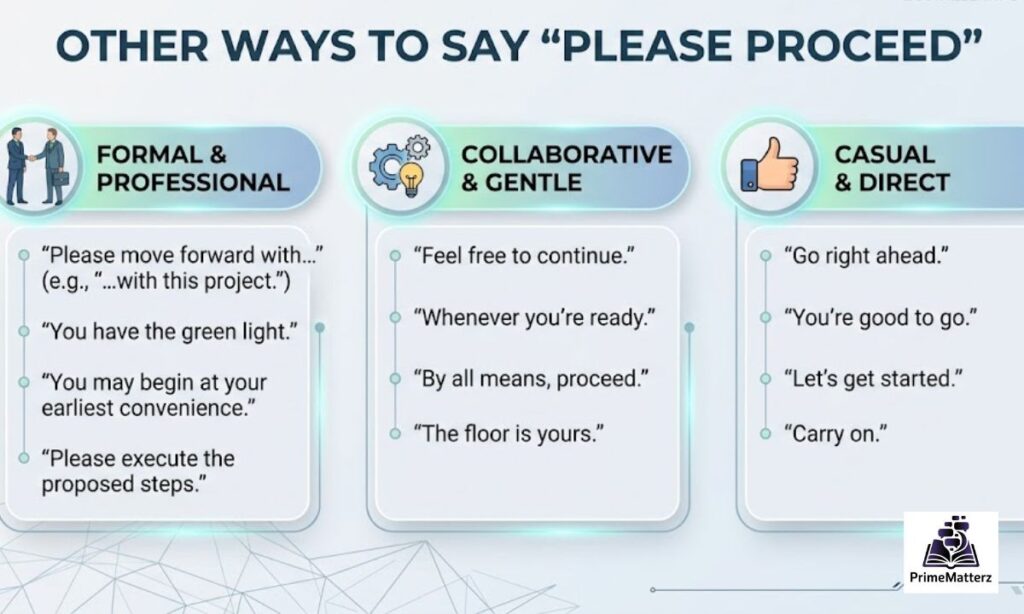
Choosing the right phrase comes down to three things: who you’re talking to, what you’re asking them to do, and where the conversation is happening.
If you’re in a formal setting — legal, academic, or regulatory — stick with phrases like “you may proceed,” “proceed as planned,” or “please continue.” These carry authority and leave no room for confusion.
For standard professional communication like work emails and business meetings, “please move forward,” “you have the go-ahead,” or “by all means” all land well. They’re polished without being stiff.
In casual or team settings, simpler phrases like “go ahead,” “we’re good to go,” or “you’re all set” sound natural and don’t make people feel like they’re reading a policy document.
Common Mistakes to Avoid
Even good communicators fall into a few traps when choosing how to give someone the green light.
Using “please proceed” in an informal chat or Slack message can make you sound like you’re quoting from a terms-of-service page. It’s not wrong — it just doesn’t match the tone.
On the flip side, using “off you go” or “don’t let me stop you” in a formal approval email can undercut your authority and confuse the reader about whether they actually have permission.
The biggest mistake is defaulting to the same phrase every time. Variety makes your writing feel more human, and matching tone to context shows communication awareness — which people notice.
Frequently Asked Questions
Is “please proceed” formal or casual?
It’s formal — most appropriate in professional emails, official documents, and structured communication.
What is the most professional alternative to “please proceed”?
“You may proceed” or “please continue” are strong, polished choices for formal settings.
Is “go ahead” a good replacement for “please proceed”?
Yes — in casual to semi-formal situations, “go ahead” sounds natural and works well.
What’s the difference between “proceed,” “continue,” and “move forward”?
“Proceed” is the most formal; “continue” is neutral; “move forward” is modern and slightly more collaborative in tone.
Can I use “please proceed” in a customer service email?
Yes, but “feel free to continue” or “you’re all set” often feel warmer and more helpful for customer-facing communication.
Final Thoughts
Having the right phrase ready makes a real difference in how you come across. Whether you’re giving a team member the green light, helping a customer with their next step, or guiding someone through a formal process, choosing a phrase that fits the moment shows you’re paying attention. “Please proceed” isn’t wrong — but now you have 20 better options for every situation.