The words you choose when reconnecting with someone say more than you might think. A simple “It’s been a while” can sound casual or detached. The right phrase can show warmth, professionalism, or genuine excitement about reconnecting.
Whether you’re emailing an old client, texting a friend, or greeting a coworker you haven’t seen in months, a thoughtful phrase keeps your message clear and makes the other person feel valued. This guide offers more than 18 ways to say it’s been a while, so you always have the right words for the moment.
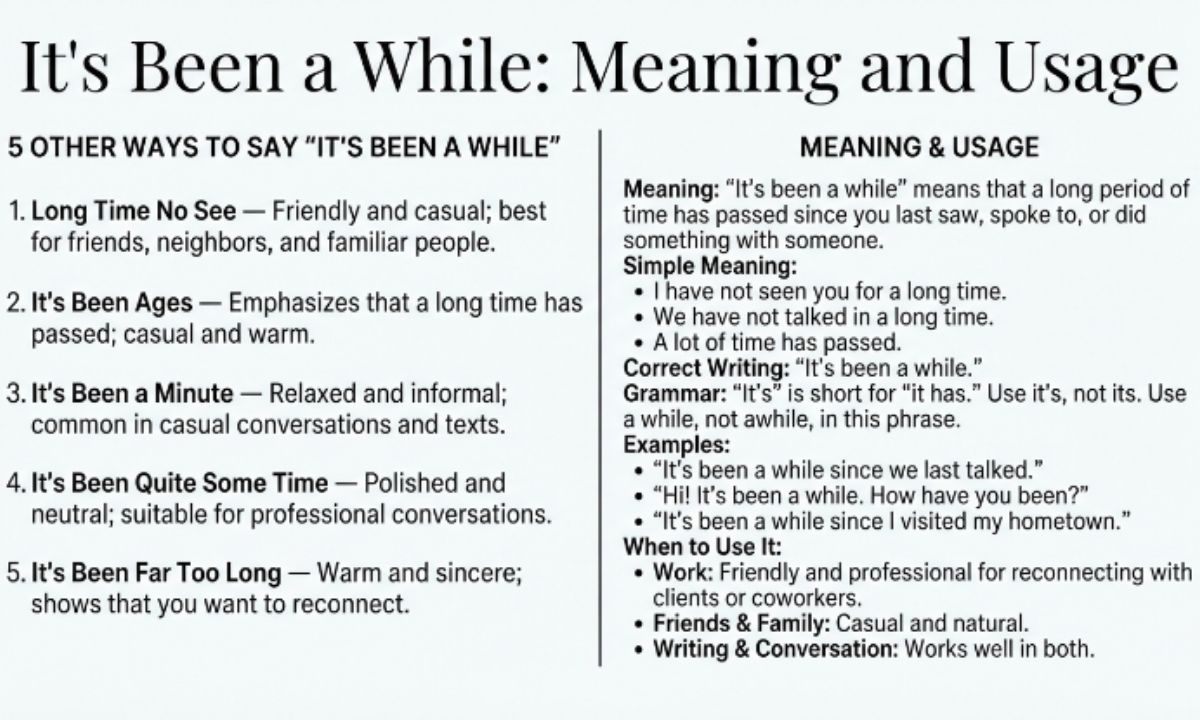
“It’s been a while” means that a long period of time has passed since you last saw, spoke to, or did something with someone. It is a friendly, natural phrase often used when reconnecting with a person after some time.
Correct Writing
It’s been a while.
“It’s” is short for “it has.”
Use an apostrophe: it’s, not its
Examples
It’s been a while since we last talked.
Hi! It’s been a while—how have you been?
It’s been a while since I visited my hometown.
It’s been a while since we met.
Simple Meaning
“I have not seen you for a long time.”
“We have not talked in a long time.”
“A lot of time has passed.”
When Should You Use “It’s Been a While”?
“It’s been a while” works in almost any setting, but the tone changes with the situation.
At work, the phrase can soften a follow-up email to a client you haven’t contacted recently. It can also open a conversation with a colleague you haven’t seen since a past project.
With friends and family, the phrase feels more casual. You might text it after finding an old photo, say it when you run into a neighbor, or use it to start a call with someone you’ve wanted to reach. The phrase works well in both conversation and writing.
Is “It’s Been a While” Professional or Polite?
This phrase sits comfortably in the middle. It’s not stiff, but it’s not too casual either, which makes it useful in many situations. Still, it has some limits worth knowing.
Pros
Works in both casual and semi-formal settings
Doesn’t sound cold or overly formal
Easy to follow with a specific reason for reaching out
Universally understood, with no risk of confusion
Cons
Can sound vague if overused without context
May come across as an excuse if you’re following up on something overdue
Lacks warmth compared to more personal alternatives
Not ideal for very formal business writing, like legal or executive communication
Grammar & Correct Usage of “It’s Been a While”
“It’s been a while” is grammatically correct. People use it often in both speech and writing.
Structure
“It’s been a while” uses the contraction “it has” and the present perfect form “been.” It describes time that has passed up to now.
Common Mistake
Some people write “it’s been awhile.”
That form is incorrect in this sentence. “Awhile” means “for a period of time” and works as an adverb.
Use “a while” as two words in this phrase.
Formal Usage
In professional writing, use a more formal version:
“It has been some time since we last connected.”
Informal Usage
In texts and casual conversations, shorter forms work well:
“Been a while!”
“Whoa, it’s been a while.”
Correct Example
“It’s been a while since we caught up properly.”
Incorrect Example
“It’s been awhile since we caught up properly.”
Use “a while,” not “awhile.”
Common Mistakes With “It’s Been a While”
Overuse
Using the phrase too often can make it sound like filler. Use it when you mean it.
Wrong Context
Don’t use it when you saw someone yesterday. The phrase suggests that some time has passed since you last met or spoke.
Tone Issues
Your tone affects how the phrase sounds. A flat tone can make it seem like you don’t care about reconnecting.
Grammar Errors
Watch for two common mistakes:
“awhile” instead of “a while”
“its” instead of “it’s”
Use “it’s” when you mean “it has” or “it is.”
How to Respond to “It’s Been a While”
Your response should match the relationship and the situation. Here are five natural options.
1. “I know, way too long!”
Meaning: You agree and show that you also missed the connection.
Best for: Friends and family.
Example:
Person A: “It’s been a while!”
Person B: “I know, way too long! We need to fix that.”
2. “Tell me about it. Life’s been busy.”
Meaning: You agree and give a simple reason for the long gap.
Best for: Someone you haven’t seen or talked to because work or home life kept you busy.
Example:
Person A: “It’s been a while since we talked.”
Person B: “Tell me about it. Life’s been busy lately.”
3. “Yes, but I’ve been thinking about you.”
Meaning: You show that you still care, even though you lost touch.
Best for: Close friends and family.
Example:
Person A: “It’s been forever!”
Person B: “Yes, but I’ve been thinking about you a lot.”
4. “Far too long. How have you been?”
Meaning: You agree and show interest in the other person.
Best for: Work contacts and semi-formal conversations.
Example:
Person A: “It’s been a while since our last project.”
Person B: “Far too long. How have you been?”
5. “I was just thinking about reaching out!”
Meaning: You show that you already wanted to contact the person.
Best for: Someone who messages you after months of silence.
Example:
Person A: “Hey, it’s been a while!”
Person B: “I was just thinking about reaching out to you!”
Meaning: A classic, friendly way to greet someone after a long gap. It works well when you meet someone in person.
Example:
Person A: “Long time no see! You look great.”
Person B: “Right back at you! It’s been way too long.”
Best for: Unexpected meetings with friends, neighbors, or acquaintances.
Avoid in: Formal emails and business writing.
Tone: Casual, friendly
2. “It’s Been Ages”
Meaning: This phrase stresses how long it feels since you last saw or spoke to someone.
Example:
Person A: “It’s been ages since we last grabbed coffee.”
Person B: “I know. We need to fix that soon.”
Best for: Old friends and family.
Avoid in: Formal or professional settings.
Tone: Casual, emphatic
3. “It’s Been a Minute”
Meaning: A relaxed way to say that some time has passed. People often use it in casual speech and texts.
Example:
Person A: “It’s been a minute since you posted anything!”
Person B: “True. Work has kept me busy.”
Best for: Friends, texts, and casual social media posts.
Avoid in: Formal emails and client messages.
Tone: Casual, informal
4. “It Feels Like Forever”
Meaning: This phrase focuses on how long the separation feels. It can also show that you missed the person.
Example:
Person A: “It feels like forever since we hung out.”
Person B: “I was thinking the same thing yesterday.”
Best for: Close friends and family.
Avoid in: Professional emails and workplace messages.
Tone: Warm, emotional
5. “It’s Been Quite Some Time”
Meaning: A polished way to say that a long time has passed. It suits professional conversations.
Example:
Person A: “It’s been quite some time since our last meeting.”
Person B: “Yes, it’s been almost a year.”
Best for: Business emails, client calls, and professional conversations.
Avoid in: Casual texts with close friends.
Tone: Formal, neutral
6. “Hello, Stranger!”
Meaning: A playful greeting for someone you haven’t seen in a while. It adds light teasing without sounding harsh.
Example:
Person A: “Hello, stranger! Where have you been?”
Person B: “Ha! Work kept me busy. Good to see you!”
Best for: Friends and familiar acquaintances.
Avoid in: Formal settings and first-time introductions.
Tone: Playful, casual
7. “We Haven’t Caught Up in Forever”
Meaning: This phrase shows that you miss having a real conversation with someone. It can also suggest that you want to meet soon.
Example:
Person A: “We haven’t caught up in forever. Let’s grab lunch.”
Person B: “Definitely. I have so much to tell you.”
Best for: Friends, colleagues, and people you know well.
Avoid in: Quick, business-focused conversations.
Tone: Warm, friendly
8. “A Considerable Amount of Time Has Passed”
Meaning: This formal phrase states that a long period has passed. It fits serious or official writing.
Example:
Person A: “A considerable amount of time has passed since our last contract review.”
Person B: “You’re right. It’s been almost 18 months.”
Best for: Formal letters, legal documents, and executive communication.
Avoid in: Casual conversations.
Tone: Formal, professional
9. “It’s Been Donkey’s Years”
Meaning: This British expression humorously exaggerates how long it has been.
Example:
Person A: “It’s been donkey’s years since we last spoke!”
Person B: “Ha, you’re right. Way too long!”
Best for: Casual conversations, especially among British English speakers.
Avoid in: Formal or international business communication.
Tone: Casual, humorous
10. “Time Really Flies”
Meaning: This phrase shows surprise at how quickly time has passed.
Example:
Person A: “Time really flies. It’s been almost two years since graduation.”
Person B: “I know. It feels like yesterday.”
Best for: Nostalgic conversations and personal milestones.
Avoid in: Direct greetings when you first reconnect.
Tone: Reflective, neutral
11. “I Haven’t Seen You in Forever”
Meaning: A warm way to point out a long gap. It often shows that you missed the person.
Example:
Person A: “I haven’t seen you in forever. You look great!”
Person B: “Thank you! Same to you. It’s been so long.”
Best for: Friends and family.
Avoid in: Professional networking with new contacts.
Tone: Warm, casual
12. “It’s Been Far Too Long”
Meaning: This phrase shows that you think the gap lasted too long. It can also suggest that you want to reconnect.
Example:
Person A: “It’s been far too long since we last spoke.”
Person B: “Agreed. Let’s not wait so long next time.”
Best for: Friends, family, and professional contacts.
Avoid in: Quick, light conversations.
Tone: Sincere, respectful
13. “We’ve Lost Touch for a While”
Meaning: This phrase directly acknowledges that you stopped communicating for some time.
Example:
Person A: “We’ve lost touch for a while, but I’d love to reconnect.”
Person B: “Me too. Let’s set up a call soon.”
Best for: Reconnecting after a long silence, including professional networking.
Avoid in: Quick, casual greetings.
Tone: Honest, neutral
14. “It’s Been a Good While”
Meaning: A relaxed way to say that some time has passed.
Example:
Person A: “It’s been a good while since we last chatted.”
Person B: “It really has. How’s everything going?”
Best for: Casual conversations with neighbors, friends, and acquaintances.
Avoid in: Formal or highly emotional situations.
Tone: Casual, neutral
15. “I Can’t Believe It’s Been So Long”
Meaning: This phrase shows surprise at how much time has passed.
Example:
Person A: “I can’t believe it’s been so long since we graduated.”
Person B: “I know. It feels like yesterday.”
Best for: Milestones, reunions, and nostalgic conversations.
Avoid in: Routine greetings.
Tone: Emotional, reflective
16. “Where Has the Time Gone?”
Meaning: This rhetorical question shows surprise at how quickly time passed.
Example:
Person A: “Where has the time gone? It’s been over a year.”
Person B: “Honestly, I ask myself that all the time.”
Best for: Nostalgic conversations and milestone check-ins.
Avoid in: Short, practical messages.
Tone: Reflective, warm
17. “It’s Been a Hot Minute”
Meaning: A casual American phrase for a noticeable amount of time.
Example:
Person A: “It’s been a hot minute since I’ve seen this place.”
Person B: “Yeah, they changed everything.”
Best for: Friends, peers, and casual conversations.
Avoid in: Client emails and formal business writing.
Tone: Casual, playful
18. “¡Qué Milagro!”
Meaning: This Mexican Spanish expression means “What a miracle!” People use it playfully when they see or hear from someone after a long time.
Example:
Person A: “¡Qué milagro verte por aquí!”
Person B: “Lo sé. Ha pasado mucho tiempo.”
Best for: Casual conversations among Spanish speakers, especially in Mexico.
Avoid in: Formal settings or professional conversations with people unfamiliar with the expression.
Tone: Playful, casual
Formal vs Informal Alternatives
Formal Alternatives
Informal Alternatives
It’s been quite some time
Long time no see
A considerable amount of time has passed
It’s been ages
It’s been far too long
It’s been a minute
We’ve lost touch for a while
Hello, stranger!
It’s been a significant period
It feels like forever
It has been some time since we last connected
It’s been a hot minute
A lengthy period has elapsed since our last contact
We haven’t caught up in forever
It’s been an extended period of time
It’s been donkey’s years
Considerable time has passed since we last spoke
I haven’t seen you in forever
It’s been some time since our last correspondence
Where has the time gone?
Which Alternative Should You Choose?
Choose a phrase that fits the person and the setting.
At Work
Use neutral or formal phrases such as “It’s been quite some time” or “A considerable amount of time has passed.” These phrases sound professional without feeling cold.
In Emails
Use a formal phrase when you write to clients or business partners. “It has been some time since we last connected” creates a respectful tone before you move to the main point.
With a Manager
Keep your language polite and professional. Avoid slang and casual idioms. Focus on why you’re reaching out instead of the time that has passed.
With a Customer
Choose a phrase that sounds warm but professional. “We’ve lost touch for a while, but we’d love to reconnect” keeps the message friendly while maintaining a professional tone.
With a Friend
You can use almost any casual phrase. “Long time no see” and “It’s been ages” sound natural and friendly.
With Family
Use warm, personal language. “It feels like forever” or “I haven’t seen you in forever” shows that you missed them.
On Social Media
Keep your message short and casual. “Hello, stranger!” and “It’s been a hot minute” work well in comments and quick messages.
Final Thoughts
The right phrase can make your message sound more natural and genuine. It can also set the right tone before you reconnect. Choose a phrase that fits the person, the setting, and your relationship. That simple choice can make your message feel more personal.