You’ve written it a hundred times on your CV. In emails, you have second-guessed it. Is it “a MA” or “an MA”? The answer is simpler than you think, and it has nothing to do with spelling.
The Real Grammar Rule: Articles Depend on Sound, Not Letters
Most people learn a shortcut in school: use “a” before consonants and “an” before vowels. That shortcut works most of the time, but it’s not actually the rule.
The real rule is about sound, not spelling. You use “an” before a word that starts with a vowel sound, and “a” before a word that starts with a consonant sound. The first letter is irrelevant if it doesn’t match how the word is spoken.
A few classic examples make this clear:
“An hour” — the H is silent, so the word starts with a vowel sound.
“A university” — starts with a “y” sound, which is a consonant sound, despite the “U.”
“An MBA” — pronounced “em-bee-ay,” starting with a vowel sound.
“A Master of Arts” — starts with the consonant sound “m.”
Once you hear the pattern, the confusion around MA starts to make sense.
How We Pronounce “MA” and Why It Takes “An”
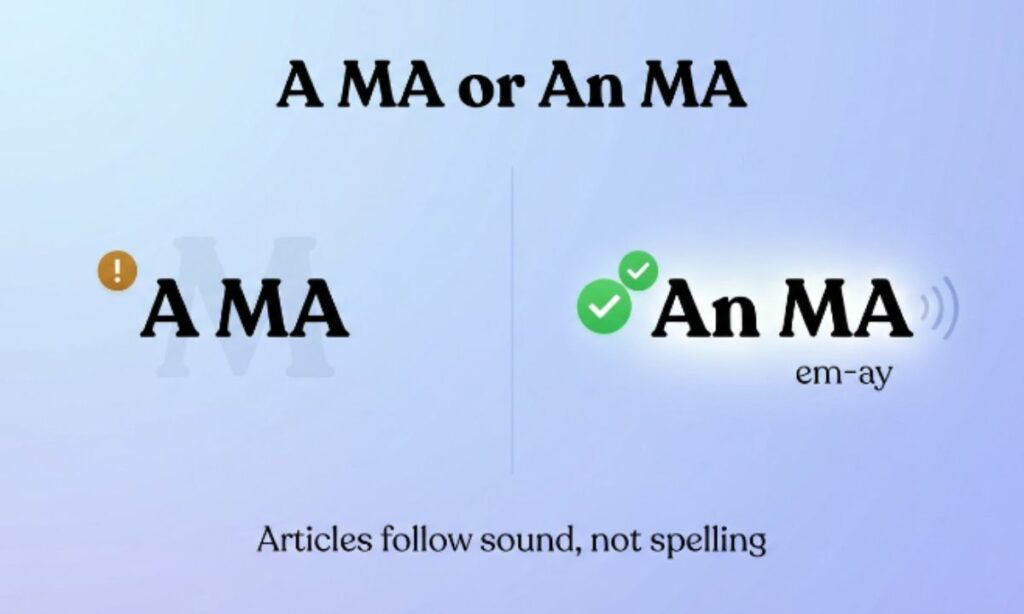
Say the letters M and A aloud, one at a time. You’ll hear em-ay. The letter M looks like a consonant on paper, but that first sound, “em,” is a vowel sound.
And that is why MA takes “an.” The abbreviation is not spoken as a word. It’s pronounced as two separate letters. And the first one just so happens to start with a vowel sound.
So the basic rule is simple: MA begins with the vowel sound “em,” so the correct form is “an MA.”
A MA or An MA? Direct Answer with Examples
The Correct Form in Modern English
“An MA degree” is the standard, correct form in academic writing, professional documents, and everyday conversation. There’s no debate among grammar authorities on this one.
Correct Sentence Examples
Here’s how it looks in real sentences:
“I completed an MA in Psychology.”
“She has an MA degree in economics.”
“He is applying for an MA program in English literature.”
Notice the pattern. Every time MA appears as the abbreviation, “an” comes right before it.
Common Incorrect Forms
These versions show up constantly online, but they’re wrong:
“A MA degree”
“A MA in History”
“A MA program”
Each one breaks the sound-based rule by treating M as a consonant. It looks like one on the page, but it doesn’t sound like one out loud.
Abbreviations, Acronyms, and the A/An Rule
Why Acronyms Like MA and MBA Use “An”
Pronounced letter-by-letter, abbreviations follow the sound of the letters “master,” not the sound of the full phrase they represent. MA is short for “Master of Arts,” but it’s not pronounced as “Master of Arts.” “You say it like ’em-ay.
That’s the key difference. The article is about what you actually say, not what the letters technically mean.
Cheat Sheet: Article Use with Common Degree Abbreviations
Here’s a quick reference table you can bookmark:
Abbreviation
Pronunciation
Correct Article
MA
em-ay
an MA
MBA
em-bee-ay
an MBA
BA
bee-ay
a BA
BSc
bee-ess-see
a BSc
LLB
ell-ell-bee
an LLB
Run any new abbreviation through the same test. Say the first letter out loud, and let your ear decide.
A Master of Arts vs. an MA: Full Name vs Abbreviation
This is where a lot of writers trip up. The rule changes depending on whether you use the abbreviation or the full degree name.
When you write out “Master of Arts,” the first word is “Master,” and that starts with a hard consonant sound. So the correct phrasing is “a Master of Arts degree,” not “an master of Arts degree.”
A few examples:
“She holds a Master of Arts in English.”
“He earned a Master of Arts from a UK university.”
Swap in the abbreviation, and the article flips:
“She holds an MA in English.”
“He earned an MA from a UK university.”
Same degree, different article, because the sound at the start changed.
Capitalization and Formatting of MA in Professional Writing
When to Capitalize Degree Names
Formal degree names get capitalized. “Master of Arts” is a proper name for a specific credential, so each major word is capitalized.
Generic references don’t get the same treatment. “She has a master’s degree” stays lowercase because you’re describing a category, not naming a specific formal title.
MA vs M.A. – Style and Regional Preferences
Both “MA” and “M.A.” are acceptable, and the preference depends on the region and style guide. US academic writing tends to prefer “M. A.” with periods. UK usage, and many international style guides, tend to drop the periods and simply write “MA.
Both versions are right. The mistake is to mix them in the same document.
Consistency in Resumes, CVs, and Academic Writing
Use either MA or M.A. but be consistent and use the same format throughout your resume, CV, or paper. The same applies to article use. Once you get “an MA” down, use it the same way every time you see the abbreviation.
Small inconsistencies like this get noticed, particularly by hiring managers and academic reviewers who read lots of documents.
Possessive Forms and Generic Degree Terms (Master’s vs Master of Arts)
“Master’s degree” and “Master of Arts” aren’t interchangeable in form, even though they describe the same idea generically.
“Master’s degree” is the generic, everyday term, and it includes an apostrophe. “Master of Arts” is the formal degree name, and it has no apostrophe at all.
Here’s how each looks in a sentence:
“I completed my master’s degree.” (generic term, apostrophe)
“He has an MA in Sociology.” (abbreviation, vowel-sound article)
“She earned a Master of Arts in Economics.” (formal name, consonant-sound article)
Mixing these up is one of the most common small errors in academic and professional writing.
Common Mistakes and Why Native Speakers Get Confused
Spelling vs Sound Confusion
Most people just default to “a MA” because M looks like a consonant. It’s a visual habit, not a grammatical choice. And it beats the sound-based rule without the writer even knowing it.
Rules for Mixing Abbreviation and Full Name
Errors like “an Master of Arts” or “a masters degree” are typically born from confusing two rules. There is one rule for abbreviations based on sound. The other controls generic terms and full degree names. Most of the confusion is solved by separating them.
Online Examples and Different Styles
There are a lot of websites and forums, even resumes, that get this wrong, and it only reinforces the mistake for the reader that thinks common usage equals correct usage. If you don’t know, use the sound-based rule rather than what you might have read elsewhere on the web.
Easy Pronunciation Trick to Always Choose “a” or “an” Correctly
Here’s a simple test you can run in your head before writing any word or abbreviation:
Say the next word or letter out loud.
Listen to the very first sound, not the first letter.
If it’s a vowel sound, use “an.”
If it’s a consonant sound, use “a.”
Try it on a few tricky examples:
MA → “em” → vowel sound → an MA
Hour → “our” → vowel sound → an hour
University → “yoo” → consonant sound → a university
Honest → “on” → vowel sound → an honest mistake
This trick works every time, because it relies on your ear instead of your memory.
Frequently Asked Questions
Is “a MA degree” ever acceptable?
No, “a MA degree” is grammatically incorrect because MA is pronounced with an initial vowel sound.
Does the a/an rule apply the same way to acronyms?
Yes, acronyms follow the same sound-based rule, so the article depends on how the first letter is pronounced.
Should I write “an MA in Economics” or “a master’s in economics”?
Both are correct on their own, since “an” pairs with the MA abbreviation and “a” pairs with the consonant sound in “master’s.”
Is it okay to mix “MA” and “Master of Arts” in the same text?
You can use both, but stay consistent with capitalization and match each one to its correct article.
Why does MA take “an” if “master” takes “a”?
Because MA is pronounced “em-ay” starting with a vowel sound, while “master” starts with the consonant sound “m.”
Conclusion
The secret to getting “an MA” right is one simple habit: trust your ears, not your eyes. The letter M looks like a consonant, but the sound “em” is a vowel, and that is all the A/A rule cares about. Once you break apart the abbreviation from the full degree name and you’re consistent with your formatting, this little grammar detail becomes second nature instead of a guessing game when writing a resume, cover letter, or your next academic bio.








1 thought on “A MA or An MA? The Correct Way to Say Your Degree”