You typed the word, and you stopped. Something about it didn’t feel correct. You deleted it, retyped it, and still weren’t sure. That momentary pause is more common than you might think. One word regularly trips up writers, students, and even professional editors. The good news is that both spellings are right. The real question is not which is correct. It’s about which one is right for you.
Both spellings come from the verb “label,” which means to mark, tag, or identify something. When you label a box, you write what it contains. When you label an idea, you put it into a category.
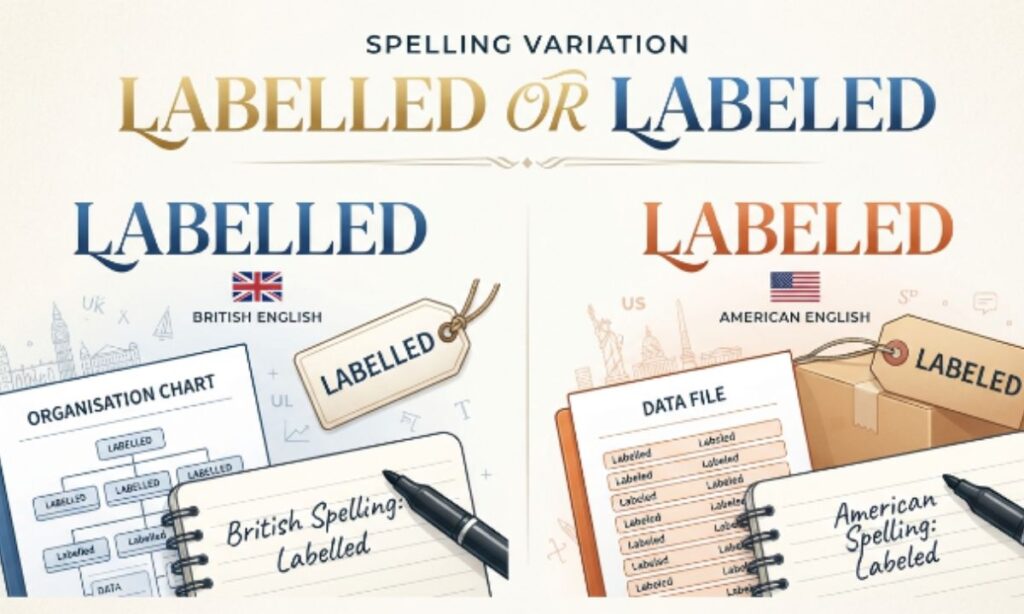
“Labelled” and “labeled” are the past tense forms of “label.” They have the same meaning.
The difference comes from regional spelling. American and British English use different spellings.
A Quick Example
Imagine two shipping teams. One works in Chicago. The other works in London. Both teams pack the same boxes.
The Chicago team writes:
“All boxes have been labeled and are ready to ship.”
The London team writes:
“All boxes have been labelled and are ready to ship.”
The meaning stays the same. Only the spelling changes.
What’s the Difference in American vs. British English?
The difference comes from spelling conventions, not grammar.
British English often doubles the final consonant when adding endings such as “-ed” and “-ing.”
American English usually keeps one consonant.
“Label” follows this pattern.
Region
Past Tense
Present Participle
American English
labeled
labeling
British English
labelled
labelling
American English usually uses the shorter spelling. British English often keeps the double “l.”
You can see the same pattern in other words:
traveled / travelled
canceled / cancelled
modeled / modelled
So if your spell checker flags “labelled” or “labeled,” check your English variety. Both spellings are correct. The choice depends on whether you follow American or British English.
How to Use “Labeled” Correctly (US English)
“Labeled” is the standard spelling across the United States. You’ll see it in American newspapers, textbooks, business writing, and everyday conversation.
When to Use It
Use “labeled” when:
You’re writing for a US-based audience.
Your company style guide follows American English.
You’re publishing on a platform that defaults to US spelling, like most American blogs or SEO content.
Example Sentences
“The samples were labeled by batch number before testing began.”
“Each folder is labeled with the client’s name for quick reference.”
“She labeled the leftovers so nobody would mix them up.”
Notice the pattern. One “l” before the ending, every time.
How to Use “Labelled” Correctly (UK English)
“Labelled” is the accepted spelling throughout the United Kingdom, as well as in Australia, Canada (in many contexts), and other regions that follow British English conventions.
When to Use It
Use “labelled” when:
You’re writing for a UK, Australian, or broader Commonwealth audience.
Your publication or company follows British English style.
You’re editing academic or formal writing intended for international, UK-based readers.
Example Sentences
“The ingredients were labelled clearly on the packaging.”
“Every wire was labelled before the electrician left the site.”
“The museum labelled each artifact with its country of origin.”
The extra “l” isn’t a typo. It’s the expected form in this variety of English.
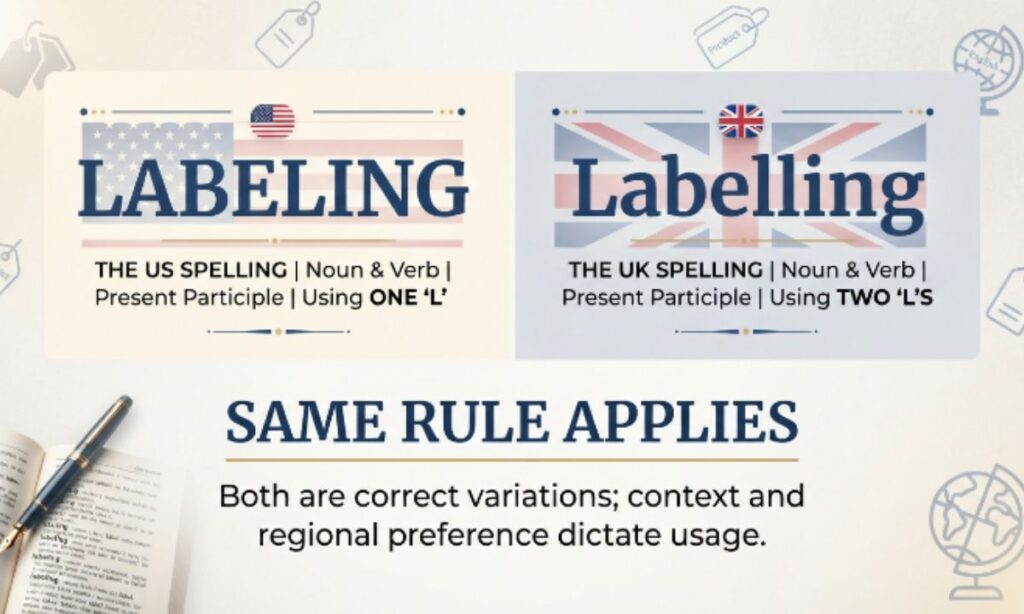
Labeling vs Labelling: Same Rule Applies
The spelling pattern does not stop with the past tense. It also applies to the present participle form.
In American English, write: labeling
In British English, write: labelling
This difference often causes confusion.
Writers may remember the correct past tense but forget to apply the same rule to the “-ing” form.
If you write “labeled” in American English, stay consistent throughout the document.
Use “labeling,” not “labelling.”
British English follows the same rule in reverse.
If you write “labelled,” use “labelling” as well.
Which Spelling Should You Use?
The answer depends on your audience. It does not depend on which spelling seems “more correct.”
Both spellings are correct in their respective varieties of English. Your readers should guide your choice.
Ask Yourself These Questions
Who is reading this?
If most of your readers are in the United States, use “labeled.” If most of your readers are in the United Kingdom, Australia, or another region that uses British English, use “labelled.”
Does your organization have a style guide?
Many companies have a preferred variety of English. Some organizations use American English. Others use British English. Follow your organization’s style guide. Do not let personal preference override an established style guide.
Are you writing for global SEO?
Your audience may include readers from several countries. Different markets may prefer different spellings.
Check which spelling gets more search volume in your target market. Then choose one spelling. Use that spelling consistently throughout the entire piece.
The One Rule That Always Applies
Whichever spelling you choose, do not mix the two forms in the same document.
Do not switch between “labeled” and “labelled” halfway through an article.
That change can make the article look like a careless editing mistake. Both spellings are correct on their own.
The problem starts when you mix the two spelling systems.
Pick one.
Stick with it.
Let your audience’s location guide your choice.
Common Mistakes and Exceptions
A few patterns can confuse even experienced writers.
Mixing Different Spellings in One Document
This is the most common mistake.
An article that uses both “labeled” and “labelled” looks inconsistent.
It can make the writing seem careless. Most readers may not notice the difference. However, consistent spelling makes the document look more polished and professional.
Assuming the Spellchecker Is Always Correct
Do not assume that your spellchecker’s default language setting is correct for every audience.
For example, you may write an article for a British audience.
Your spellchecker may use American English. It may then flag correctly spelled British English words as errors. Check your spellchecker’s language settings before changing the spelling.
Forgetting to Change the “-ing” Ending
Writers often remember the “-ed” ending but forget the “-ing” ending.
Both forms should follow the same spelling system. If you change “labeled” to “labelled,” you should also change “labeling” to “labelling.” Do not mix the two forms in the same document.
Overzealous Editing
Multiple editors can create another spelling problem. One editor may change the spelling to American English.
Another editor may change it back to British English. The document can then contain both spelling systems.
This can happen when several people edit the same document. Run a consistency check before you publish.
Make sure the document follows one spelling system from beginning to end.
Assuming One Spelling Is More Professional
Neither “labelled” nor “labeled” is more professional than the other.
Both spellings are standard.
They belong to different dialects of English.
Use the spelling that matches your audience and your chosen English variety.
If your organization has a style guide, follow that guide.
Quick Reference Table
Term
American English
British English
Past tense
Labeled
Labelled
Present participle
Labeling
Labelling
Noun (unaffected)
Label
Label
Common regions
US
UK, Australia, much of the Commonwealth
Frequently Asked Questions
Is “labelled” a misspelling of “labeled”?
No. Both are correct spellings, used in different varieties of English.
Which spelling should I use for a global audience?
Pick one spelling based on your primary audience, then stay consistent throughout your writing.
Does Canadian English use “labeled” or “labelled”?
Canadian English often leans toward “labelled,” though usage can vary by publication and context.
Is “labeling” ever spelled with two L’s in American English?
No. American English consistently uses one “l” in both “labeled” and “labeling.”
Will using the wrong regional spelling confuse readers?
It’s unlikely to confuse, but consistent spelling looks more polished and professional.
Conclusion
Both “labelled” and “labeled” are correct. It doesn’t matter which one you choose, as there is no right or wrong option; it’s important to consider your audience when deciding which to use. Pick between American and British English and then stick to your choice. This is the only way to avoid the issue of “labelled” vs. “labeled” altogether.







1 thought on “Labelled or Labeled: Which Spelling Is Correct?”