15+ Better Ways to Say “Good to Know” (For Any Situation)
Hayat
June 05, 2026No comments
“Good to know” is one of those phrases that feels fine until you say it too many times. It is quick, it acknowledges information, and it closes a conversation — but it can also come across as flat, dismissive, or even slightly bored, depending on the context.
The words you use to respond to new information tell people whether you were genuinely listening or just filling space. Swapping in a more specific, thoughtful reply takes almost no effort and makes a real difference in how you come across — in emails, meetings, and everyday conversation.
“Good to know” is a casual phrase people use to acknowledge that they have just received useful, interesting, or relevant information. It signals receipt and light appreciation without committing to anything further.
You are essentially saying: I heard you, I found that helpful, and I do not necessarily need to respond further. It is one of the most common acknowledgment phrases in spoken and written English.
People use it in work emails, text messages, team chats, and face-to-face conversations. Its brevity is its strength — and also its main limitation. When the situation calls for more warmth, more formality, or more engagement, “good to know” often falls short.
When Should You Use “Good to Know”?
This phrase works well in fast-moving conversations where brevity is valued and no action is needed. If a colleague mentions that the office will be closed next Friday, or a friend tells you a new restaurant opened nearby, “good to know” covers it cleanly. It is an efficient acknowledgment for low-stakes, informal exchanges.
It becomes less effective in professional emails, client communication, or conversations where the person sharing the information has invested some effort.
A detailed project update, a piece of feedback, or a heads-up from a manager often deserves more than a two-word reply. In those cases, something slightly more specific shows that you actually processed what was shared, and that matters for your professional relationships.
Is “Good to Know” Professional or Polite?
It sits somewhere in the middle. The phrase is generally acceptable in workplace settings, but its tone is casual enough that it can feel out of place in formal correspondence or high-stakes conversations.
Pros
Fast and easy to use in any conversation
Polite without being overly formal
Works naturally in spoken English and casual texts
Signals acknowledgment without requiring elaboration
Widely understood across different English-speaking cultures
Cons
Can sound indifferent or dismissive if used without warmth
Too casual for formal emails, reports, or client communication
Offers no real engagement with the content of what was shared
Easily overused, especially in work chat tools like Slack or Teams
Does not show that you found the information actionable or valuable
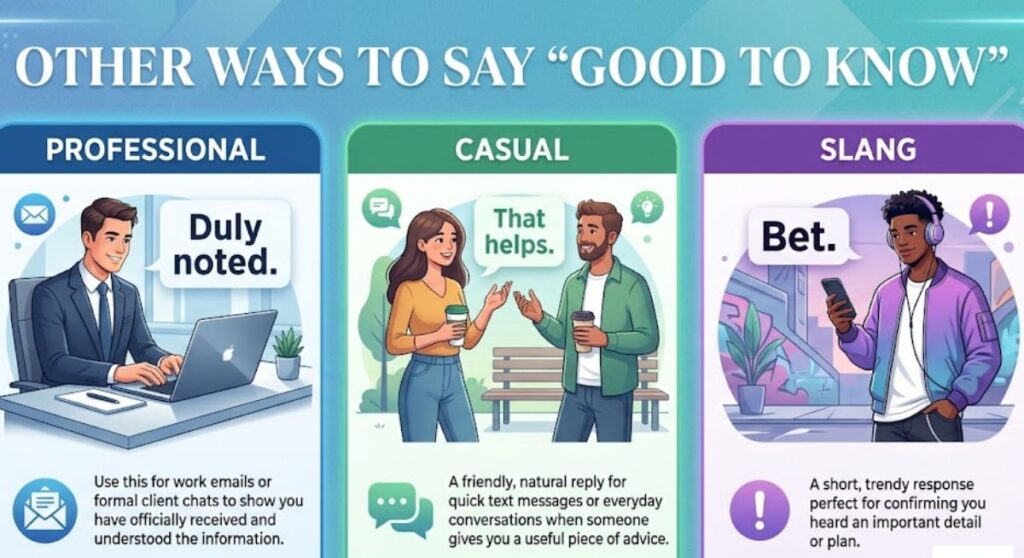
15+ Other Ways to Say “Good to Know”
1. Thanks for the Update
Meaning: A warm, professional acknowledgment that shows you received and valued the information
Why It Works: It does two things at once — acknowledges the information and thanks the person who shared it. That small expression of gratitude shifts the whole tone of the reply.
Example:
Person A: “Just so you know, the deadline has been pushed to Thursday.”
Person B: “Thanks for the update — I’ll adjust my schedule accordingly.”
Best Use: Work emails, project communication, team announcements
Worst Use: Very casual texts where it may sound slightly more formal than the conversation warrants
Tone: Warm, Professional, Appreciative
2. Noted
Meaning: A clean, confident acknowledgment that the information has been received and registered
Why It Works: It is short but it carries weight. “Noted” implies that the information has been filed mentally and may be acted on. It sounds more deliberate than “good to know.”
Example:
Person A: “The client prefers reports in PDF, not Word.”
Person B: “Noted — I’ll make that change going forward.”
Best Use: Quick professional replies, responses to instructions, workplace messaging
Worst Use: Emotional or personal conversations where one word can seem cold or dismissive
Tone: Professional, Direct, Efficient
3. I Appreciate the Insight
Meaning: A formal phrase that acknowledges the value and quality of what was shared
Why It Works: The word “insight” elevates the information. It tells the other person that what they shared was not just data — it was actually useful thinking. That is a meaningful compliment in professional settings.
Example:
Person A: “Based on what I’ve seen, the team performs better with async check-ins.”
Person B: “I appreciate the insight — that’s worth keeping in mind as we plan the next quarter.”
Best Use: Feedback emails, expert input, strategic conversations, performance discussions
Worst Use: Casual chat where “insight” feels too elevated for the level of information shared
Tone: Formal, Respectful, Thoughtful
4. That’s Really Helpful
Meaning: A direct, genuine acknowledgment that the information was useful
Why It Works: Adding “really” gives the phrase warmth and specificity. It tells the speaker that their contribution made a difference, which encourages continued sharing and openness.
Example:
Person A: “You can skip the form — just email the HR team directly.”
Person B: “Oh, that’s really helpful, thanks.”
Best Use: Everyday professional conversations, team chats, informal client interactions
Worst Use: Very formal correspondence where the casual warmth of “really” may not fit the tone
Tone: Friendly, Warm, Genuine
5. I’ll Keep That in Mind
Meaning: Signals that you have absorbed the information and plan to apply it in the future
Why It Works: It goes one step further than a simple acknowledgment. You are not just saying you heard something — you are telling the other person it will influence your thinking. That shows real engagement.
Example:
Person A: “The board tends to respond better to visual data than written summaries.”
Person B: “I’ll keep that in mind when I put together the next presentation.”
Best Use: Advice, tips, strategic context, guidance from a more experienced colleague
Worst Use: Urgent or action-required situations where “keeping it in mind” is not enough of a commitment
Tone: Professional, Thoughtful, Engaged
6. Glad to Hear It
Meaning: A warm response to positive information or reassuring news
Why It Works: It expresses genuine relief or happiness about what was shared. It is warmer than “noted” and more personal than “thanks for the update,” which makes it ideal for good news or positive updates.
Example:
Person A: “The client approved the proposal this morning.”
Person B: “Glad to hear it — that’s been a long time coming.”
Best Use: Good news, resolved issues, positive project updates
Worst Use: Neutral or negative updates where “glad” would be an odd emotional mismatch
Tone: Warm, Friendly, Genuine
7. That’s Useful to Know
Meaning: A slightly more specific version of the original phrase
Why It Works: Adding “useful” makes the acknowledgment feel more considered. You are not just registering the information — you are specifically identifying its value.
Example:
Person A: “The system goes down for maintenance every Sunday between 2 and 4 AM.”
Person B: “That’s useful to know — I’ll schedule my uploads accordingly.”
Best Use: Practical tips, process information, anything with a clear application
Worst Use: Emotional conversations or personal news where “useful” sounds clinical
Tone: Neutral, Professional, Practical
8. I Appreciate You Sharing That
Meaning: A warm, personal acknowledgment that values both the information and the person who shared it
Why It Works: It centers the other person, not just the information. That shift in focus builds trust and strengthens relationships, especially in conversations where openness matters.
Example:
Person A: “I’ve noticed the team is feeling a bit burned out lately.”
Person B: “I appreciate you sharing that — it’s important for me to hear.”
Best Use: Feedback conversations, sensitive topics, team check-ins, mentorship
Worst Use: Quick operational updates where the warmth of this phrase would feel disproportionate
Tone: Warm, Empathetic, Respectful
9. That’s Reassuring
Meaning: A response to information that alleviates concern or uncertainty
Why It Works: This phrase acknowledges emotional context, not just content. It tells the speaker that their update had a real impact on how you feel about a situation. That kind of response deepens professional and personal conversations.
Example:
Person A: “The security team reviewed the system and found no vulnerabilities.”
Person B: “That’s reassuring — I’ve had that concern on my list for a while.”
Best Use: Updates that resolve a worry, confirm that something is on track, or follow up on a concern
Worst Use: Neutral information with no emotional stakes attached
Tone: Relieved, Professional, Human
10. Thanks for Letting Me Know
Meaning: A simple, genuine thank-you for being informed
Why It Works: It is direct, warm, and natural. The phrase works across almost every context — formal or casual — because it does not overcomplicate the acknowledgment. It just says: I’m glad you told me.
Example:
Person A: “The 3 o’clock meeting has been moved to 4.”
Person B: “Thanks for letting me know — I’ll update my calendar.”
Best Use: Scheduling changes, quick informational updates, any context where a brief thank-you fits
Worst Use: Deep feedback or strategic insights where more engagement is expected
Tone: Friendly, Versatile, Natural
11. That’s Interesting
Meaning: A response that signals genuine curiosity or engagement with new information
Why It Works: It opens rather than closes a conversation. It tells the speaker you found their information worth thinking about, which often leads to more open dialogue.
Example:
Person A: “Our highest-traffic pages get most of their visits after 9 PM.”
Person B: “That’s interesting — I wonder if it’s a time zone thing.”
Best Use: Data discussions, research findings, observations worth exploring further
Worst Use: Situations where the information is not actually interesting — using this phrase flatly can sound sarcastic
Tone: Curious, Engaged, Conversational
12. Noted With Thanks
Meaning: A formal acknowledgment that combines confirmation with brief gratitude
Why It Works: It is slightly warmer than “noted” alone but still professional and efficient. It works especially well in written communication where a one-word reply would feel abrupt.
Example:
Person A: “I’ve attached the revised contract for your review.”
Person B: “Noted with thanks — I’ll go through it today.”
Best Use: Formal email replies, document exchanges, professional correspondence
Worst Use: Casual conversations where the phrasing sounds unnecessarily formal
Tone: Formal, Polite, Professional
13. I Wasn’t Aware of That
Meaning: An honest acknowledgment that the information was new to you
Why It Works: It is humble and genuine. It tells the speaker their input actually added something — which most people find satisfying. It can also open a conversation if you want to learn more.
Example:
Person A: “You can actually submit those forms online now — they changed the process last month.”
Person B: “Oh, I wasn’t aware of that — thanks for the heads-up.”
Best Use: When the information is genuinely surprising or new to you
Worst Use: When you already knew something — using this phrase insincerely can damage trust if the other person finds out
Tone: Honest, Warm, Conversational
14. I’ll Take Note of That
Meaning: A formal phrase signaling that the information has been consciously registered for future use
Why It Works: It is more deliberate than “good to know.” It implies action and intention — not just passive receipt of information.
Example:
Person A: “The regional director prefers to be briefed in bullet points, not paragraphs.”
Person B: “I’ll take note of that before our next presentation.”
Best Use: Work settings where a colleague or manager shares a preference, a pattern, or a process tip
Worst Use: Casual conversations where this level of formality feels heavy
Tone: Professional, Intentional, Respectful
15. That Makes Sense
Meaning: A response that signals understanding and logical agreement with the information shared
Why It Works: It does more than acknowledge — it validates. It tells the speaker that their information was not just received but understood and accepted. That is a much richer response than a simple “okay.”
Example:
Person A: “We shifted the launch date because the marketing assets weren’t ready.”
Person B: “That makes sense — better to delay than go out with something unfinished.”
Best Use: Explanations, context-setting, reasoning behind a decision
Worst Use: Information that does not actually connect to any logical structure — forcing “that makes sense” where it does not fit sounds odd
Tone: Understanding, Engaged, Conversational
16. Appreciate the Heads-Up
Meaning: A casual but genuine thank-you for being informed in advance
Why It Works: “Heads-up” implies that the person went out of their way to warn or inform you before something happened. Acknowledging that specifically shows you noticed the effort.
Example:
Person A: “Just a heads-up — the server will be down from noon to 2 tomorrow.”
Person B: “Appreciate the heads-up — I’ll make sure to save everything before then.”
Best Use: Advance warnings, proactive updates, informational alerts
Worst Use: Information shared after the fact where “heads-up” no longer applies
Tone: Casual, Grateful, Professional
17. That’s Worth Knowing
Meaning: A phrase that affirms the value of the information shared
Why It Works: It sounds considered and deliberate. You are specifically saying this information has merit — which validates the other person’s decision to share it.
Example:
Person A: “The vendor has a history of missing deadlines by about two weeks.”
Person B: “That’s worth knowing — I’ll build some buffer into the timeline.”
Best Use: Tips, warnings, historical context, industry knowledge
Worst Use: Obvious or routine information where “worth knowing” might come across as slightly patronizing
Tone: Thoughtful, Professional, Affirming
18. I’m Glad You Mentioned That
Meaning: A warm acknowledgment that tells the speaker their contribution was timely or important
Why It Works: It conveys that the information arrived at the right moment. It has a natural, human quality that encourages people to keep sharing openly in future conversations.
Example:
Person A: “By the way, the client mentioned they’d like more frequent check-ins.”
Person B: “I’m glad you mentioned that — I’ll reach out to schedule them this week.”
Best Use: Details that could have been missed, follow-ups, feedback shared in passing
Worst Use: Very formal correspondence where this phrase reads too conversational
Tone: Warm, Attentive, Friendly
19. Good Point
Meaning: An acknowledgment that what was shared reflects clear thinking or a valuable observation
Why It Works: It does not just register information — it compliments the quality of the thinking behind it. That is affirming without being excessive.
Example:
Person A: “We should probably test this on mobile before the launch.”
Person B: “Good point — I’ll add that to the checklist.”
Best Use: Discussions, brainstorming, feedback, team meetings
Worst Use: Purely factual updates where there is no reasoning to credit — “good point” implies thought, not just data
Tone: Affirming, Collaborative, Professional
20. I’ll Bear That in Mind
Meaning: A formal, slightly British expression of intention to remember and apply the information
Why It Works: It signals respect and consideration. It is more formal than “I’ll keep that in mind” and fits neatly into professional written communication.
Example:
Person A: “The finance team tends to be more responsive in the mornings.”
Person B: “I’ll bear that in mind when I send over the budget request.”
Best Use: Formal professional emails, communication with senior colleagues, cross-team correspondence
Worst Use: Casual conversations where it sounds old-fashioned or stiff
Tone: Formal, Considerate, Professional
How to Pick the Right Response in the Moment
The best acknowledgment phrase depends on three things: the relationship you have with the person, the weight of the information they shared, and the tone of the conversation around it.
For quick operational updates — schedule changes, process tips, minor announcements — “thanks for the update,” “noted,” or “appreciate the heads-up” covers it cleanly.
For something more significant, like feedback, strategic context, or sensitive information, “I appreciate you sharing that” or “I’m glad you mentioned that” shows you recognized the effort behind what was said.
When in doubt, pair a short acknowledgment with a brief action. “Noted — I’ll follow up on this by Friday” is always better than a two-word reply sitting on its own, because it tells the other person their information actually influenced what happens next.
Why Your Acknowledgment Phrases Reflect Your Professional Presence
The way you respond to information is a small but consistent part of how you come across at work. People who reply with “noted” to every update are hard to read.
People who respond with specific, context-aware phrases seem more present, more engaged, and generally easier to work with.
This is not about overcommunicating or adding filler to every reply. It is about being intentional. A phrase like “that’s reassuring” or “I appreciate the insight” takes three seconds to type and signals that you actually read what was sent. Over time, those small signals build a reputation for attentiveness — and that matters more than most people realize.
Frequently Asked Questions
Is “good to know” rude or dismissive?
Not inherently, but it can come across that way if the information shared deserved a more engaged response or was shared with clear effort.
What is the most professional alternative to “good to know”?
“Noted with thanks,” “I appreciate the insight,” or “thanks for the update” are all strong formal alternatives appropriate for workplace emails.
Can I use “noted” as a full reply in a professional email?
Yes, in most workplace contexts “noted” is acceptable, though adding a brief follow-up like “I’ll action this by [date]” makes it stronger.
What should I say instead of “good to know” in a text message?
“Thanks for the heads-up,” “that’s helpful,” or “glad you mentioned that” all work well in casual text exchanges.
How do I respond to feedback without saying “good to know”?
“I appreciate you sharing that” or “I’ll take note of that going forward” both acknowledge the feedback while showing you found it valuable.
Final Thoughts
“Good to know” has its place, but it should not be your default response to everything. The phrases in this guide give you real options for every situation — formal and casual, brief and engaged, warm and professional.
Use them based on the person, the context, and what the moment actually calls for. Small upgrades in how you respond to information are one of the easiest ways to sound more thoughtful, more present, and more worth listening to.