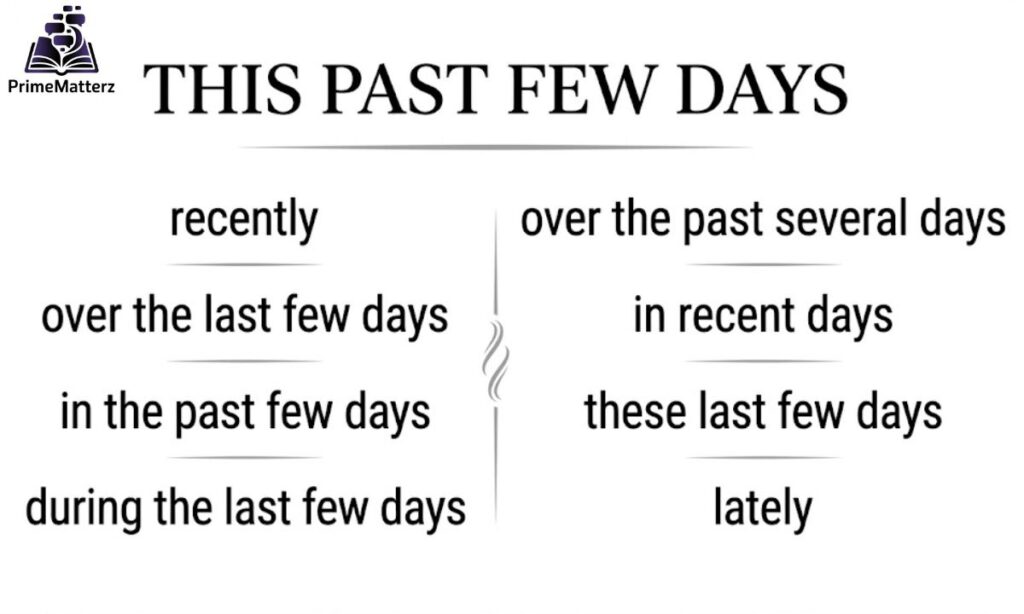
The words you pick can change how people feel about what you are saying. If you keep using the same phrase over and over, your writing or speech can start to sound flat. Choosing the right alternative to “this past few days” can make you sound more clear, more professional, and more thoughtful in emails, conversations, and daily updates.
What Does “This Past Few Days” Mean?
“This past few days” is a way to talk about a short, recent period of time, usually two to seven days. It points to something that happened or has been happening lately, close to the present moment.
People use this phrase to give a quick time reference without naming exact dates. It is common in casual talk, updates, and check-ins where the exact day does not matter much.
When Should You Use “This Past Few Days”?
In the workplace, this phrase often shows up in status updates, like talking about recent project progress or a short delay. In emails, it helps explain a recent change without sounding too formal or too vague.
And In customer service, it can explain a recent issue or delay in a soft way. Among friends and family, it works well for small talk, like catching up after being sick or busy for a few days.
Is “This Past Few Days” Professional or Polite?
This phrase is generally polite, but it is not always seen as fully professional because of a small grammar issue. Here is a quick breakdown.
Pros
- Sounds natural and friendly
- Easy for anyone to understand
- Works in spoken and written English
- Fits casual and semi-formal settings
Cons
- Slightly grammatically awkward (“this” with a plural noun)
- Vague, since it does not give an exact number of days
- Can sound repetitive if overused in writing
- Less suited for very formal business documents
Grammar & Correct Usage of “This Past Few Days”
This phrase is actually a small grammar mix-up that many people use anyway. Here is what you need to know.
- “This” is singular, but “few days” is plural, so technically it should be “these past few days.”
- Common grammar mistake: saying “this past few days” instead of “these past few days.”
- Correct formal sentence: “These past few days have been busy.”
- Correct casual sentence: “This past few days has been crazy” (common in speech, but not textbook correct).
- Formal usage: “Over the past few days, our team has reviewed the report.”
- Informal usage: “This past few days has been a lot, honestly.”
Common Mistakes When Using “This Past Few Days”
- Overuse: Repeating it in every update makes writing sound lazy.
- Wrong context: Using it for long time periods, like months, instead of just a few days.
- Tone issues: Using it in very formal reports where exact dates are expected.
- Grammar errors: Mixing singular “this” with plural “days” without realizing the mismatch.
How to Respond to “This Past Few Days”
1. “I hope things get easier soon.” Meaning: Shows care without asking too many questions. Best use: When a coworker shares stress from recent days. Example: “This past few days has been rough.” / “I hope things get easier soon.”
2. “That sounds like a lot to deal with.” Meaning: Validates the other person’s experience. Best use: Friends or family sharing a tough stretch. Example: “This past few days has been non-stop.” / “That sounds like a lot to deal with.”
3. “Let me know if you need any help.” Meaning: Offers support directly. Best use: Workplace or close friendships. Example: “This past few days has been hectic at work.” / “Let me know if you need any help.”
4. “Glad you’re catching a break now.” Meaning: Shows relief that things are settling down. Best use: After someone mentions a busy stretch is ending. Example: “This past few days has finally calmed down.” / “Glad you’re catching a break now.”
5. “Thanks for the update.” Meaning: A neutral, professional acknowledgment. Best use: Emails or workplace check-ins. Example: “This past few days, we finished the testing phase.” / “Thanks for the update.”
15+ Other Ways to Say “This Past Few Days”
Recently
Meaning: A simple, common way to talk about something close to now. It feels light and easy in almost any setting. Example:
- Person A: “Recently, we changed our delivery process.”
- Person B: “Good to know, thanks for telling me.” Best Use: Emails, casual chats, quick updates. Worst Use: Detailed reports needing exact timing. Tone: Neutral
Lately
Meaning: Suggests an ongoing pattern over a short stretch of time, often used for feelings or habits. Example:
- Person A: “Lately, sales have picked up a bit.”
- Person B: “That’s great to hear.” Best Use: Personal conversations, casual business talk. Worst Use: Formal legal or technical writing. Tone: Casual
Over the Last Few Days
Meaning: A clear, grammatically smooth way to point to a short recent stretch of time. Example:
- Person A: “Over the last few days, we fixed three bugs.”
- Person B: “Nice progress.” Best Use: Workplace updates, project reports. Worst Use: Very casual texting. Tone: Professional
In Recent Days
Meaning: A slightly more formal phrase often used in news or official statements. Example:
- Person A: “In recent days, the team has reviewed the budget.”
- Person B: “Sounds thorough.” Best Use: News updates, formal announcements. Worst Use: Texting friends. Tone: Formal
These Past Few Days
Meaning: The grammatically correct version of the original phrase, with the same friendly tone. Example:
- Person A: “These past few days have been exhausting.”
- Person B: “I can imagine.” Best Use: Any setting where you want correctness without sounding stiff. Worst Use: None really, very flexible. Tone: Neutral
As of Late
Meaning: A slightly old-fashioned but still understood way to describe recent time. Example:
- Person A: “As of late, traffic has been terrible.”
- Person B: “Tell me about it.” Best Use: Storytelling, writing with personality. Worst Use: Quick texts or chats. Tone: Formal
This Week
Meaning: Useful when the time period actually fits within a single week, giving a clearer picture. Example:
- Person A: “This week has been packed with meetings.”
- Person B: “Same here, it’s been a lot.” Best Use: Work updates, planning conversations. Worst Use: When the timeframe is unclear or longer than a week. Tone: Neutral
In the Past Couple of Days
Meaning: A close cousin to the original phrase, but smoother and easier to say out loud. Example:
- Person A: “In the past couple of days, I’ve felt better.”
- Person B: “Glad to hear that.” Best Use: Health updates, casual catch-ups. Worst Use: Strict formal writing. Tone: Friendly
Of Late
Meaning: A short, slightly formal phrase that fits well in writing more than speech. Example:
- Person A: “Of late, our numbers have improved.”
- Person B: “That’s encouraging.” Best Use: Business writing, articles. Worst Use: Texting or casual talk. Tone: Formal
The Last Several Days
Meaning: Slightly broader than “a few days,” useful when the timeframe feels a bit longer. Example:
- Person A: “The last several days have been stressful.”
- Person B: “Hang in there.” Best Use: Personal or workplace stress talk. Worst Use: Very short timeframes like one or two days. Tone: Neutral
Not Long Ago
Meaning: Focuses on closeness in time rather than an exact number of days. Example:
- Person A: “Not long ago, we switched software systems.”
- Person B: “How’s that going?” Best Use: Storytelling, casual explanations. Worst Use: Precise business reporting. Tone: Casual
Just Recently
Meaning: Adds a bit more emphasis on how close in time something happened. Example:
- Person A: “Just recently, we hired two new staff members.”
- Person B: “That’s exciting news.” Best Use: Announcements, casual updates. Worst Use: Very formal legal documents. Tone: Friendly
In the Recent Past
Meaning: A more formal academic-sounding phrase, often used in writing rather than speech. Example:
- Person A: “In the recent past, prices have risen sharply.”
- Person B: “Yes, I’ve noticed that too.” Best Use: Reports, essays, articles. Worst Use: Texting or casual speech. Tone: Formal
These Last Few Days
Meaning: Almost identical to the original phrase but grammatically cleaner and just as warm. Example:
- Person A: “These last few days have flown by.”
- Person B: “Same here, can’t believe it.” Best Use: Everyday conversation, social media captions. Worst Use: None significant. Tone: Warm
Within the Last Few Days
Meaning: Adds a slightly more precise, professional feel while keeping the short timeframe. Example:
- Person A: “Within the last few days, we resolved the issue.”
- Person B: “Glad that’s sorted.” Best Use: Customer service replies, status updates. Worst Use: Very casual texting. Tone: Professional
Lately On
Meaning: A more regional or conversational twist on “lately,” often heard in spoken English. Example:
- Person A: “Lately on, things have been quieter at the office.”
- Person B: “That’s a nice change.” Best Use: Informal spoken conversation. Worst Use: Written business communication. Tone: Casual
A Few Days Back
Meaning: A relaxed, friendly way to point to something that happened recently without sounding stiff. Example:
- Person A: “A few days back, I tried that new restaurant.”
- Person B: “How was it?” Best Use: Friends, family, casual chats. Worst Use: Formal emails or reports. Tone: Casual
Formal vs Informal Alternatives
| Formal Alternatives | Informal Alternatives |
|---|---|
| Over the last few days | A few days back |
| In recent days | Lately |
| In the recent past | Not long ago |
| Of late | Lately on |
| These past few days | This past few days |
| Within the last few days | Just recently |
| The last several days | This week |
| As of late | These last few days |
| In the past couple of days | Recently |
| These last few days | Of late, casually said |
Which Alternative Should You Choose?
At the workplace, “over the last few days” or “within the last few days” sound clear and professional without feeling stiff. In emails, “in recent days” or “these past few days” strike a good balance between polite and clear.
When writing to a manager, lean formal with phrases like “in the recent past” or “over the last several days.” For customer replies, “within the last few days” keeps things professional and reassuring.
With friends, “a few days back” or “lately” feel natural and relaxed. For family, almost any casual option works fine, since tone matters more than precision. On social media, short and catchy phrases like “these last few days” or “lately” fit best.
Frequently Asked Questions
Is “this past few days” grammatically correct?
Not fully, since “this” is singular and “days” is plural, so “these past few days” is the correct form.
What can I say instead of “this past few days” in an email?
You can say “over the last few days” or “in recent days” for a clean, professional tone.
Is “lately” the same as “this past few days”?
They are close in meaning, but “lately” feels more general while “this past few days” points to a shorter, specific stretch.
Can I use “recently” instead of “this past few days”?
Yes, “recently” works well as a simple, neutral replacement in most situations.
Is “these past few days” more professional than “this past few days”?
Yes, it is the grammatically correct version and sounds slightly more polished in writing.
Final Thoughts
Small phrases like “this past few days” shape how clear and polished your communication feels. Switching between alternatives keeps your writing fresh and shows attention to detail. Whether you choose something formal for work or something relaxed for friends, the right words always make your message land better.