Someone calls your coworker “a real stickler” and you’re not sure if that’s a compliment or a warning. The word shows up constantly in office talk, sports commentary, and grammar debates. It always seems to mean the same thing, but somehow the tone changes every time. Here’s the full picture.
What Does “Stickler” Mean?
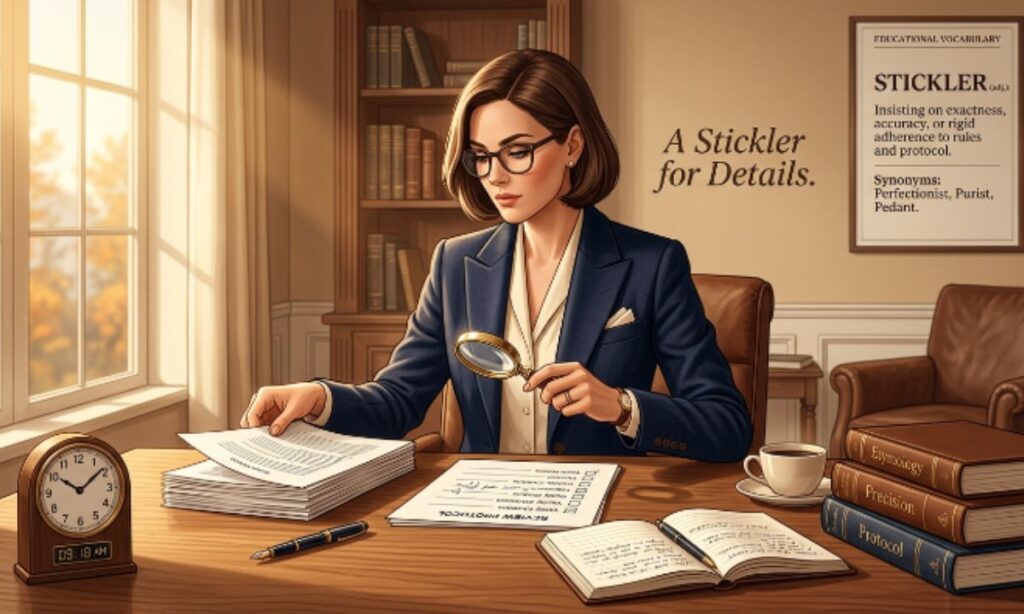
A stickler is someone who insists on doing things exactly right and expects the same from everyone around them. It’s a noun, and it almost never appears alone. You’ll see it paired with “for,” followed by whatever the person cares so much about: rules, detail, punctuality, grammar, procedure.
The word is informal, more at home in everyday conversation than in a formal report. It’s said out loud about people, in offices, classrooms, and sports commentary, far more often than it’s written in a legal document.
Pronunciation
Stickler is pronounced STIK-ler, two syllables, stress on the first. In both UK and US English, it comes out essentially the same way, no real regional split to worry about.
“Stickler for the Rules” – Core Meaning and Usage
The phrase follows a simple, repeatable pattern: stickler for + noun. Whatever fills that blank tells you exactly what the person refuses to compromise on.
Some of the most common fill-ins:
- Stickler for detail
- Stickler for accuracy
- Stickler for punctuality
- Stickler for etiquette
- Stickler for procedure
- Stickler for grammar
Swap in almost any noun describing a standard, rule, or expectation, and the phrase still works. That flexibility is part of why the word has stuck around in everyday English for so long.
Where the Word Comes From
Stickler traces back to an old sense of “stick,” related to fighting or standing firm in a dispute. Centuries ago, a “stickler” was someone who acted as a referee or umpire in duels and contests, the person whose job was to make sure both sides followed the agreed-upon rules.
That referee sense faded from everyday use, but the core idea never really left. Today’s stickler still enforces standards, just in an office meeting instead of a duel. The word shifted from a specific job title to a general personality trait, but the thread connecting the two is obvious once you see it: someone who won’t let a rule slide.
Examples of “Stickler” in Sentences
Seeing the word in different settings makes the pattern click faster than any definition can.
Workplace and Office Examples
- “Our manager is a stickler for deadlines, so don’t even think about asking for an extension.”
- “She’s a stickler for formatting, right down to the font size on every slide.”
Legal and Procedural Examples
- “The judge was known as a stickler for courtroom procedure.”
- “He’s a stickler for following the contract to the letter.”
Everyday Life Examples
- “My grandfather was a stickler for punctuality. Showing up five minutes late felt like a crime in his house.”
- “She’s a stickler for table manners, even at casual family dinners.”
Grammar Sticklers
“Grammar stickler” deserves its own mention, since it’s one of the most common ways the word appears online. A grammar stickler is someone who corrects split infinitives, dangling modifiers, or “less” versus “fewer,” often more strictly than the grammar rules actually require.
Plenty of the rules these sticklers defend so fiercely came from style preferences invented long after English itself had settled into its modern form, which is worth keeping in mind the next time someone gets corrected over an “informal” sentence structure.
Synonyms and Related Words
Stickler sits in a crowded neighborhood of words about precision and rule-following, though each one carries its own shade of meaning.
| Word | Closest Meaning | Typical Tone |
| Pedant | Overly focused on minor, technical details | Usually negative |
| Perfectionist | Wants everything done to the highest standard | Mixed |
| Purist | Insists on traditional or “correct” methods | Neutral to critical |
| Punctilious | Extremely attentive to formality and correctness | Mostly neutral |
| Finicky | Fussy, hard to satisfy | Negative |
| Over-particular | Excessively picky about small things | Negative |
Stickler vs. Pedant: What’s the Difference?
These two get confused constantly, but there’s a real distinction. A stickler cares about following an established rule or standard, often for good reason, like safety procedures or contract terms. A pedant cares about being technically correct, frequently over details that don’t actually matter much in practice, and often does it in a way that comes across as showing off.
Every pedant could probably be called a stickler in some sense, but not every stickler is being pedantic. A stickler for safety protocol on a construction site is doing something useful. A pedant correcting someone’s grammar mid-argument is usually just being annoying.
Is “Stickler” Positive or Negative?
This is where the word gets genuinely interesting, because it swings both directions depending entirely on context.
When It Sounds Complimentary
Call a surgeon a stickler for sterile procedure, and that’s a compliment. Call an accountant a stickler for accuracy, and you’re praising exactly the trait you want in that job. In fields where precision actually protects people or prevents costly mistakes, being a stickler reads as professionalism.
When It Sounds Critical
Flip the context, and the same word turns into a mild insult. Call a manager a stickler for pointless paperwork, and you’re describing someone rigid, bureaucratic, or difficult to work with. The word doesn’t change. The thing they’re a stickler for does all the work.
A quick way to judge the tone: ask whether the rule being enforced actually matters. Sticklers for safety, fairness, and accuracy tend to get praised. Sticklers for arbitrary formatting or outdated formalities tend to get side-eyed.
Other Meanings of “Stickler”
Most people only ever encounter the “strict about rules” sense, but there’s a second, much rarer meaning worth knowing about: a stickler can also refer to a difficult problem or puzzle, something that stumps you. You might come across a sentence like “this math problem turned out to be a real stickler,” meaning it was genuinely hard to solve.
This sense shows up far less often than the personality-trait meaning. In modern everyday English, if someone says “stickler” without much context, they’re almost certainly talking about a rule-obsessed person, not a tricky puzzle. Still, running into the puzzle sense in older writing or a crossword clue shouldn’t throw you off.
How to Tell If You’re Being a Stickler (In a Good Way)
If you’ve ever wondered whether your own attention to detail crosses into stickler territory, a few questions can help sort it out:
- Does the rule you’re enforcing actually prevent a real problem?
- Would relaxing it cause harm, confusion, or unfairness?
- Are you applying the standard consistently, or only when it’s convenient?
- Is the issue actually important or just a personal preference dressed up as a rule?
Answer yes to the first three and no to the last one, and you’re probably a stickler in the useful sense. Flip those answers, and you might be edging closer to being pedantic.
Frequently Asked Questions
What does “stickler for the rules” mean?
It describes someone who insists on strict, exact compliance with rules or standards and expects others to do the same.
Is “stickler” a positive or negative word?
It can be either, depending on whether the standard being enforced is genuinely important or just rigid for its own sake.
What’s the difference between a stickler and a pedant?
A stickler enforces meaningful standards, while a pedant tends to fixate on minor technical details that often don’t matter much.
Can “stickler” mean something other than a strict person?
Yes, in a much rarer sense, it can describe a difficult puzzle or problem that’s hard to solve.
Is “stickler” formal or informal?
It’s informal, common in everyday speech and casual writing rather than in formal or legal documents.
Conclusion
“Stickler” is a small word doing a lot of work: it captures the exact mix of precision, insistence, and rule-following that shows up in offices, courtrooms, sports fields, and grammar debates alike.
Its meaning barely shifts from one context to the next, but its tone shifts constantly, swinging between admiration and mild criticism depending on whether the rule in question actually deserves the fuss. Once you know the pattern “stickler for” and understand what tips the word from compliment to complaint, you’ll never misread it again.