
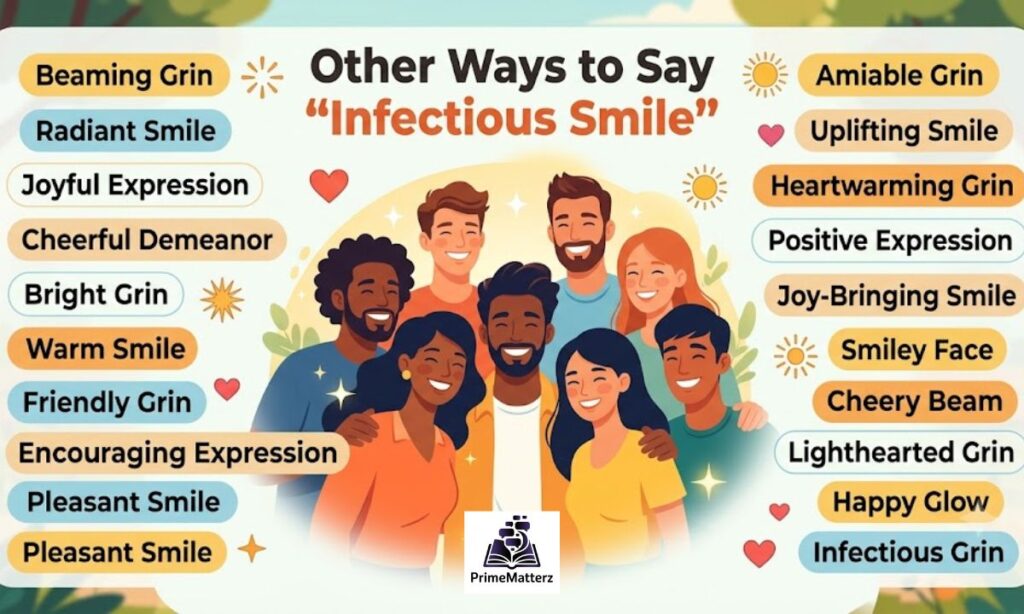
Word choice shapes how people feel when they read your writing or hear you speak. Saying someone has an “infectious smile” is a compliment, but the phrase has been used so many times it barely lands anymore.
Whether you are writing a character description, paying someone a genuine compliment, crafting a social caption, or building a profile bio, the right phrase does more work than a tired default. This guide gives you 15+ fresh alternatives to “infectious smile,” sorted by tone, context, and purpose, so you always pick the one that fits.
What Does “Infectious Smile” Mean?
An infectious smile is a smile so genuine and warm that other people involuntarily smile back. The word “infectious” here borrows from medicine — something that spreads from one person to another without much effort.
When we call a smile infectious, we mean it has a contagious quality: the person is not trying to make you smile, but you simply cannot help it.
The phrase is almost always a compliment. It suggests that the person radiates positive energy, that their happiness is authentic, and that being around them lifts the mood of everyone nearby.
It is used in casual conversations, social media captions, eulogy tributes, character descriptions in fiction, and professional profiles on LinkedIn.
When Should You Use “Infectious Smile”?
“Infectious smile” works well in informal writing — social captions, birthday cards, casual compliments between friends, and lighthearted character sketches.
It reads as warm and genuine when used once, in the right place. It also fits in tribute writing such as yearbook quotes and memorial posts, where emotional resonance matters more than precision.
In more polished or professional writing, though, the phrase starts to feel lazy. A novelist describing their protagonist for the fifth time should not lean on “infectious smile” as a default.
A bio writer trying to make a business leader sound memorable would do better to reach for something more specific. The phrase is overused enough that most readers skip right past it without feeling anything at all.
Is “Infectious Smile” Professional or Polite?
The phrase is polite and positive in almost any context, but its professional usefulness depends on where you use it.
Pros:
- Immediately understood by any reader
- Always reads as a compliment
- Works across cultures and age groups
- Appropriate in both spoken and written English
- Fits emotional and personal writing contexts
Cons:
- Overused to the point of feeling generic
- Can feel clinical in purely formal writing (the word “infectious” carries medical associations)
- Does not help a reader picture anything specific
- Adds little to professional bios or performance reviews
- Can feel hollow in literary or creative writing where originality matters
Grammar and Correct Usage of “Infectious Smile”
“Infectious smile” is grammatically correct and has been in standard English use for decades. It works as a noun phrase (“She has an infectious smile”) and as a modifier (“His infectious smile lit up the room”). The adjective “infectious” modifies the noun “smile,” which is standard adjective-noun construction.
A common mistake is confusing “infectious” with “contagious.” Both work here, but they carry slightly different connotations, which the nuance guide below covers in detail. Another mistake is overusing the phrase in a single piece of writing — if it appears three times in one paragraph, it loses all impact.
Correct structures:
- “She has an infectious smile that puts everyone at ease.”
- “His infectious smile was the first thing people noticed.”
- “You could not spend five minutes around her infectious smile without feeling better.”
Incorrect or awkward uses:
- “She smiled infectiously” — grammatically fine but slightly clinical-sounding
- “Her smile was very infectious” — the word “very” weakens it without adding anything
Common Mistakes When Using “Infectious Smile”
- Overusing it in one piece. Using “infectious smile” more than once in a bio, story, or post dilutes the impact each time.
- Using it in formal professional writing. A performance review or formal recommendation letter calling someone’s smile “infectious” can feel oddly casual or even strange.
- Mistaking it for a physical description. “Infectious smile” describes emotional effect, not appearance. It does not tell you whether the smile is wide, crooked, gap-toothed, or subtle.
- Pairing it with other clichés. Phrases like “infectious smile and contagious laughter” in the same sentence stack tired images on top of each other.
- Assuming it works in every language register. In literary fiction, the phrase reads as a first-draft placeholder. Push further.
How to Respond to “Infectious Smile”
When someone tells you that you have an infectious smile, the response depends on the context. Here are six natural ways to reply.
1. “That honestly made my day.”
Meaning: Genuine appreciation without over-explaining. Best use: When the compliment comes from a friend or colleague. Example: Person A: “You have such an infectious smile.” Person B: “That honestly made my day, thank you.”
2. “You’re too kind.”
Meaning: A humble, gracious acknowledgment. Best use: In professional or semi-formal settings where you want to accept warmly without being effusive. Example: Person A: “Your infectious smile is the best thing about our team meetings.” Person B: “You’re too kind, I appreciate that.”
3. “I learned it from you.”
Meaning: A playful deflection that returns the warmth. Best use: Among close friends or in lighthearted conversations. Example: Person A: “You have such an infectious smile.” Person B: “I learned it from you.”
4. “Smiling is free, so why not.”
Meaning: A casual, upbeat response that keeps the energy light. Best use: In relaxed settings or on social media comment sections. Example: Person A: “Your infectious smile is everything.” Person B: “Smiling is free, so why not!”
5. “That means a lot, truly.”
Meaning: A sincere response that shows the compliment landed. Best use: When the comment comes at a meaningful moment or from someone whose opinion you value. Example: Person A: “Even on hard days, your infectious smile keeps us going.” Person B: “That means a lot, truly.”
6. “Good, I was hoping it was working.”
Meaning: A light, confident, and slightly humorous reply. Best use: When you want to keep the conversation easy and charming. Example: Person A: “You have such an infectious smile.” Person B: “Good, I was hoping it was working.”
15+ Other Ways to Say “Infectious Smile”
1. Radiant Smile
Meaning: A smile so bright and full of warmth that it seems to emit its own light. Focuses on glow and warmth rather than the spreading quality. Works beautifully when you want to emphasize how visually striking the smile is.
- Person A: “She walked into the room and everyone looked up.”
- Person B: “That’s her radiant smile. It just fills the space.”
Best Use: Character descriptions, compliments, romantic writing, profile bios. Worst Use: Clinical or technical writing, formal business emails. Tone: Warm, admiring, slightly poetic.
2. Disarming Smile
Meaning: A smile that makes people feel immediately safe, lowering any social tension or guard. It suggests a kind of quiet power — the person does not need to say anything because the smile does the work.
- Person A: “I was nervous going into the meeting.”
- Person B: “Then you met her disarming smile and relaxed instantly.”
Best Use: Fiction writing, professional profiles, describing leaders or public figures. Worst Use: Casual compliment to a friend, social media captions. Tone: Sophisticated, observational, slightly literary.
3. Beaming Smile
Meaning: A wide, full, openly joyful smile. “Beaming” suggests the person is glowing with happiness. It implies sincerity and a kind of can’t-help-it delight.
- Person A: “What did she look like when she got the news?”
- Person B: “She had this beaming smile. You could feel the joy from across the room.”
Best Use: Describing happy moments, character reactions in fiction, everyday compliments. Worst Use: Describing a subtle or restrained smile — it implies width and exuberance. Tone: Joyful, warm, energetic.
4. Winsome Smile
Meaning: A smile that is charming in a gentle, appealing way — often with an innocent or earnest quality. It attracts without trying to. “Winsome” is an older word that gives writing an elegant, slightly literary feel.
- Person A: “What makes her so easy to trust right away?”
- Person B: “Partly her winsome smile. She looks like she genuinely means well.”
Best Use: Literary fiction, character portraits, descriptive writing, period settings. Worst Use: Casual texts, modern casual social media captions. Tone: Literary, gentle, refined.
5. Contagious Smile
Meaning: The closest synonym to “infectious smile” — a smile that spreads from one person to the next automatically. “Contagious” is slightly more casual and modern-sounding than “infectious.”
- Person A: “I don’t know why I smiled the whole drive home.”
- Person B: “That’s his contagious smile doing its job.”
Best Use: Casual compliments, captions, everyday conversation. Worst Use: Formal writing — it still carries medical connotations for some readers. Tone: Casual, upbeat, warm.
6. Magnetic Smile
Meaning: A smile that pulls people in without any obvious effort. It suggests irresistible attraction — not necessarily romantic, but drawing. The person smiles and others naturally orient toward them.
- Person A: “How does she hold a room like that?”
- Person B: “Starts with that magnetic smile. People just gravitate toward her.”
Best Use: Profiles, fiction, describing charismatic people, LinkedIn bios. Worst Use: Overused in motivational content — has become somewhat clichéd in marketing copy. Tone: Confident, admiring, slightly dramatic.
7. Warm Smile
Meaning: A smile that communicates genuine care and approachability. Less about visual impact and more about emotional safety. It says “you are welcome here.”
- Person A: “Was it hard starting at the new school?”
- Person B: “Her warm smile on day one made everything easier.”
Best Use: Professional writing, education settings, customer service, everyday compliments. Worst Use: When you want to describe energy or charisma — “warm” is gentle, not electrifying. Tone: Gentle, professional, friendly.
8. Irresistible Smile
Meaning: A smile that is genuinely hard to resist responding to or looking away from. It carries a slightly more intense, almost seductive energy — though it works in non-romantic contexts too.
- Person A: “He said no three times, then agreed.”
- Person B: “She turned on that irresistible smile. Nobody says no for long.”
Best Use: Romantic writing, fiction, descriptions of charismatic characters. Worst Use: Professional profiles, formal contexts — can read as flirtatious. Tone: Romantic, playful, slightly bold.
9. Dazzling Smile
Meaning: A smile that visually stuns — often bright, wide, and arresting. It is one of the more appearance-focused alternatives, suggesting perfect teeth or brilliant light.
- Person A: “What was your first impression?”
- Person B: “Honestly? That dazzling smile. I almost forgot what I was going to say.”
Best Use: Compliments, celebrity profiles, commercial or advertising copy. Worst Use: Describing subtle or quiet smiles — “dazzling” implies high visual impact. Tone: Bright, admiring, energetic.
10. Endearing Smile
Meaning: A smile that makes people feel affection — not just admiration. It is sweet and likable in a way that inspires protectiveness or fondness.
- Person A: “Why does everyone love him even when he messes up?”
- Person B: “That endearing smile. You just cannot stay annoyed.”
Best Use: Character descriptions in fiction, tribute writing, family or personal contexts. Worst Use: Formal business writing — it reads as soft or sentimental. Tone: Affectionate, gentle, personal.
11. Luminous Smile
Meaning: A smile that seems to glow from within — radiant but softer, more ethereal. It carries a poetic quality that works well in literary or emotional writing.
- Person A: “How do you describe her without sounding over the top?”
- Person B: “You just say she has a luminous smile. That’s accurate and not a word too much.”
Best Use: Literary fiction, poetry, emotional profiles, tribute writing. Worst Use: Casual conversation or social captions — it can sound a bit formal out of context. Tone: Poetic, warm, literary.
12. Captivating Smile
Meaning: A smile that holds your attention and stays with you after the moment passes. It implies a deeper spell than “magnetic” — you are not just drawn in, you are held there.
- Person A: “I keep thinking about that person I met at the event.”
- Person B: “I know exactly who you mean. That captivating smile is hard to forget.”
Best Use: Romantic writing, fiction, personal essays, tribute bios. Worst Use: Very casual settings — it can feel slightly intense or overly formal. Tone: Admiring, romantic, slightly intense.
13. Sunlit Smile
Meaning: An evocative, image-driven phrase that compares the smile to sunlight — bright, natural, and warming. It is descriptive rather than analytic, appealing to sensation over logic.
- Person A: “What is she like?”
- Person B: “Easy. She has a sunlit smile. Talking to her feels like stepping outside on a good day.”
Best Use: Creative writing, fiction, personal essays, poetic captions. Worst Use: Professional bios, formal writing — too figurative for practical contexts. Tone: Creative, warm, evocative.
14. Open Smile
Meaning: A smile that is genuine and unguarded — the person is not performing warmth, they are actually feeling it. The word “open” suggests honesty and ease.
- Person A: “You can tell he is not putting on a show.”
- Person B: “Exactly. His open smile is what makes him trustworthy.”
Best Use: Character description in fiction, professional profiles, personal compliments. Worst Use: Describing someone known for intensity or drama — “open” implies simplicity and ease. Tone: Neutral to warm, honest, approachable.
15. Irrepressible Smile
Meaning: A smile that cannot be contained — it breaks through even when the person tries to hold it back. It suggests joy that is too big to suppress, which makes it feel especially real.
- Person A: “Did she stay serious during the whole speech?”
- Person B: “She tried. But that irrepressible smile kept breaking through every time.”
Best Use: Storytelling, fiction, tribute writing, descriptions of joyful people. Worst Use: Static descriptions in formal profiles — it implies movement and spontaneity. Tone: Joyful, lively, human.
16. Spontaneous Smile
Meaning: A smile that arrives without prompting — unrehearsed and real. It communicates authenticity more than charm, making the person seem genuinely happy rather than strategically warm.
- Person A: “How do you know the happiness is real?”
- Person B: “You see that spontaneous smile and there is no question about it.”
Best Use: Fiction, biographical writing, character development, personal compliments. Worst Use: Romantic writing where intensity is the goal — “spontaneous” is more honest than seductive. Tone: Authentic, natural, personal.
Nuance Guide: Knowing the Difference
Many of these phrases overlap but carry different shades of meaning. Here is how to tell them apart.
Infectious vs. Contagious: Both mean the smile spreads to others. “Infectious” is the classic phrase; “contagious” is slightly more casual and conversational. Use “contagious” in texting or captions; “infectious” in written descriptions.
Radiant vs. Beaming: Both describe brightness, but “radiant” is quieter and more elegant, while “beaming” implies a wide, exuberant, full-face smile. “Radiant” fits a serene or composed person; “beaming” fits someone bursting with excitement.
Charming vs. Winsome: “Charming” suggests deliberate appeal — the person knows they are charming and uses it. “Winsome” is gentler and more innocent, suggesting the appeal is accidental or natural. A charismatic politician has a charming smile; a shy person who surprises you has a winsome one.
Warm vs. Disarming: “Warm” says you feel welcome. “Disarming” says your guard comes down. “Warm” is softer and more general; “disarming” has an edge of surprise to it, like the smile caught you off guard.
Formal vs. Informal Alternatives
| Formal Alternatives | Informal Alternatives |
| Disarming smile | Contagious smile |
| Luminous smile | Beaming smile |
| Winsome smile | Warm smile |
| Captivating smile | Dazzling smile |
| Endearing smile | Irresistible smile |
| Open smile | Sunlit smile |
| Spontaneous smile | Magnetic smile |
| Irrepressible smile | Radiant smile |
| Gracious smile | Bright smile |
| Reassuring smile | Big smile |
Which Alternative Should You Choose?
At work or in a professional bio: Go with “warm smile,” “disarming smile,” or “open smile.” These feel polished without being over the top. They communicate trustworthiness and approachability.
In an email to a manager or client: Skip smile descriptions entirely unless they are essential. If you need one, “warm smile” is your safest bet.
For a friend or family member: Reach for “beaming smile,” “irrepressible smile,” or “spontaneous smile.” These feel personal and alive.
In fiction or creative writing: Use “disarming smile,” “luminous smile,” “winsome smile,” or “sunlit smile” depending on the mood. Avoid “contagious” and “infectious” — they are too common to do real work in fiction.
For social media captions: “Radiant smile,” “beaming smile,” or “contagious smile” all work well. They are short, clear, and easy to read fast.
In a bio or tribute post: “Endearing smile,” “captivating smile,” or “irrepressible smile” add emotional weight without feeling stiff.
Frequently Asked Questions
What is another way to say infectious smile?
Strong alternatives include radiant smile, disarming smile, captivating smile, beaming smile, and contagious smile, each with slightly different emotional shades.
What is the difference between contagious and infectious smile?
Both mean the smile spreads to others involuntarily, but “contagious” reads as more casual and modern, while “infectious” is the more traditional phrasing.
What are some romantic ways to describe a smile?
Irresistible smile, captivating smile, and luminous smile all carry romantic weight and work well in personal or creative writing.
How do you describe a bright or radiant smile in writing?
“Radiant smile,” “beaming smile,” “dazzling smile,” and “sunlit smile” all describe a smile with visual brightness and warmth.
What words describe a warm and welcoming smile?
“Warm smile,” “open smile,” “endearing smile,” and “disarming smile” all convey approachability and genuine friendliness.
Final Thoughts
“Infectious smile” still works, but the alternatives in this guide give you more precision and more impact. Pick the phrase that fits your tone, your context, and the exact feeling you want the reader to walk away with. One well-chosen word does more than three familiar ones.