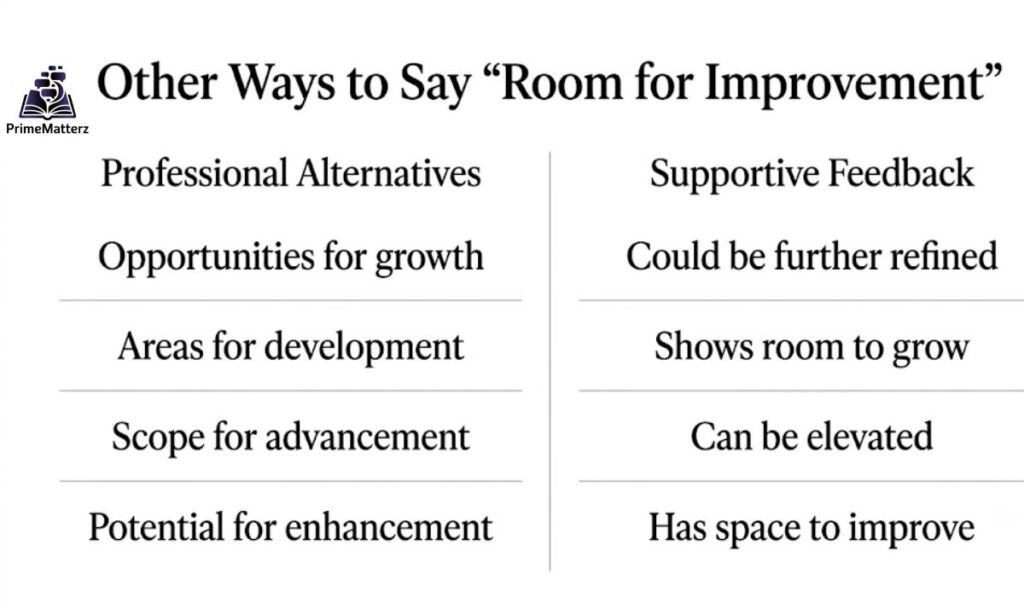
The words that you choose when giving feedback can affect what message you’re trying to get across. Using the phrase “room for improvement” too much can make people feel like you’re using a computer script.
Choosing the right words to say can help someone feel better about themselves instead of like they need to change everything. Word choice is important in giving effective feedback, in creating a good impression, and in maintaining relationships even after difficult conversations.
Workplace and Performance Review Alternatives
These phrases work well in formal settings like reviews, reports, and manager check-ins. They sound professional without feeling cold.
1. Areas for Development
Meaning: Points to specific skills or habits someone can build on. It feels forward-looking instead of critical.
Example:
- Manager: “Your presentation skills are an area for development.”
- Employee: “Got it; I’ll sign up for that workshop.”
Best Use: Formal performance reviews. Worst Use: Casual chats with a friend. Tone: Professional.
2. Opportunities for Growth
Meaning: Frames a weak spot as a chance to move forward, not a flaw to fix.
Example:
- HR Lead: “We see strong opportunities for growth in your project planning.”
- Employee: “That’s fair; I’ve felt rushed on deadlines.”
Best Use: Career development conversations. Worst Use: Quick, informal feedback between colleagues. Tone: Encouraging.
3. Scope for Advancement
Meaning: Suggests someone is close to the next level and just needs a push.
Example:
- Director: “There’s scope for advancement in how you lead meetings.”
- Team member: “I’ll work on speaking up more.”
Best Use: Promotion discussions. Worst Use: Feedback on a first draft or early attempt. Tone: Formal.
4. Margin for Improvement
Meaning: Common in data-driven feedback, where numbers or metrics show a gap.
Example:
- Analyst: “There’s a margin for improvement in our conversion rate.”
- Colleague: “Let’s test a new headline next week.”
Best Use: Reports, KPIs, and performance metrics. Worst Use: Personal or emotional conversations. Tone: Neutral.
5. Requires Further Development
Meaning: A direct, no-nonsense way to say something isn’t finished yet.
Example:
- Editor: “This section requires further development before we publish.”
- Writer: “I’ll expand the middle part.”
Best Use: Formal write-ups and academic feedback. Worst Use: Encouraging a nervous beginner. Tone: Formal.
Coaching and Encouraging Alternatives
These phrases fit mentoring, coaching, and any moment where you want honesty wrapped in support.
6. Room to Grow
Meaning: A softer, warmer version of the original phrase. It keeps things light.
Example:
- Coach: “You’ve got room to grow in your footwork.”
- Player: “I’ll practice more drills this week.”
Best Use: Sports coaching or casual mentoring. Worst Use: Formal written evaluations. Tone: Friendly.
7. Chance to Improve
Meaning: Highlights a specific, actionable moment rather than a general trait.
Example:
- Teacher: “This essay is a chance to improve your structure.”
- Student: “I’ll rewrite the intro.”
Best Use: One-on-one coaching sessions. Worst Use: High-level executive reviews. Tone: Warm.
8. Could Be Even Better
Meaning: A gentle nudge that still acknowledges the current effort was good.
Example:
- Friend: “This recipe is great; it could be even better with more spice.”
- Cook: “Noted, I’ll add chili next time.”
Best Use: Casual, supportive feedback. Worst Use: Serious business documents. Tone: Casual.
9. Untapped Potential
Meaning: Suggests someone has more ability than they’re currently showing.
Example:
- Mentor: “You have untapped potential as a public speaker.”
- Mentee: “I never thought of it that way.”
Best Use: Motivational coaching talks. Worst Use: Technical or numeric reports. Tone: Inspiring.
10. Work in Progress
Meaning: Frames the person or project as still developing, not finished or failed.
Example:
- Designer: “This layout is a work in progress.”
- Client: “Sounds good; keep me posted.”
Best Use: Ongoing projects and creative work. Worst Use: Final performance reviews needing closure. Tone: Neutral.
Academic and Formal Alternatives
These suit essays, research feedback, and structured writing where precision matters.
11. Potential for Enhancement
Meaning: A polished, academic way to point out something could be stronger.
Example:
- Professor: “Your thesis shows potential for enhancement in the second chapter.”
- Student: “I’ll revise the argument.”
Best Use: Academic papers and formal critiques. Worst Use: Everyday spoken conversation. Tone: Formal.
12. Need for Refinement
Meaning: Points to something close to done but not quite polished yet.
Example:
- Reviewer: “The methodology shows a need for refinement.”
- Researcher: “I’ll tighten the sample size section.”
Best Use: Research and technical writing. Worst Use: Quick verbal feedback. Tone: Formal.
13. Areas for Continued Development
Meaning: Suggests progress is already happening and should keep going.
Example:
- Supervisor: “Time management remains an area for continued development.”
- Employee: “I’ll block out my calendar better.”
Best Use: Follow-up reviews after past feedback. Worst Use: First-time feedback with no prior context. Tone: Professional.
14. Shows Potential for Further Development
Meaning: A longer, more formal phrase often used in written evaluations.
Example:
- Evaluator: “The proposal shows potential for further development.”
- Applicant: “I’ll add more detail to the budget section.”
Best Use: Grant applications and formal proposals. Worst Use: Short, casual emails. Tone: Formal.
15. Has Scope to Grow
Meaning: A slightly informal cousin of “scope for advancement,” used more in speech than writing.
Example:
- Manager: “This team has scope to grow in collaboration.”
- Employee: “We could try weekly check-ins.”
Best Use: Team meetings and verbal reviews. Worst Use: Legal or contractual documents. Tone: Professional.
Everyday and Casual Alternatives
Use these in daily conversations, texts, or quick check-ins where formality isn’t needed.
16. Areas to Work On
Meaning: Simple and direct. No fancy wording, just a clear point.
Example:
- Friend: “Your serve is one of your areas to work on.”
- Player: “Yeah, I know, it’s inconsistent.”
Best Use: Casual sports or hobby feedback. Worst Use: Formal HR documentation. Tone: Casual.
17. Growth Opportunities
Meaning: A flexible phrase that works in both casual and semi-formal settings.
Example:
- Team Lead: “Let’s talk about your growth opportunities this quarter.”
- Employee: “I’d love to take on more writing tasks.”
Best Use: Quarterly check-ins. Worst Use: Legal or compliance reports. Tone: Encouraging.
18. Areas Needing Attention
Meaning: A slightly more urgent tone, useful when something needs fixing soon.
Example:
- Landlord: “The roof is an area needing attention before winter.”
- Tenant: “I’ll get a quote this week.”
Best Use: Maintenance, safety, or urgent issues. Worst Use: Gentle encouragement for beginners. Tone: Neutral.
19. Space for Enhancement
Meaning: Implies fine-tuning rather than a major overhaul.
Example:
- Designer: “There’s space for enhancement in the color palette.”
- Client: “Let’s brighten it up a bit.”
Best Use: Creative and product feedback. Worst Use: Serious performance concerns. Tone: Neutral.
20. Potential for Betterment
Meaning: A less common but useful phrase for long-term, big-picture improvement.
Example:
- Consultant: “The company shows potential for betterment in customer service.”
- Owner: “Let’s start with staff training.”
Best Use: Business strategy discussions. Worst Use: Small, everyday tasks. Tone: Formal.
Frequently Asked Questions
Is “room for improvement” positive or negative?
It’s meant as constructive feedback, pointing out potential rather than failure.
What’s a polite way to say someone needs improvement?
Try phrases like “growth opportunities” or “areas for development” instead of blunt criticism.
Is “room for improvements” grammatically correct?
The standard form is singular, “room for improvement,” not “improvements.”
What should I say instead of “room for improvement” in a performance review?
Use specific phrases like “areas for development” or “potential for enhancement” tied to real examples.
How do I give feedback without sounding harsh?
Pair the phrase with a specific, actionable suggestion so the person knows exactly what to do next.
Final Thoughts
Picking the right phrase changes how feedback lands, whether you’re writing a review, coaching a friend, or leading a team. Match the tone to the setting, stay specific, and your words will build trust instead of tension. Small language changes often lead to bigger changes in how people respond.