The words you choose shape how people see you. If you say “interesting” every time, your writing and speech start to sound flat and repetitive. Using fresh words instead helps you sound clear, confident, and more engaging in emails, conversations, and even casual chats. This guide gives you 15+ other ways to say “interesting” so your communication feels natural, not repetitive.
“Interesting” describes something that grabs your attention or makes you curious. It is a simple adjective used to show that a topic, story, or person holds value or appeal.
People use it because it is easy and safe. It works in almost any sentence, but that also makes it a little boring after a while.
When Should You Use “Interesting”?
In the workplace, “interesting” is often used to react politely to an idea, even if you do not feel strongly. In emails, it works as a soft, safe way to respond to information without sounding too excited or too cold.
And In customer service, it shows you are listening without overcommitting. With friends and family, it slips into daily talk so easily that most people barely notice they are repeating it.
Is “Interesting” Professional or Polite?
“Interesting” is generally safe, but it can sound vague if overused.
Pros
Works in almost any situation
Sounds neutral and polite
Easy to use without much thought
Cons
Can feel vague or unclear
Overused in workplace conversations
Sometimes sounds like a polite way to avoid a real opinion
Grammar & Correct Usage of “Interesting”
It is grammatically correct as an adjective describing a noun or situation.
A common mistake is using it without explaining why something is interesting, which weakens the sentence.
Correct structure: “This report is interesting because it shows new sales data.”
Informal: “That’s interesting!” Formal: “I found this proposal quite interesting.”
Common Mistakes When Using “Interesting”
Overuse: Saying it in almost every reply makes your language sound repetitive.
Wrong context: Using it for serious topics like bad news can sound careless.
Tone issues: It can sound sarcastic if said with the wrong timing, like “Oh, that’s interesting” after bad news.
Grammar errors: Forgetting to follow it with a reason leaves your sentence incomplete in meaning.
How to Respond to “Interesting”
1. “Right? I thought so too.” Meaning: Agreement and shared enthusiasm. Best use: Casual chats with friends. Example: “This documentary is interesting.” → “Right? I thought so too.”
2. “What part stood out to you?” Meaning: Asking for more detail. Best use: Workplace discussions. Example: “That report was interesting.” → “What part stood out to you?”
3. “I felt the same way.” Meaning: Confirming a shared reaction. Best use: Friendly or professional settings. Example: “This idea is interesting.” → “I felt the same way.”
4. “Tell me more.” Meaning: Showing genuine curiosity. Best use: Conversations with family or coworkers. Example: “That story was interesting.” → “Tell me more.”
5. “Glad you think so!” Meaning: Light appreciation without overexplaining. Best use: Casual or semi-formal replies. Example: “Your presentation was interesting.” → “Glad you think so!”
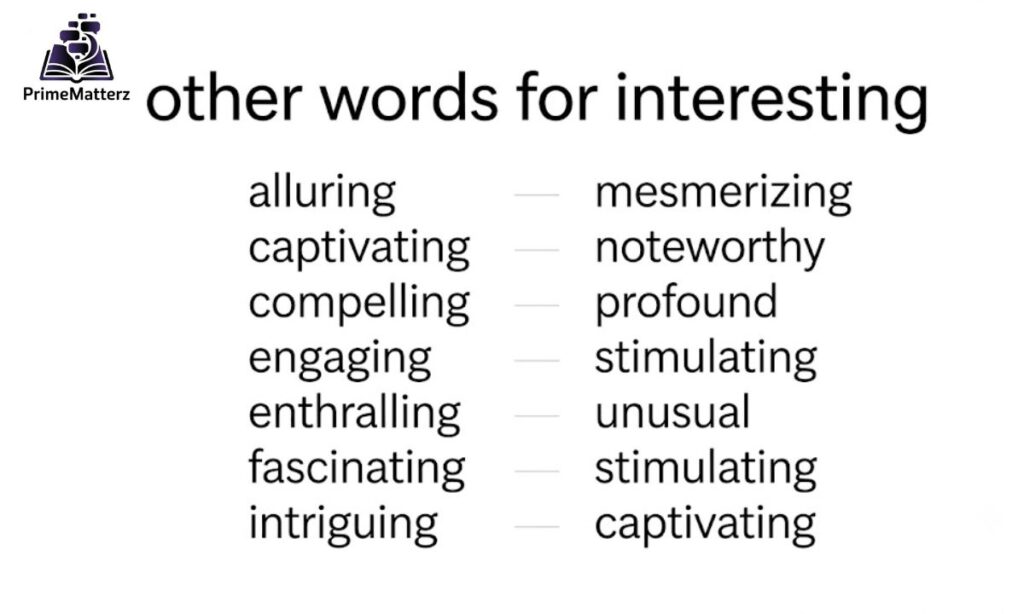
15+ Other Ways to Say “Interesting”
Intriguing
Meaning: Suggests something sparks curiosity and makes you want to know more. It feels smarter and more specific than “interesting.” Example:
Person A: “This mystery novel is so intriguing.”
Person B: “I love books that keep me guessing like that.”
Best Use: Books, mysteries, plans with hidden details. Worst Use: Casual small talk about weather. Tone: Curious, Thoughtful
Fascinating
Meaning: Shows strong interest, almost like you cannot look away. It carries more energy than “interesting.” Example:
Person A: “The history of ancient Rome is fascinating.”
Person B: “I could listen to stories like that for hours.”
Best Use: Documentaries, history, deep topics. Worst Use: Simple daily updates. Tone: Warm, Enthusiastic
Engaging
Meaning: Describes something that holds your attention actively, often through interaction or good storytelling. Example:
Person A: “Her presentation was really engaging.”
Person B: “Yeah, she kept everyone focused the whole time.”
Best Use: Presentations, classes, speeches. Worst Use: Describing a quiet, calm moment. Tone: Professional, Friendly
Compelling
Meaning: Suggests something is so strong it pulls you in and feels hard to ignore. Example:
Meaning: Suggests something so attention-holding it feels almost hypnotic. Example:
Person A: “The sunset was mesmerizing tonight.”
Person B: “I couldn’t stop watching the colors change.”
Best Use: Nature, art, visuals. Worst Use: Business writing. Tone: Poetic, Warm
Eye-Catching
Meaning: Describes something that grabs visual attention quickly, often used for design or appearance. Example:
Person A: “That poster is eye-catching.”
Person B: “Yeah, the colors really pop.”
Best Use: Marketing, design, visuals. Worst Use: Describing emotions or stories. Tone: Casual, Practical
Formal vs Informal Alternatives
Formal Alternatives
Informal Alternatives
Compelling
Cool
Thought-provoking
Neat
Engaging
Fun
Captivating
Wild
Stimulating
Crazy good
Fascinating
Awesome
Riveting
Gripping (casual use)
Intriguing
Curious
Enthralling
Amazing
Absorbing
Hooked-on-it
Which Alternative Should You Choose?
At work, use “compelling” or “engaging” to sound professional without being too casual. In emails, “thought-provoking” or “intriguing” sound polished and thoughtful.
When replying to a manager, “compelling” or “stimulating” can show you took the topic seriously. With a customer, “engaging” or “captivating” keep things polite and positive.
With friends, go casual using “amusing,” “cool,” or “fun.” And with family, simple words like “entertaining” or “curious” feel natural. On social media, “mesmerizing” or “eye-catching” work well for visuals and short captions.
Frequently Asked Questions
What is another word for interesting?
“Intriguing” or “fascinating” are common and natural alternatives.
What is a more formal synonym for interesting?
“Compelling” or “thought-provoking” sound more formal and polished.
What is a stronger word than interesting?
“Riveting” or “enthralling” carry more intensity and excitement.
What word means interesting but unusual?
“Peculiar” or “curious” both suggest something interesting because it feels odd.
Is intriguing better than interesting?
“Intriguing” feels more specific and curious, making it a stronger choice in many sentences.
Final Thoughts
Choosing the right word for “interesting” can make your writing and speech feel sharper and more genuine. Each alternative carries its own tone, from playful to formal, so picking the right one depends on your audience and intent. With these 15+ options, you now have the vocabulary to sound clear, confident, and never repetitive again.