Too frequently saying “I’m swamped” gets a little flat, both to you and to the person hearing it. Your words literally create how people respond to you when you are overloaded. Say the proper thing, and a colleague offers to help, or a buddy backs off with understanding.
Say the wrong thing, and you sound like you are making excuses. Whether you’re texting a friend, emailing your boss, or just attempting to explain why you haven’t phoned back, having a few great options up your sleeve makes you sound clearer, more confident, and more human.
“Swamped” is when you are buried with more work, chores, or responsibilities than you can easily handle. It is informal and conversational, coming from the notion of a boat getting water in faster than it can be bailed out. When someone says “I’m inundated,” they don’t imply that they have stopped working totally but that their task has become so large that they are having a hard time keeping up.
The word is good for informal and semi-informal situations. A short Slack message. A text to a friend. A check-in with a coworker. It’s less at home in professional writing such as client correspondence or a performance report, where a more measured phrase tends to hit better.
Grammar and Correct Usage of “Swamped”
“Swamped” is the past tense and past participle of the verb “swamp.” Most people use it as an adjective after a linking verb, as in “I am swamped” or “She’s been swamped all week.”
A few quick rules to keep it sounding natural:
Use ‘with’ or ‘by,’ not ‘from.’ You are overwhelmed with work or overwhelmed by deadlines. Never use “of” anything.
Pair it with a time frame if possible. Saying “I’ve been swamped since Monday” provides individuals with more helpful information than just “I’m swamped” because it tells how long the condition has lasted.
Do not overdo it in writing. If you use the word “swamped” in every other message, it loses its force. That’s why it’s nice to have alternative options in your back pocket.”
Mind your tense. Right now is “I’m busy.” “I’ve been swamped” implies a continuing stretch. “I was swamped” is something that has already passed. And if you pick the appropriate one, you won’t confuse the person you’re speaking to.
Why Word Choice Matters When You’re Overloaded
But the words you use when you’re at a loss for words do more than fill the holes in a sentence. It sets the tone for how the other person will respond. A casual “I’m slammed” to a close buddy sounds normal, but the same word to your CEO may seem reckless.
On the flip side, a cold, formal reply to a buddy can feel aloof when they were only looking for a short update. Using terms that are appropriate for the time preserves your professionalism, keeps your connections flowing smoothly, and makes sure that others genuinely understand what you are talking about instead of trying to guess.
15+ Other Ways to Say “I’m Swamped”
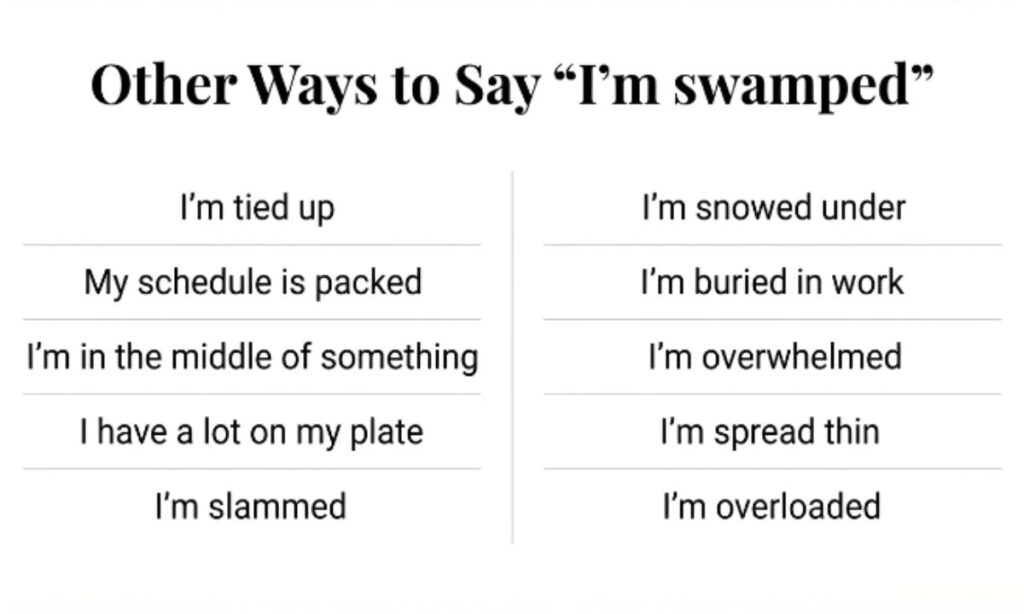
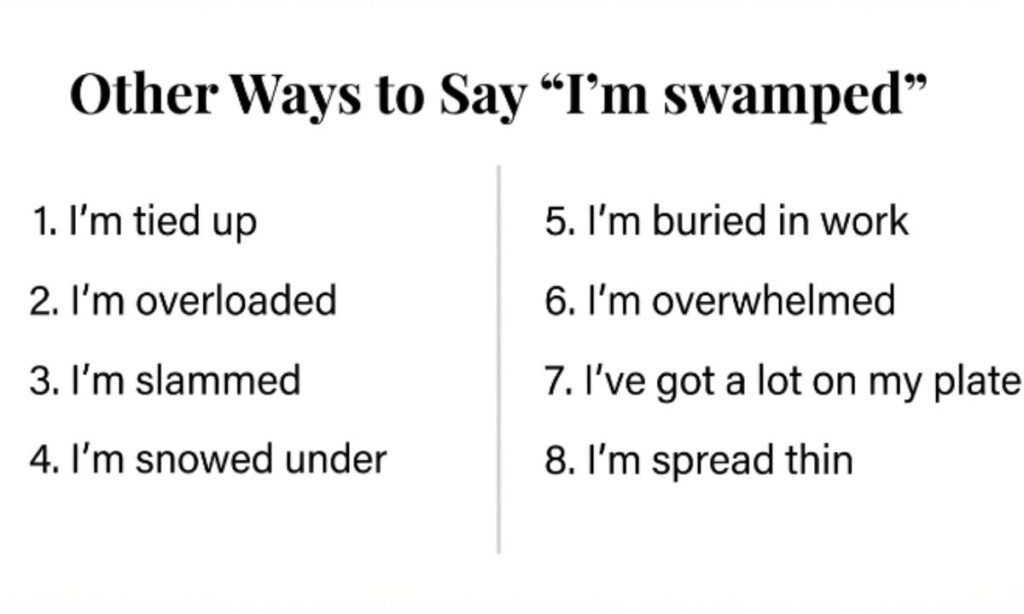
1. I’m slammed
Meaning: A high-energy way to say your schedule is packed with almost no breathing room. It carries a sense of speed and pressure, like everything hit at once.
Example:
Person A: “Can you jump on a call this afternoon?”
Person B: “I’m slammed today; can we push it to tomorrow morning?”
Best Use: Quick messages to coworkers or friends who already know your work style. Worst Use: Formal emails to clients or senior leadership. Tone: Casual, energetic. Length: Short and punchy, works well in texts or chat messages.
2. I’m buried in work
Meaning: Suggests you’re deep under a pile of tasks, almost hidden by the sheer volume. It paints a visual picture of being trapped under a workload.
Example:
Person A: “Did you get a chance to review my draft?”
Person B: “Not yet, I’m buried in work this week, but I’ll get to it Friday.”
Best Use: Explaining a delay to a colleague or manager in a semi-casual way. Worst Use: Very formal written correspondence. Tone: Neutral, slightly informal. Length: Works well as a full sentence with a bit of context.
3. I’m stretched thin
Meaning: Implies your time and energy are being pulled in too many directions at once. It focuses on the strain of juggling, not just the volume of work.
Example:
Person A: “You seem exhausted lately.”
Person B: “Yeah, I’m stretched thin between the new project and covering for Sam.”
Best Use: Talking about balancing multiple responsibilities, like work and personal life. Worst Use: Situations where you need to sound fully capable and unbothered. Tone: Honest, slightly vulnerable. Length: Best used with a short explanation of what’s stretching you.
4. I’m up to my ears
Meaning: A vivid, informal image of being almost submerged in tasks. It leans playful even while describing real pressure.
Example:
Person A: “How’s the move going?”
Person B: “I’m up to my ears in boxes, honestly.”
Best Use: Friendly, informal conversations with people you know well. Worst Use: Professional emails or client-facing communication. Tone: Casual, friendly. Length: Best as a short, conversational reply.
5. I’m snowed under
Meaning: Describes being overwhelmed as though buried beneath an avalanche of tasks. It suggests the workload arrived suddenly and heavily.
Example:
Person A: “Are you free for lunch?”
Person B: “I wish; I’m completely snowed under right now.”
Best Use: British and Commonwealth English contexts, casual to semi-formal messages. Worst Use: American formal business writing, where it can sound slightly unfamiliar. Tone: Casual, mildly dramatic. Length: Works well as a short standalone line.
6. I have my hands full
Meaning: Suggests you’re actively managing several things at once, with little capacity left for anything new. It’s often used when responsibilities, not just tasks, are piling up.
Example:
Person A: “Could you take on one more client?”
Person B: “I have my hands full right now, but check with me next month.”
Best Use: Politely declining new requests without sounding dismissive. Worst Use: Situations where you need to sound highly available or eager. Tone: Polite, measured. Length: Pairs well with a suggested alternative timeline.
7. I’m overwhelmed
Meaning: A more direct, emotionally honest way to describe feeling like the workload has exceeded what you can manage well. It carries more emotional weight than most alternatives.
Example:
Person A: “You okay? You seem off today.”
Person B: “Honestly, I’m a bit overwhelmed with everything going on.”
Best Use: Personal conversations, check-ins with close colleagues, or moments you need real support. Worst Use: Quick professional updates where you just need to explain a delay. Tone: Honest, vulnerable. Length: Best paired with a brief reason, not left alone.
8. I’m at full capacity
Meaning: A professional way to say you literally cannot take on anything more without sacrificing quality elsewhere. It sounds measured rather than frantic.
Example:
Person A: “Can you fit in one more project this sprint?”
Person B: “I’m at full capacity right now, but I can revisit next sprint.”
Best Use: Workplace conversations about workload and project planning. Worst Use: Casual texts to friends, where it can sound stiff. Tone: Professional, calm. Length: Clean and short, ideal for status updates.
9. I’m juggling a lot right now
Meaning: Focuses on the number of different tasks or roles you’re managing simultaneously, rather than the sheer volume. It highlights the mental effort of switching between things.
Example:
Person A: “How’s the new role treating you?”
Person B: “I’m juggling a lot right now, but slowly finding a rhythm.”
Best Use: Explaining a busy period that involves variety, not just quantity. Worst Use: Very formal reports or written status updates. Tone: Warm, conversational. Length: Works best with a bit of added detail.
10. I’m drowning in tasks
Meaning: A strong, urgent phrase suggesting you’re barely keeping your head above water. It communicates real strain, sometimes bordering on distress.
Example:
Person A: “How’s your week been?”
Person B: “Rough. I’m drowning in tasks and haven’t had a real break.”
Best Use: Talking to someone close who can offer support or perspective. Worst Use: Client emails or anywhere you need to project control. Tone: Casual, urgent. Length: Best kept short since the phrase itself carries a lot of weight.
11. My plate is full
Meaning: A classic, widely understood way to say you already have as much as you can take on. It’s neutral enough to work in most settings.
Example:
Person A: “Would you be able to help organize the event?”
Person B: “My plate is pretty full at the moment, but ask me again next quarter.”
Best Use: Turning down requests politely, in both work and personal settings. Worst Use: Situations where you need to sound highly enthusiastic and available. Tone: Neutral, polite. Length: Simple and versatile, works alone or with added context.
12. I’m running on empty
Meaning: Less about volume of work and more about your energy levels being drained by it. It signals burnout risk more than task overload.
Example:
Person A: “Want to grab drinks after work?”
Person B: “I’m running on empty, I think I just need to go home and rest.”
Best Use: Personal conversations about exhaustion, not just busyness. Worst Use: Professional emails, where it can sound too personal. Tone: Honest, tired. Length: Works well as a short, direct statement.
13. I’m crunched for time
Meaning: Zeroes in on time pressure specifically, rather than the volume of tasks. Useful when the deadline, not the workload itself, is the real issue.
Example:
Person A: “Can we chat for thirty minutes?”
Person B: “I’m crunched for time today; can we do fifteen instead?”
Best Use: Scheduling conversations where time is the main constraint. Worst Use: Explaining a broader sense of being overwhelmed beyond just today. Tone: Neutral, practical. Length: Short and direct, best for scheduling contexts.
14. I’m underwater
Meaning: A workplace-common phrase meaning you’re behind and struggling to catch up, almost like the work has submerged you entirely.
Example:
Person A: “How’s the backlog looking?”
Person B: “Honestly, I’m underwater. I need another set of hands.”
Best Use: Tech and business settings, especially when discussing backlogs or deadlines. Worst Use: Very casual personal texts, where it can sound like workplace jargon. Tone: Professional, candid. Length: Works well with a request for help attached.
15. I have a lot on my plate
Meaning: A slightly longer, softer version of “my plate is full.” It leans more descriptive and often opens the door to explaining what exactly is going on.
Example:
Person A: “You’ve seemed distracted lately.”
Person B: “Yeah, I have a lot on my plate between work and family stuff.”
Best Use: Personal check-ins where you want to explain without going into full detail. Worst Use: Quick professional replies where brevity matters more. Tone: Warm, reflective. Length: Works best with a short follow-up about what’s going on.
16. I’m maxed out
Meaning: Suggests you’ve hit your absolute limit and have nothing left to give, whether in time, energy, or attention.
Example:
Person A: “Can you squeeze in one more favor?”
Person B: “I’m maxed out right now, sorry; ask me next week.”
Best Use: Setting boundaries clearly and firmly, at work or in personal life. Worst Use: Formal written communication, where it can sound blunt. Tone: Direct, firm. Length: Short and effective on its own.
17. I’m in over my head
Meaning: Implies the workload has exceeded not just your time but possibly your ability to manage it well right now. It carries a note of concern.
Example:
Person A: “How’s the new project going?”
Person B: “Honestly, I think I’m in over my head. I might need to loop in the team.”
Best Use: Admitting you need help or support, especially with a manager or mentor. Worst Use: Situations where you need to project full confidence. Tone: Honest, vulnerable. Length: Best paired with a next step, like asking for help.
18. I’m pressed for time
Meaning: A polished, professional way to say time is tight without sounding dramatic. It works well in business writing.
Example:
Person A: “Do you have a moment to review this?”
Person B: “I’m pressed for time this afternoon; could we look at it tomorrow?”
Best Use: Professional emails and meetings, especially with clients. Worst Use: Casual chats with close friends, where it can sound overly formal. Tone: Formal, polite. Length: Clean and brief, ideal for scheduling replies.
19. I’m bogged down
Meaning: Suggests you’re stuck moving slowly through tasks, like wading through mud. It implies frustration with the pace, not just the amount.
Example:
Person A: “Any update on the report?”
Person B: “I’m a bit bogged down in the details, should have it by Thursday.”
Best Use: Explaining a delay caused by complexity, not just volume. Worst Use: When the issue is truly about having too much, not moving too slowly. Tone: Neutral, practical. Length: Works well with a specific reason attached.
20. I’m operating at capacity
Meaning: A formal, almost technical way to describe having no room left for additional work. Common in business and project management language.
Example:
Person A: “Can your team take on this new client?”
Person B: “We’re operating at capacity this quarter, but let’s revisit in Q3.”
Best Use: Formal business communication, project planning, resourcing discussions. Worst Use: Everyday personal conversations, where it can sound overly corporate. Tone: Formal, professional. Length: Works best in written business communication.
Frequently Asked Questions
Is it unprofessional to say “I’m swamped” at work?
It’s not unprofessional exactly, but it’s informal, so in emails to clients or senior leadership, a phrase like “I’m at full capacity” or “operating at capacity” tends to read as more polished.
What’s a polite way to say I’m too busy to help someone?
“My plate is full right now” or “I have my hands full at the moment” both decline politely without sounding dismissive.
What can I say instead of “I’m swamped” in a formal email?
Try “I’m currently at full capacity” or “I’m pressed for time this week,” both of which sound measured and professional.
Does “swamped” mean the same thing as “overwhelmed”?
They’re close, but “swamped” leans more toward having too much to do, while “overwhelmed” often includes an emotional or mental strain on top of the workload.
How do I say I’m swamped without sounding like I’m making excuses?
Pair the phrase with a clear timeline, like “I’m slammed today, but I’ll have this to you by Thursday,” so it reads as a plan rather than a dodge.
Final Thoughts
Feeling overloaded is universal, but how you talk about it shapes how people respond to you. Keep a few of these phrases handy, match the tone to the situation, and you’ll sound clearer and more in control, even on your busiest days.