You have typed “don’t” a hundred times today without thinking. Then you receive an official email and all of a sudden “do not” seems like the safer decision. When each one genuinely belongs. Here’s what is really going on.
What “Do Not” and “Don’t” Actually Mean
“Don’t” is just “do not” squashed into one word. Both employ ” do ” as an auxiliary verb in order to make a negative statement in the present tense . Both essentially imply the exact same thing .
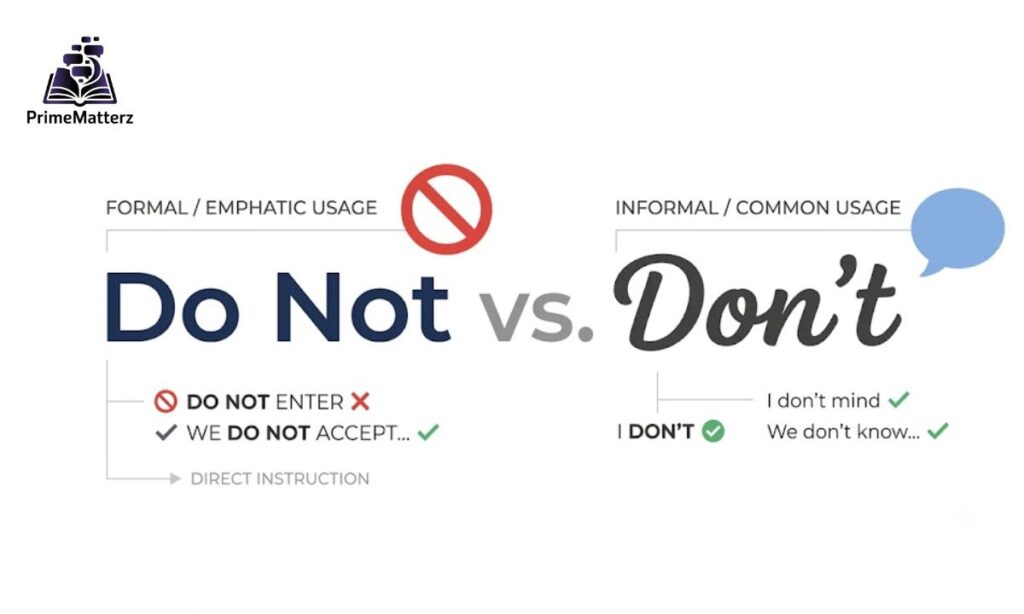
The difference is not really in meaning. Its tone. “Do not” is more formal and, occasionally, stronger. “Don’t” sounds calm and natural, the way people actually talk.
Formal vs. Informal: The Style Difference
This is where most of the confusion starts, so it helps to see the two side by side.
When “Do Not” Sounds More Appropriate
“Do not” shows up in formal writing, official notices, and legal or technical documents. It’s also the go-to choice for firm instructions and warnings.
- Do not enter.
- Do not smoke.
- Do not share your password.
You’ll also hear it in speech when someone wants to sound serious. “I do not agree” carries more weight than “I don’t agree,” even though the meaning is identical.
When “Don’t” Fits Everyday English
“Don’t” is what people use in conversation, texts, emails, and casual writing. It’s the contraction your brain reaches for by default.
- We don’t know yet.
- They don’t care about the outcome.
- I don’t have time today.
If you’re writing anything meant to sound like a real person talking, “don’t” is almost always the natural pick.
| Context | Preferred Form | Example |
| Legal or technical writing | Do not | Do not exceed the recommended dose. |
| Safety signs | Do not | Do not touch the equipment. |
| Casual conversation | Don’t | I don’t think that’s right. |
| Everyday emails | Don’t | We don’t need to reschedule. |
Grammar Basics: How These Negatives Work
Both forms follow the same underlying structure, and that structure doesn’t change based on formality.
The Present Simple Negative Pattern
The pattern is: subject + do/does + not + base verb. The main verb never changes form here, no matter how the sentence is phrased.
- I do not like it. / I don’t like it.
- She does not agree. / She doesn’t agree.
Notice the verb stays as “like” and “agree,” not “likes” or “agrees.” The helper verb carries all the grammatical weight.
Don’t vs. Doesn’t: Getting Agreement Right
This is the single most common mistake people make with this pair, and it’s an easy one to fix once you know the rule.
- Use “don’t” with I, you, we, they, and plural nouns.
- Use “doesn’t” with he, she, it, and singular nouns.
“He don’t like it” is wrong. “He doesn’t like it” is correct. If you’re ever unsure, expand the contraction in your head. “He does not like it” sounds obviously right, and that’s your answer.
Read Must: There Has Been or There Have Been: Correct Usage with Examples
Commands and Prohibitions: Do Not vs. Don’t in Action
Negative commands are where the tone gap between these two really shows up.
Strong Warnings and Official Signs
“Do not” is the standard choice for signs, manuals, and anything meant to sound official or non-negotiable.
- Do not feed the animals.
- Do not bend.
- Do not disclose confidential information.
That formality is intentional. A sign that says “don’t touch” feels almost friendly by comparison, and safety instructions usually want the opposite effect.
Everyday Spoken Commands
In regular speech, “don’t” takes over almost completely.
- Don’t go.
- Don’t tell anyone.
- Don’t forget to call me.
Compare “do not forget” with “don’t forget.” The first sounds like a warning. The second sounds like a friendly nudge. Same words, very different feel.
Common Mistakes to Watch For
A couple of errors show up constantly, especially with learners, but they’re worth double-checking even if English is your first language.
Using “Don’t” with He, She, or It
This is the classic slip: “He don’t like it” instead of “He doesn’t like it.” The fix is simple. Mentally expand the contraction and see if it still sounds right.
- Wrong: She don’t know the answer.
- Right: She doesn’t know the answer.
Adding an Extra -s to the Main Verb
Once “doesn’t” is in the sentence, the main verb should never carry an -s. The helper verb already handles that job.
- Wrong: He doesn’t goes to the gym.
- Right: He doesn’t go to the gym.
Tone and Emphasis: Choosing the Right One
Beyond formality, “do not” can also add emphasis in a way “don’t” simply can’t match.
How “Do Not” Adds Weight
“I do not agree” hits harder than “I don’t agree.” Splitting the words apart gives each one more room to land, which is why people reach for it during arguments or serious statements.
Say it out loud and you’ll hear it: stressing “do” in “I do not want that” makes the sentence feel almost like a warning.
Contractions Are Standard, Not Sloppy
Some writers avoid contractions out of habit, thinking they look unprofessional. That’s outdated advice for most modern writing. “Don’t” is completely standard in spoken English and in the vast majority of written contexts, aside from strict legal or academic prose.
If you’re writing to sound human, don’t be afraid to use “don’t.”
Real Examples in Context
Seeing both forms in actual use makes the tone difference click faster than any rule ever will.
Conversational Examples
- I don’t know what happened.
- We don’t have time for that today.
- You don’t understand what I meant.
Formal Writing and Signage Examples
- Do not bend before mailing.
- Do not share your login credentials.
- Do not operate this equipment without training.
Quick Reference Checklist
Keep this shortlist handy the next time you’re unsure which one to use.
- Formal, legal, or official tone? Use “do not.”
- Casual or conversational tone? Use “don’t.”
- Subject is I, you, we, they, or a plural noun? Use “don’t.”
- Subject is he, she, it, or a singular noun? Use “doesn’t,” never “don’t.”
- Want extra emphasis or seriousness? “Do not” does that job better.
Frequently Asked Questions
Is “don’t” more informal than “do not”?
Yes, “don’t” is the natural choice for everyday speech and casual writing, while “do not” leans formal.
Should I use “do not” or “don’t” in formal writing?
Use “do not” for formal, legal, or official writing where a serious tone matters.
What’s the grammar rule for “don’t” and “doesn’t”?
“Don’t” pairs with I, you, we, they, and plural nouns, while “doesn’t” pairs with he, she, it, and singular nouns.
Why is “he don’t” wrong but “he doesn’t” correct?
Because “he” is third-person singular, and that subject requires “does not,” not “do not.”
Does “do not” mean the same as “don’t”?
Yes, they carry identical meaning; the only real difference is tone and formality.
Conclusion
“Do not” and “don’t” mean precisely the same thing, but they don’t sound the same. That’s the whole point of choosing between the two.
Match the form to your situation Formal writing gets “do not.” Everyday speech gets “don’t.” Double-check your subject before choosing “don’t” or “doesn’t.” After you get used to it , this grammar choice becomes second nature .