15+ Other Ways to Say “Would Be Greatly Appreciated”
Hayat
July 20, 2026No comments
The words you use define how people read your tone, not just your message. It can get a little stiff and even disingenuous to say “would be appreciated” in every email after a while. The right alternative builds trust, shows confidence, and makes your request feel personal and not copy-pasted. This guide walks you through 20 natural ways to say it, so your writing sounds like you, not a template.
“Would be greatly appreciated” is a nice way to ask for help and show appreciation before it even happens. That takes the sharpness off the request.
Suppose your coworker needs a report reviewed by Friday. Instead of writing “Review this by Friday,” they might write, “A review by Friday would be greatly appreciated.” Same request but sounds like a favor, not a command.
Grammar and Correct Usage of “Would Be Greatly Appreciated”
Passive Voice and Why It Works Here
This phrase uses passive voice on purpose. “Your help would be appreciated” removes the direct “I” and shifts focus onto the action itself. That small shift softens the tone and keeps the sentence from sounding self-centered.
“Would” vs. “Will”
“Would” signals politeness and hypothetical framing, which is why it sounds gentler than “will.” “Your help will be appreciated” sounds almost like a promise or a warning. Would” keeps things conditional and courteous.
Placement in a Sentence
This phrase usually works best at the end of a request, right after you’ve explained what you need. Leading with it can confuse the reader before they know what you’re actually asking for.
Pairing With “If”
Adding “if you could” before the request makes it even softer. If you could send the file by noon, it would be greatly appreciated” gives the other person a clear, low-pressure ask.
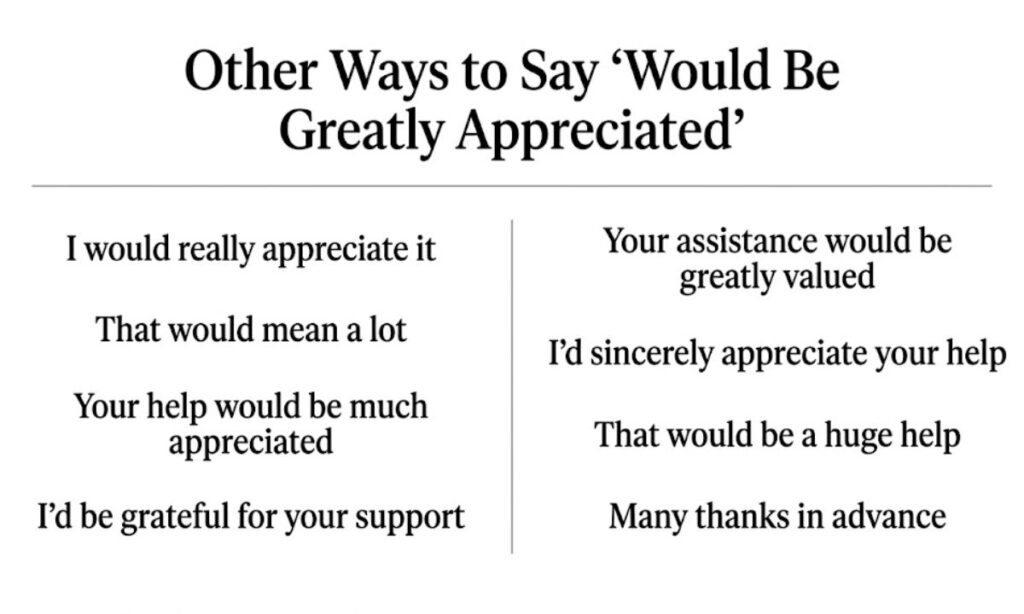
15+ Alternatives to “Would Be Greatly Appreciated”
1. I would sincerely appreciate it
Meaning: This version adds emotional weight through the word “sincerely.” It signals that the request matters to you personally, not just professionally.
Example:
Person A: “Could you send over the contract draft today?”
Person B: “I would sincerely appreciate it if you could.”
Best Use: Formal emails where you want warmth without sounding casual. Worst Use: Quick internal chats between close colleagues. Tone: Formal, Sincere
2. Your assistance would be highly valued
Meaning: This phrase shifts focus onto the other person’s contribution, making the request feel like a compliment rather than a burden.
Example:
Person A: “We’re short-staffed this week.”
Person B: “Your assistance would be highly valued if you have time.”
Best Use: Professional requests to senior staff or clients. Worst Use: Texting a friend for a small favor. Tone: Formal, Respectful
3. Your cooperation would be appreciated
Meaning: This works well for group requests, especially when multiple people need to follow the same instruction.
Example:
Person A: “We’re updating the office schedule next week.”
Person B: “Your cooperation would be appreciated during the transition.”
Best Use: Company-wide announcements or policy updates. Worst Use: One-on-one personal favors. Tone: Formal, Neutral
4. Your help would be greatly valued
Meaning: This puts direct emphasis on the person’s specific effort, making it feel more personal than “cooperation.”
Example:
Person A: “I’m stuck on this budget spreadsheet.”
Person B: “Your help would be greatly valued right now.”
Best Use: Asking a specific colleague for hands-on support. Worst Use: Mass emails to a large group. Tone: Warm, Professional
5. That would be much appreciated
Meaning: A shorter, slightly more casual version that still keeps things polite. It works well as a closing line after a request.
Example:
Person A: “Can you double-check these numbers before I send them out?”
Person B: “That would be much appreciated, thanks.”
Best Use: Everyday work emails and quick requests. Worst Use: Very formal letters or legal correspondence. Tone: Neutral, Friendly
6. I would appreciate it
Meaning: A direct, simple way to express gratitude without extra formality. It gets straight to the point.
Example:
Person A: “I’ll have the invoice ready by tomorrow.”
Person B: “I would appreciate it, thank you.”
Best Use: Fast-paced work conversations or short replies. Worst Use: Situations needing extra warmth, like condolences or big favors. Tone: Neutral, Direct
7. It would help a lot
Meaning: This phrase is honest and practical. It tells the other person their action has real impact, not just polite value.
Example:
Person A: “Do you want me to proofread this before you submit it?”
Person B: “Yes, it would help a lot.”
Best Use: Casual work settings or peer-to-peer requests. Worst Use: Formal client communication. Tone: Casual, Practical
8. I’d be grateful for your help
Meaning: This version leans into gratitude directly, making the requester’s appreciation the focus of the sentence.
Example:
Person A: “I can walk you through the new system if you’d like.”
Person B: “I’d be grateful for your help with that.”
Best Use: Asking mentors, teachers, or senior colleagues for guidance. Worst Use: Quick casual texts. Tone: Respectful, Warm
9. It would mean a lot to me
Meaning: This is one of the most personal options on the list. It connects the request to your emotions, not just the outcome.
Example:
Person A: “Do you want me to come to your presentation?”
Person B: “It would mean a lot to me if you could.”
Best Use: Personal requests to friends or family. Worst Use: Formal business emails. Tone: Warm, Personal
10. I’d really appreciate that
Meaning: A friendly, natural way to accept help or ask for it, often used in spoken conversation.
Example:
Person A: “Want me to grab your dry cleaning while I’m out?”
Person B: “I’d really appreciate that, thanks.”
Best Use: Everyday conversations with friends or coworkers. Worst Use: Formal written correspondence. Tone: Casual, Friendly
11. That would be a huge help
Meaning: This phrase emphasizes scale. It tells someone their help matters more than a small favor would.
Example:
Person A: “I can cover your shift on Saturday.”
Person B: “That would be a huge help, seriously.”
Best Use: Situations involving real effort or time from the other person. Worst Use: Minor, low-effort requests. Tone: Casual, Enthusiastic
12. I’d be thankful for your support
Meaning: This version works well when the request involves ongoing help, not just a one-time task.
Example:
Person A: “I can check in with you weekly during the project.”
Person B: “I’d be thankful for your support throughout it.”
Best Use: Long-term collaborations or mentorships. Worst Use: One-off small requests. Tone: Warm, Professional
13. It would be a great favor
Meaning: This phrase openly names the request as a favor, which works well when you know you’re asking for something extra.
Example:
Person A: “I could pick up the packages on my way home.”
Person B: “It would be a great favor, thank you.”
Best Use: Personal requests between friends or neighbors. Worst Use: Corporate or client-facing writing. Tone: Friendly, Sincere
14. I’d owe you one
Meaning: This is a light, informal way to acknowledge a favor, often used between people who know each other well.
Example:
Person A: “I’ll cover for you at the front desk.”
Person B: “I’d owe you one, for real.”
Best Use: Casual conversations with close coworkers or friends. Worst Use: Formal emails or first-time interactions. Tone: Casual, Playful
15. Your kindness would not go unnoticed
Meaning: This phrase acknowledges the emotional generosity behind someone’s help, not just the practical result.
Example:
Person A: “I can stay late to help you finish this.”
Person B: “Your kindness would not go unnoticed.”
Best Use: Thank-you notes or heartfelt requests. Worst Use: Quick, transactional work messages. Tone: Warm, Sincere
16. I’d be in your debt
Meaning: A slightly dramatic but genuine way to show how much a favor matters, often used with a light tone.
Example:
Person A: “I can lend you my notes from today’s class.”
Person B: “I’d be in your debt, thank you so much.”
Best Use: Informal favors among classmates or friends. Worst Use: Professional client emails. Tone: Casual, Expressive
17. It would ease my mind
Meaning: This version focuses on emotional relief, useful when the request is tied to stress or worry.
Example:
Person A: “I’ll confirm the flight details tonight.”
Person B: “It would ease my mind, thank you.”
Best Use: Situations involving anxiety, deadlines, or uncertainty. Worst Use: Lighthearted or low-stakes requests. Tone: Warm, Honest
18. Any help would be wonderful
Meaning: This phrase keeps things open-ended, showing you’ll welcome even small contributions, not just a full solution.
Example:
Person A: “I can only help for an hour, is that okay?”
Person B: “Any help would be wonderful, thank you.”
Best Use: Volunteer requests or group projects. Worst Use: Situations needing a specific, guaranteed outcome. Tone: Friendly, Encouraging
19. I’d value your input greatly
Meaning: This works best when you’re asking for opinions or feedback rather than direct action.
Example:
Person A: “I can review your proposal this weekend.”
Person B: “I’d value your input greatly, thank you.”
Best Use: Requesting feedback from mentors, editors, or managers. Worst Use: Simple task-based requests. Tone: Professional, Respectful
20. Thanks in advance for your help
Meaning: This closes a request by assuming a “yes,” which can feel efficient, though it works best when the ask is reasonable.
Example:
Person A: “Can you send the updated file by end of day?”
Person B: “Thanks in advance for your help.”
Best Use: Quick, low-pressure work requests. Worst Use: Big favors, since assuming agreement can feel presumptuous. Tone: Neutral, Efficient
Frequently Asked Questions
Is “would be greatly appreciated” grammatically correct?
Yes, it’s a correct and commonly used passive construction in both spoken and written English.
Is it too formal for everyday emails?
It fits most professional emails fine, but casual alternatives like “that would help a lot” work better for informal messages.
What’s the most polite alternative on this list?
“Your assistance would be highly valued” tends to sound the most formal and respectful.
Can I use these phrases in text messages?
Casual options like “I’d owe you one” or “I’d really appreciate that” fit texts far better than formal alternatives.
Does repeating this phrase too often sound bad?
Yes, repeating it in the same email or conversation can sound robotic, so switching between alternatives keeps your writing natural.
Final Thoughts
Small word choices carry more weight than most people realize. Swapping out one repeated phrase for the right alternative makes your requests feel more genuine and your relationships feel more human. Use this list as a starting point, then pick whatever sounds most like you.