The words you choose to express gratitude shape the impression you make on others. “Thanks for these” sounds good, but it can get boring. To sound more considerate, competent, and courteous, you need to have several alternative phrases at your disposal.
“Thanks for these” is a brief way of saying that someone is grateful for something that you sent them. It could be documents, files, gifts, and more. Being highly informal, this should be used in casual settings rather than professional writing.
It is used because it is straightforward. However, being simple does not mean it is appropriate for all scenarios. You would not say it in an email to a client the same way you would say it in a text to a coworker.
Grammar and Correct Usage of “Thanks for These”
Grammatically, “Thanks for these” is informal. “Thanks” is short for “thank you,” and “these” are plural objects you received. If you are talking about one single item, you would use “this” instead.
In formal writing, replace “thanks” with “thank you.” So “Thank you for these” sounds more polished than “Thanks for these.” Either way, the structure is the same: a gratitude word plus a reference to what was given.
Why Word Choice Matters in Everyday Communication
The phrase you choose sends a signal. It tells the other person how much effort you’re putting into the message. A flat “thanks” can feel rushed, while a specific phrase shows you actually noticed what they did.
This matters more in professional settings. Clients and managers remember how you communicate, not just what you say. Small phrasing choices build trust over time.
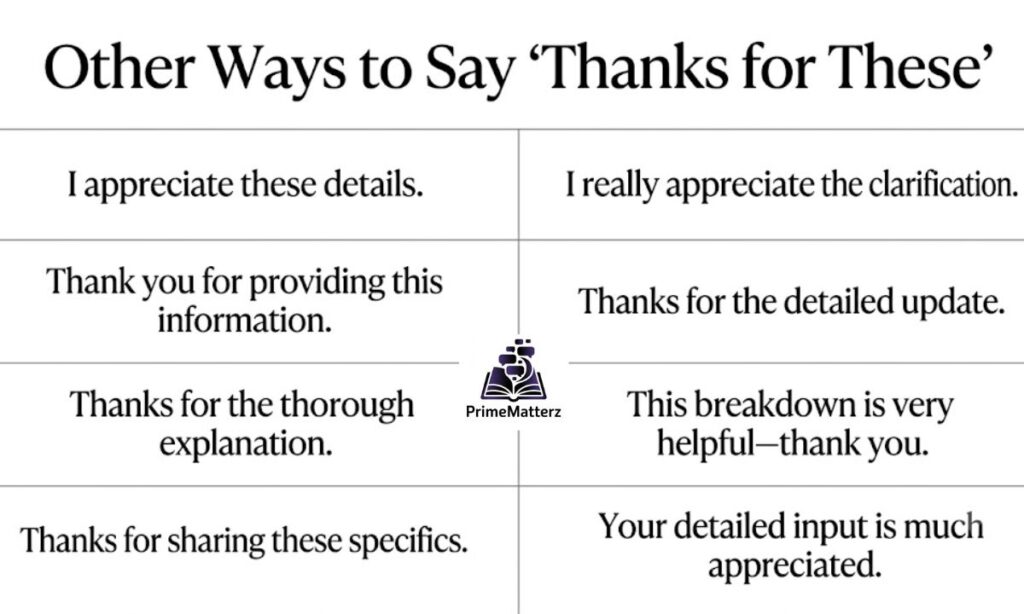
15+ Alternative Ways to Say “Thanks for These”
1. I Appreciate These Details
Meaning: This phrase shows genuine gratitude for information someone shared. It signals that you value the effort behind the details, not just the details themselves.
Example:
Person A: “Here’s the full report you asked for.”
Person B: “I appreciate these details; this will save me hours.”
Best Use: Business emails and project updates. Worst Use: Casual texts between friends. Tone: Professional
2. Thank You for Providing This Information
Meaning: A formal way to acknowledge received data or facts. It works well when you need to sound polished and precise.
Example:
Person A: “Attached is the client’s contract history.”
Person B: “Thank you for providing this information ahead of the meeting.”
Best Use: Client-facing emails. Worst Use: Group chats or informal messages. Tone: Formal
3. Thank You for Sharing These Specifics
Meaning: This highlights that someone gave you precise, useful detail rather than a vague summary. It rewards thoroughness.
Example:
Person A: “Here’s the exact timeline for each phase.”
Person B: “Thank you for sharing these specifics; it clears up my confusion.”
Best Use: Technical or project discussions. Worst Use: Quick social exchanges. Tone: Professional
4. Thank you for the comprehensive explanation.
Meaning: Use this when someone gave you a full, detailed answer instead of a short one. It acknowledges the extra effort they put in.
Example:
Person A: “Let me walk you through the whole process step by step.”
Person B: “Thank you for the comprehensive explanation; everything makes sense now.”
Best Use: After a detailed briefing or training session. Worst Use: Short factual replies. Tone: Formal
5. Thank You for the Clarification
Meaning: This works when someone clears up confusion or corrects a misunderstanding. It shows you value accuracy.
Example:
Person A: “Just to be clear, the deadline is Friday, not Monday.”
Person B: “Thank you for the clarification; I’ll adjust my schedule.”
Best Use: Emails and meetings where instructions changed. Worst Use: Casual chats without any confusion involved. Tone: Neutral
6. Thank You for Outlining Everything So Clearly
Meaning: This praises someone’s ability to organize information in a way that’s easy to follow. It’s more specific than a generic thanks.
Example:
Person A: “Here’s a numbered list of what we need from you.”
Person B: “Thank you for outlining everything so clearly; this makes my job easier.”
Best Use: Project instructions or onboarding documents. Worst Use: One-line responses. Tone: Warm
7. I Sincerely Appreciate the Thorough Overview
Meaning: A stronger, more heartfelt version of thanks, best for situations where someone went above and beyond. It carries extra weight.
Example:
Person A: “I put together a full summary of the quarter’s results.”
Person B: “I sincerely appreciate the thorough overview; it’s exactly what the board needs.”
Best Use: Executive or high-stakes communication. Worst Use: Everyday small talk. Tone: Formal
8. I’m Grateful for This Detailed Breakdown
Meaning: This phrase leans emotional. It shows real appreciation, not just polite acknowledgment.
Example:
Person A: “I broke the budget down line by line for you.”
Person B: “I’m grateful for this detailed breakdown; it answers all my questions.”
Best Use: Financial or technical reports. Worst Use: Quick casual replies. Tone: Warm
9. Many Thanks for the detailed update.
Meaning: A slightly British-leaning, polished phrase good for professional updates. It sounds courteous without being stiff.
Example:
Person A: “Here’s where we stand on the project as of today.”
Person B: “Many thanks for the detailed update; I’ll share this with the team.”
Best Use: Status update emails. Worst Use: Personal conversations. Tone: Professional
10. Your Detailed Input Is Much Appreciated
Meaning: This shifts focus to the person’s effort rather than the information itself. It feels personal and respectful.
Example:
Person A: “I added my notes throughout the document.”
Person B: “Your detailed input is much appreciated; it really strengthens the proposal.”
Best Use: Collaborative work and peer reviews. Worst Use: One-word acknowledgments. Tone: Respectful
11. Thanks for All the Details
Meaning: A neutral, everyday phrase that works in most workplace settings. It’s simple without sounding careless.
Example:
Person A: “Here’s everything you asked for in one email.”
Person B: “Thanks for all the details; I’ll get started right away.”
Best Use: Regular work emails. Worst Use: Formal client proposals. Tone: Neutral
12. Thanks for the Clear Explanation
Meaning: This works when someone simplifies something complicated. It shows you value clarity over complexity.
Example:
Person A: “Basically, we just need your signature on page three.”
Person B: “Thanks for the clear explanation; that saves me a phone call.”
Best Use: Quick clarifications at work. Worst Use: Long, formal reports. Tone: Semi-formal
13. Thanks for Sending This Over
Meaning: A simple, direct way to confirm you received something. It’s practical and to the point.
Example:
Person A: “Just sent the invoice to your inbox.”
Person B: “Thanks for sending this over; I’ll process it today.”
Best Use: Everyday email replies. Worst Use: Emotional or high-stakes moments. Tone: Casual
14. I Appreciate You Walking Me Through This
Meaning: This acknowledges someone’s patience, not just the information. It’s ideal after a live explanation or call.
Example:
Person A: “Let’s go over the steps together on this call.”
Person B: “I appreciate you walking me through this; it makes so much more sense now.”
Best Use: After training sessions or calls. Worst Use: Written-only exchanges. Tone: Warm
15. This Is Really Helpful, Thanks for Breaking It Down
Meaning: A friendly, upbeat way to thank someone for simplifying something complex. It feels genuine and conversational.
Example:
Person A: “Here’s a simple version of the contract terms.”
Person B: “This is really helpful; thanks for breaking it down.”
Best Use: Team chats and informal work messages. Worst Use: Formal legal correspondence. Tone: Friendly
16. Thanks for All the Info!
Meaning: A casual, upbeat phrase perfect for quick digital messages. The exclamation adds energy and warmth.
Example:
Person A: “Sent you everything you need for the trip!”
Person B: “Thanks for all the info! Can’t wait now.”
Best Use: Texts and casual chats. Worst Use: Business emails. Tone: Casual
17. Appreciate You Spelling That Out
Meaning: This works when someone explains something in very plain terms. It has a relaxed, friendly feel.
Example:
Person A: “So basically, just fill in the yellow boxes.”
Person B: “Appreciate you spelling that out; I was totally lost before.”
Best Use: Informal team conversations. Worst Use: Client-facing communication. Tone: Casual
18. That Clears Things Up, Thanks!
Meaning: A quick, natural way to confirm confusion is resolved. It sounds relieved and genuine.
Example:
Person A: “The meeting moved to 3 PM, not 2.”
Person B: “That clears things up, thanks!”
Best Use: Quick chats or group messages. Worst Use: Formal reports. Tone: Casual
19. Thank You for Your Continued Support and Guidance
Meaning: This goes beyond a single exchange and thanks someone for ongoing help. It builds long-term goodwill.
Example:
Person A: “Let me know if you need anything else moving forward.”
Person B: “Thank you for your continued support and guidance; it means a lot.”
Best Use: Mentors, managers, or long-term collaborators. Worst Use: One-time small requests. Tone: Respectful
20. Your Support and Detailed Input Mean a Lot
Meaning: This phrase combines gratitude for both help and information. It feels personal and sincere.
Example:
Person A: “I reviewed your draft and added suggestions throughout.”
Person B: “Your support and detailed input mean a lot. Thank you for taking the time.”
Best Use: Close working relationships. Worst Use: First-time or formal introductions. Tone: Warm
Frequently Asked Questions
What can I say instead of “thanks for these”?
You can say “I appreciate these details” or “thank you for sharing this information.”
Is “thanks for these” grammatically correct?
Yes, it’s correct and informal, best suited for casual conversation.
What’s a formal way to say “thanks for these details”?
“Thank you for providing this information” works well in formal emails.
How do I thank someone for detailed information at work?
Try “thank you for the comprehensive explanation” or “I’m grateful for this detailed breakdown.”
Can “thanks for these” sound rude?
No, but it can sound rushed if used without any added warmth or context.
Final Thoughts
The right way to say thank you is essential to sound more professional or sincere in any conversation. With this list of alternatives, you will never have to say the same old phrase again.