The word “that” is one of the most common words in the English language. It is simple, familiar, and easy to overuse. Most writers are not even aware of how often they use this word when constructing their sentences.
The issue with the word “that” is that it has multiple meanings. It serves different functions within a sentence, and there is not a single word that can be substituted for every use of “that” within a sentence.
Therefore, to correctly substitute the word “that,” it is important to identify which function of the word is being used within a given context.
The Four Jobs “That” Can Do
Before you swap it out, figure out what “that” is actually doing in your sentence. It changes everything.
1. Relative Pronoun
“That” can introduce a clause describing a person, place, or thing.
Example: “The book that I borrowed was fascinating.”
2. Demonstrative Pronoun
Here, “that” points to something specific.
Example: “That was an incredible presentation.”
3. Conjunction
“That” can link two clauses together.
Example: “She said that she would attend.”
4. Determiner
Sometimes “that” simply modifies a noun.
Example: “That report needs another look.”
Once you know which role it’s playing, picking a replacement gets much easier.
Synonyms When “That” Is a Relative Pronoun
This is where writers get the most confused. “That,” “which,” and “who” often get mixed up here.
Which works for extra, nonessential information, usually set off by commas.
Who works when you’re talking about people, not things or objects?
What can work in certain informal or rhetorical constructions.
That vs. Which
Use “that” when the clause is essential to the meaning.
“The car that has a flat tire belongs to Sarah.”
Use “which” when the clause adds extra detail you could remove.
“The car, which has a flat tire, belongs to Sarah.”
That vs. Who
When you’re referring to people, “who” almost always sounds better than “that.”
“The teacher who inspired me” reads more naturally than “The teacher that inspired me.”
Synonyms When “That” Is a Demonstrative Pronoun
Here, “that” is pointing at something. Your synonym options depend on distance and number.
Original
Alternative
When to Use
That
This
The item is closer, in time or space
That
These
Referring to multiple nearby items
That
Those
Referring to multiple distant items
That
The aforementioned
Formal or legal writing
That
Said
Legal or technical documents
That
The specified
Technical instructions
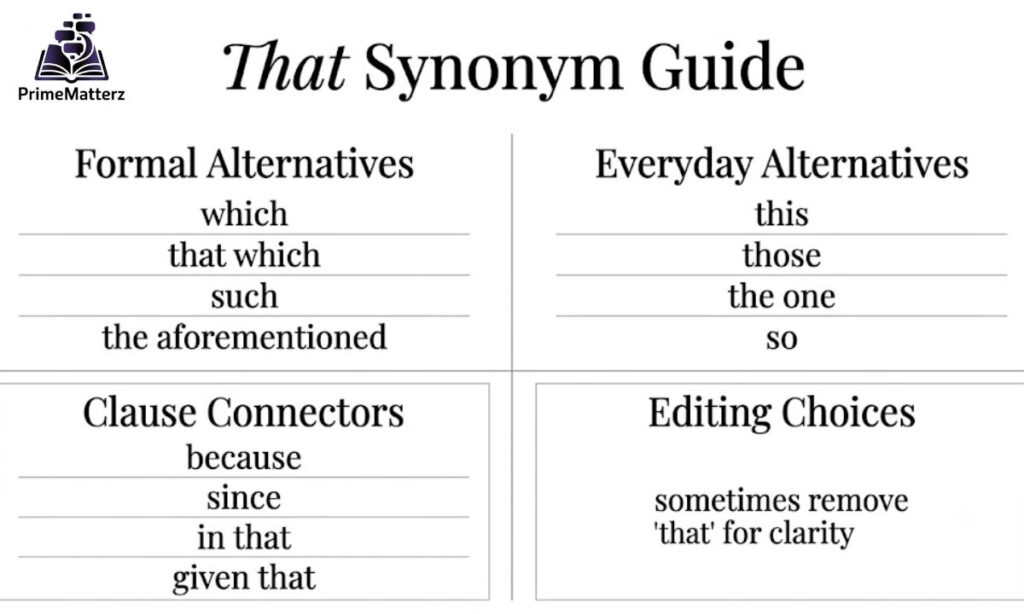
These swaps aren’t interchangeable. Pick based on tone and formality, not just habit.
Synonyms When “That” Is a Conjunction
When “that” links two clauses, you have more flexibility. Depending on the meaning you’re going for, try:
Because
Since
So
In that
Given that
Example: “She left early that she might beat traffic” becomes “She left early because she might beat traffic.”
When You Should Just Delete “That”
Here’s something most writers miss. A lot of the time, the best synonym for “that” is nothing at all.
Professional editors cut “that” constantly. If removing it doesn’t change the meaning or clarity, cut it.
Before: “She said that she would attend.” After: “She said she would attend.”
Before: “I believe that this strategy will work.” After: “I believe this strategy will work.”
Both versions read cleaner. Neither loses meaning. This is often a stronger fix than any synonym.
A Simple Editing Process
Use this quick workflow whenever your draft feels clogged with “that.”
Search your document for every instance of “that.”
Read the sentence aloud without it.
If it still makes sense, delete it.
If it doesn’t, decide if a synonym fits better than the original.
Replace only when it improves clarity or tone.
This process takes minutes and instantly tightens your writing.
Best Synonyms by Context
Academic Writing
Academic prose tends to favor precision and formality.
Which
Such
These findings
Those results
The aforementioned
Business Writing
Business writing should sound clear and direct, not stiff.
This proposal
The recommendation
Those ideas
The specified requirements
Legal and Technical Writing
Legal and technical documents often need exact, unambiguous references.
Said (as in “said agreement”)
The specified requirements
The designated device
The identified party
Creative Writing and Dialogue
In fiction and in everyday writing, cutting out “that” is preferable to putting it in most of the time.
That’s because people don’t actually say “that” when they are speaking. “I think that you should go” just sounds unnatural, doesn’t it?
Common Mistakes Writers Make
Fixing overused “that” can create new problems if you’re not careful.
Overusing “which.” Swapping every “that” for “which” without checking the clause type creates grammar errors.
Using “who” for objects. “Who” only works for people, never things.
Adding synonyms instead of cutting words. Sometimes writers replace “that” with a longer phrase, making the sentence heavier instead of lighter.
Ignoring tone. “The aforementioned” fits a contract. It doesn’t fit a casual blog post.
Quick Decision Guide
Not sure what to do with your “that”? Run through this short checklist.
Can you delete it without losing meaning? Delete it.
Is it introducing essential info about a thing? Keep “that” or consider “which” for nonessential info.
Is it referring to a person? Use “who.”
Is it linking two clauses with a reason? Try “because” or “since.”
Is it pointing to something specific? Try “this,” “these,” or “those” depending on distance and number.
Real Sentence Examples
Seeing these side by side makes the differences click faster.
Academic: “The data that we collected supports the hypothesis.” → “The data collected supports the hypothesis.”
Business: “We recommend that you review the proposal.” → “We recommend you review the proposal.”
Legal: “The party that signed the agreement is liable.” → “The party who signed the agreement is liable.”
Creative: “I knew that something was wrong.” → “I knew something was wrong.”
Each fix reads cleaner. None of them lose the original meaning.
Why This Matters for AI-Generated and Everyday Writing
AI writing tools have a tendency to overuse “that.” It provides a grammatically correct default option, making it a popular choice for automated writing. When editing writing that was either produced by an AI tool or your own first draft, it is one of the first things that should be looked at.
It is one of those subtle things that people don’t think about, but readers will certainly take notice of. Reducing your usage of “that” will make your writing more fluid and engaging for the reader.
Frequently Asked Questions
What is a good synonym for “that”?
It depends on the role. Try “which,” “who,” “this,” or simply delete it.
Can I always remove “that” from a sentence?
Not always. Remove it only if the sentence still makes sense without it.
Use “who” for people. Save “that” for things and objects.
Why does AI-generated text overuse “that”?
AI models default to “that” because it’s grammatically safe, which leads to repetitive, mechanical-sounding sentences.
Conclusion
There are several synonyms for the word ‘that’ because the word ‘that’ is not a word with only one definition. The word ‘that’ can be a pronoun, conjunction, or determiner depending on the context of the sentence. Knowing what word category ‘that’ belongs to in the sentence will help determine which synonym to use, if any should be used.