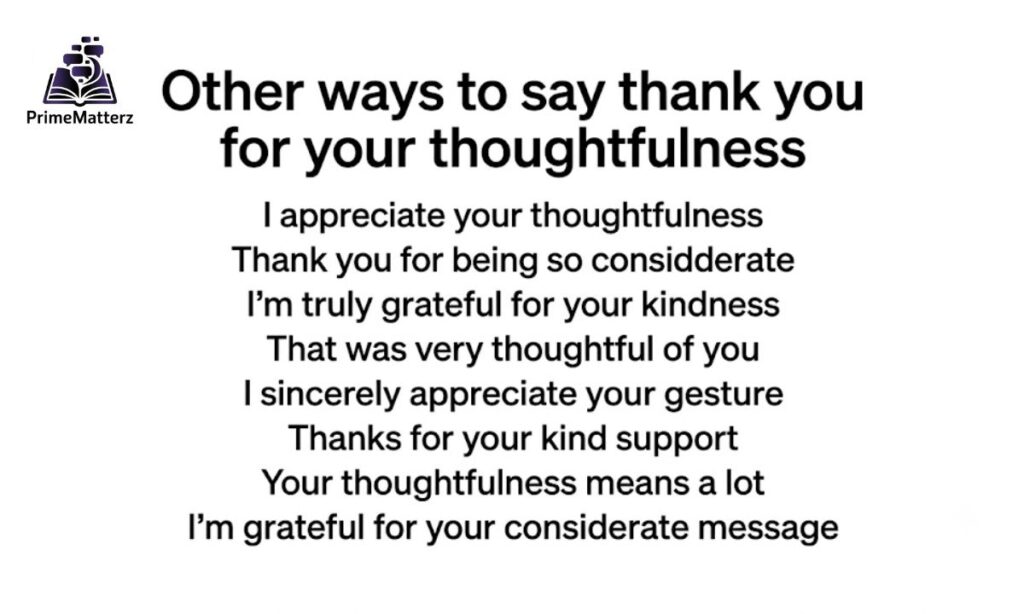
15+ Other Ways to Say “Thank You for Your Thoughtfulness”
Hayat
June 29, 2026No comments
The words you choose when someone does something kind say a lot about you. “Thank you for your thoughtfulness” is a warm phrase, but using it every time makes it feel routine.
Knowing how to switch it up helps you sound more genuine, connect better with people, and come across as confident — whether you’re writing a professional email, sending a quick text, or expressing gratitude in person.
What Does “Thank You for Your Thoughtfulness” Mean?
“Thank you for your thoughtfulness” is a phrase used to acknowledge that someone acted with care, consideration, or kindness toward you. It goes beyond thanking someone for a gift — it recognizes the thought and intent behind their action.
People use it when they want to express that they noticed someone’s effort and that it genuinely meant something to them. It’s more personal than a plain “thank you” and carries a warmer, more sincere tone.
When Should You Use “Thank You for Your Thoughtfulness”?
This phrase works well in workplace settings when a colleague goes out of their way to help, or when a manager wants to acknowledge a team member’s effort. It also fits naturally in professional emails where you want to sound appreciative without being too casual.
It’s equally suitable for personal situations — thanking a friend who remembered something important to you, or acknowledging a family member who did something extra without being asked. It works for gifts, gestures, notes, and acts of support.
Is “Thank You for Your Thoughtfulness” Professional or Polite?
It’s both. This phrase strikes a balance between warmth and formality, which makes it flexible across different settings.
Pros:
Sounds sincere and genuine
Works in both formal and personal contexts
Highlights the person’s intent, not just the action
Adds depth to a simple thank-you
Cons:
Can feel slightly stiff in very casual conversations
May come across as overly formal in quick text exchanges
Overusing it reduces its emotional impact
Doesn’t always fit situations where the gesture was minor
Grammar & Correct Usage of “Thank You for Your Thoughtfulness”
Is it grammatically correct? Yes. “Thoughtfulness” is a noun, and the structure “thank you for + noun” is standard English.
Common mistake: Saying “thank you for your thoughtful” — this is incomplete. You need the noun form: thoughtfulness.
Formal usage: “Please accept my sincerest thanks for your thoughtfulness.”
Informal usage: “Thanks so much — your thoughtfulness really made my day.”
Tip: You can replace “thoughtfulness” with a specific action for more impact: “Thank you for your thoughtfulness in remembering my promotion.”
Common Mistakes When Using “Thank You for Your Thoughtfulness”
Overusing it: Saying it for every small favor dilutes its meaning — save it for genuine moments.
Using it in the wrong context: It sounds odd as a quick reply to a casual text — use simpler phrases there.
Wrong tone: Pairing it with formal language in a fun, casual setting makes the response feel awkward.
Being vague: Just saying the phrase without specifying what the person did can feel hollow — add a detail when possible.
Grammar error: Avoid “thank you for your thoughtful” (missing the noun) or “thanks for your thoughtfulness-ness” (double suffix).
How to Respond to “Thank You for Your Thoughtfulness”
When someone thanks you for being thoughtful, here are five natural ways to reply:
1. “It was my pleasure — I’m glad it meant something to you.”Meaning: Warm and genuine without overdoing it. Best use: Personal conversations or professional acknowledgments. Example: “It was my pleasure — I’m glad it meant something to you after such a tough week.”
2. “You would have done the same for me.”Meaning: Builds connection and mutual appreciation. Best use: Close friendships or long-term colleagues. Example: “You would have done the same for me — that’s what we’re here for.”
3. “I just wanted to show I care.”Meaning: Honest and down-to-earth. Best use: Personal relationships, messages to family. Example: “I just wanted to show I care — you’ve been on my mind lately.”
4. “Happy to help — it was no trouble at all.”Meaning: Reassures the person they weren’t a burden. Best use: Workplace, customer service, or favors. Example: “Happy to help — it was no trouble at all, really.”
5. “That means a lot to hear — thank you for saying so.”Meaning: Grateful and reciprocal. Best use: Formal emails, professional notes, or sincere personal replies. Example: “That means a lot to hear — thank you for saying so, it made my day.”
15+ Other Ways to Say “Thank You for Your Thoughtfulness”
1. I Appreciate Your Kindness
Meaning: A clean, professional alternative that focuses on the person’s caring nature rather than just their action. It works in almost any setting without sounding forced.
Person A: “I left some extra notes on your desk to help with the handover.”
Person B: “I appreciate your kindness — that’s going to save me so much time.”
Best Use: Workplace emails, client communication, professional thank-you notes. Worst Use: Very close friendships where something more personal feels better. Tone: Professional, warm, respectful.
2. Your Gesture Meant a Lot to Me
Meaning: This phrase focuses on the emotional impact of what someone did. It tells the person their action didn’t just help — it actually touched you.
Person A: “I dropped off some food when I heard you weren’t feeling well.”
Person B: “Your gesture meant a lot to me — I really needed that today.”
Best Use: Personal situations, condolence responses, or when someone helped during a hard time. Worst Use: Minor, routine gestures in a professional setting. Tone: Warm, sincere, heartfelt.
3. I’m Truly Grateful for Your Consideration
Meaning: “Consideration” implies the person thought carefully before acting. This phrase recognizes that effort and shows you noticed.
Person A: “I moved the meeting to a time that works better for your schedule.”
Person B: “I’m truly grateful for your consideration — I really appreciate that.”
Best Use: Formal emails, manager-to-employee communication, business correspondence. Worst Use: Casual text messages — it can feel heavy for everyday conversation. Tone: Formal, appreciative, respectful.
4. That Was So Kind of You
Meaning: Simple and direct — it names the quality (kindness) while keeping the tone light and genuine. It doesn’t try too hard, which makes it feel real.
Person A: “I picked up your prescription since I was passing the pharmacy anyway.”
Person B: “That was so kind of you — I didn’t even have to ask.”
Best Use: Everyday interactions, in-person thank-yous, quick but sincere replies. Worst Use: Formal business emails where more structure is expected. Tone: Friendly, casual, natural.
5. I’m Touched by Your Thoughtfulness
Meaning: “Touched” carries an emotional weight — it signals the gesture reached you on a deeper level. Great when someone did something unexpected or especially meaningful.
Person A: “I framed a photo from our first project together as a goodbye gift.”
Person B: “I’m touched by your thoughtfulness — I’ll keep that on my desk always.”
Best Use: Farewell messages, heartfelt personal notes, condolence acknowledgments. Worst Use: Routine workplace interactions where lighter language fits better. Tone: Emotional, sincere, warm.
6. Your Support Means the World to Me
Meaning: This one goes beyond a single action — it acknowledges the person as someone who shows up for you. It adds emotional depth and gratitude for their presence, not just one gesture.
Person A: “I kept checking in because I knew the project was stressing you out.”
Person B: “Your support means the world to me — seriously, thank you.”
Best Use: Close colleagues, friends, mentors, or anyone who supported you through something difficult. Worst Use: First-time interactions or when the gesture was minor. Tone: Heartfelt, personal, deeply appreciative.
7. I Value Your Thoughtful Input
Meaning: Specifically designed for professional feedback or advice situations. It honors not just the help, but the quality and care behind someone’s contribution.
Person A: “Here are some suggestions to strengthen your proposal before the pitch.”
Person B: “I value your thoughtful input — this is exactly what I needed to hear.”
Best Use: Work emails, responding to feedback, team collaboration settings. Worst Use: Non-work situations where “input” sounds out of place. Tone: Professional, direct, respectful.
8. Thank You for Going Out of Your Way
Meaning: This phrase acknowledges extra effort — the person didn’t have to help, but they chose to. It makes them feel truly seen for the sacrifice they made.
Person A: “I stayed late to help you prepare for your presentation tomorrow.”
Person B: “Thank you for going out of your way — I know you had a full day too.”
Best Use: When someone sacrifices their time or comfort to help you. Worst Use: For small, effortless gestures — it can seem like an overstatement. Tone: Appreciative, genuine, warm.
9. Your Kindness Didn’t Go Unnoticed
Meaning: This is perfect when you want the person to know you saw what they did — even if it seemed small or quiet. It’s reassuring and affirming.
Person A: “I made sure to speak up for your idea in the meeting when you weren’t in the room.”
Person B: “Your kindness didn’t go unnoticed — that meant more than you know.”
Best Use: Workplace acknowledgments, peer recognition, team settings. Worst Use: Personal emotional situations where a warmer phrase feels more fitting. Tone: Professional, observant, appreciative.
10. I’m So Grateful for Your Care
Meaning: “Care” makes it personal and human. This phrase works especially well when someone has been attentive to your feelings or wellbeing — not just your tasks.
Person A: “I kept checking in because you seemed stressed about the move.”
Person B: “I’m so grateful for your care — it helped me feel less alone in all of this.”
Best Use: Personal relationships, health-related situations, emotional support moments. Worst Use: Purely transactional or task-based professional exchanges. Tone: Warm, personal, emotionally open.
11. It Means More Than I Can Say
Meaning: A poetic and sincere way to express that words feel inadequate. Use it when someone’s gesture was so meaningful that “thank you” doesn’t feel like enough.
Person A: “I flew in just to be there for you on that day.”
Person B: “It means more than I can say — I’ll never forget that you did that.”
Best Use: Emotional milestones, unexpected acts of generosity, deeply personal moments. Worst Use: Quick, casual replies — it deserves a sincere, quiet moment. Tone: Emotional, reflective, deeply grateful.
12. Thank You for Being So Considerate
Meaning: “Considerate” highlights the person’s awareness — they thought about how their actions would affect you. It’s a notch above “kind” in terms of specificity.
Person A: “I made sure to schedule the call around your time zone, not mine.”
Person B: “Thank you for being so considerate — I noticed you did that.”
Best Use: Professional settings, client emails, or any situation involving scheduling or accommodation. Worst Use: When the situation is highly emotional and you need a warmer phrase. Tone: Respectful, professional, sincere.
13. I Deeply Appreciate Your Thoughtful Gesture
Meaning: Adding “deeply” raises the level of gratitude and makes it clear this isn’t a casual or automatic response. Use it when you genuinely feel moved.
Person A: “I wrote you a reference letter and made sure to include your best work.”
Person B: “I deeply appreciate your thoughtful gesture — it will make a real difference.”
Best Use: Thank-you cards, formal letters, significant personal or professional moments. Worst Use: Everyday or light conversations — the intensity can feel mismatched. Tone: Formal, sincere, respectful.
14. You Always Know Just What to Do
Meaning: This phrase compliments not just the action, but the person’s instinct. It says: “You get me — and you act on it.” It feels like a real compliment alongside a thank-you.
Person A: “I brought your favorite snack because I knew you’d be stressed today.”
Person B: “You always know just what to do — honestly, thank you.”
Best Use: Close friendships, long-term colleagues, family members who know you well. Worst Use: With someone you don’t know well — it can feel too familiar. Tone: Warm, familiar, affectionate.
15. Your Thoughtfulness Made a Real Difference
Meaning: This focuses on impact — the person’s gesture didn’t just feel nice, it actually changed something. It’s validating and specific in a way generic phrases aren’t.
Person A: “I reorganized the project files so the team could find everything faster.”
Person B: “Your thoughtfulness made a real difference — the team felt it too.”
Best Use: Team environments, project acknowledgments, situations with clear outcomes. Worst Use: When the gesture was more emotional than practical. Tone: Result-oriented, genuine, appreciative.
16. I’m Lucky to Have Someone Like You
Meaning: This is gratitude plus affection. It thanks the person while also celebrating who they are — not just what they did. It’s personal and warm.
Person A: “I cleared my whole afternoon just to help you move.”
Person B: “I’m lucky to have someone like you in my corner — thank you.”
Best Use: Close friends, partners, family, or mentors who consistently show up. Worst Use: Professional or formal settings — too personal for business tone. Tone: Affectionate, personal, heartfelt.
Formal vs. Informal Alternatives
Formal Alternatives
Informal Alternatives
I’m truly grateful for your consideration
That was so kind of you
I deeply appreciate your thoughtful gesture
You’re the best — seriously
Please accept my sincere thanks for your kindness
You always know just what to do
Your thoughtfulness is greatly appreciated
Thanks for thinking of me
I value your thoughtful input
You didn’t have to do that — thank you
I’m honored by your generous consideration
You totally made my day
Your care and attention did not go unnoticed
I owe you one!
Thank you for your continued support and kindness
That meant everything, honestly
I’m touched by your thoughtful consideration
You’re such a thoughtful person
Your gesture is a testament to your character
I can’t thank you enough
Which Alternative Should You Choose?
The right phrase depends on who you’re talking to and what the moment calls for.
Workplace or manager: Go with “I value your thoughtful input” or “Your kindness didn’t go unnoticed” — both sound professional without being stiff.
Email to a client or colleague: “I’m truly grateful for your consideration” or “Thank you for being so considerate” works well in writing and reads clearly.
Friend or close colleague: “You always know just what to do” or “Your support means the world to me” fits naturally — it’s warm without being over the top.
Family member: “I’m lucky to have someone like you” or “It means more than I can say” brings the right emotional weight.
Social media comment or reply: Keep it short — “That was so kind of you” or “Your gesture meant a lot to me” reads well publicly without feeling performative.
Condolence or difficult situation: Always lean warmer. “I’m touched by your thoughtfulness” or “Your care and kindness during this time means everything” is appropriate for grief or hardship.
Frequently Asked Questions
Is “thank you for your thoughtfulness” too formal for a text message?
Yes, in most cases — for a text, something like “that was so kind of you” or “thanks for thinking of me” sounds more natural.
Can I use these phrases in a professional email?
Absolutely — phrases like “I appreciate your consideration” or “your thoughtfulness is greatly appreciated” work well in any professional context.
What’s the difference between “kindness” and “thoughtfulness”?
Kindness is about being good-natured and generous; thoughtfulness is specifically about noticing what someone needs and acting on it intentionally.
How do I make my thank-you feel more sincere?
Add a specific detail — instead of a general phrase, mention what the person actually did and how it helped you.
Can these phrases work in a thank-you card?
Yes, all of them work in written cards — especially “your gesture meant a lot to me,” “I’m deeply grateful,” and “it means more than I can say.”
Final Thoughts
A thank-you is only as strong as the words behind it. Whether you’re writing a note, sending an email, or saying it face-to-face, choosing the right phrase shows you didn’t just say thanks — you meant it. Use these alternatives to express gratitude in a way that actually sounds like you.