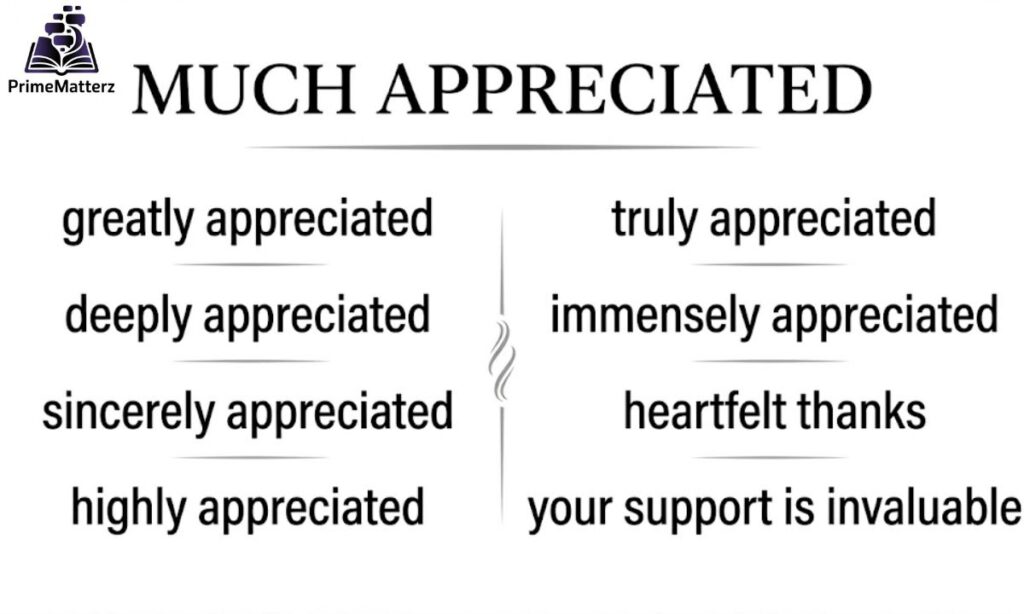
The way you say thank you can shape how people see you. A simple word swap can make you sound more sincere, more professional, or more personal depending on the moment. Knowing other ways to say “much appreciated” helps your communication feel fresh instead of repetitive, and it builds stronger relationships at work and in daily life.
“Much appreciated” is a short way to say thank you, showing that someone’s action or words mattered to you. It is a shortened version of “it is much appreciated.”
People use this phrase because it feels warm but quick, fitting easily into texts, emails, and conversations. It works well when you want to sound grateful without writing a long thank-you message.
When Should You Use “Much Appreciated”?
In the workplace, this phrase fits well after a coworker helps with a task or shares useful information. In emails, it works as a polite closing line after someone answers a question or sends a file.
And In customer service, it shows gratitude for patience or feedback from a client. Among friends and family, it can feel a bit more formal, so it often works best in slightly more serious or sincere moments.
Is “Much Appreciated” Professional or Polite?
This phrase is widely seen as polite and professional, making it a safe choice in most settings. Here is a closer look.
Pros
Sounds professional without being stiff
Works well in emails and chat messages
Short and easy to use
Fits both spoken and written communication
Cons
Can feel a bit impersonal if overused
Lacks warmth compared to fuller sentences
May sound distant with close friends or family
Can feel repetitive in long email threads
Grammar & Correct Usage of “Much Appreciated”
This phrase is grammatically correct, but it works best as a short, standalone expression rather than a full sentence on its own.
It is grammatically correct as a shortened form of “It is much appreciated.”
Common mistake: treating it as a full sentence in formal writing without context.
Correct sentence structure: “Your help with this report is much appreciated.”
Casual sentence structure: “Thanks, much appreciated!”
Formal usage: “Your quick response is much appreciated.”
Informal usage: “Much appreciated, you’re a lifesaver.”
Common Mistakes When Using “Much Appreciated”
Overuse: Saying it after every small favor can make it feel less sincere.
Wrong context: Using it for big, emotional moments where deeper words are expected.
Tone issues: Sounding too short or cold when a warmer reply is needed.
Grammar errors: Forgetting to attach it to a clear subject, making sentences feel incomplete.
How to Respond to “Much Appreciated”
1. “Anytime, happy to help.” Meaning: Shows you are open to helping again in the future. Best use: Workplace or close friendships. Example: “Much appreciated for fixing this.” / “Anytime, happy to help.”
2. “Of course, that’s what teammates are for.” Meaning: Builds a sense of teamwork and support. Best use: Office settings or group projects. Example: “Much appreciated for covering my shift.” / “Of course, that’s what teammates are for.”
3. “Glad I could help.” Meaning: A simple, warm acknowledgment of their thanks. Best use: Everyday conversations. Example: “Much appreciated for the advice.” / “Glad I could help.”
4. “No problem at all.” Meaning: Keeps things light and casual. Best use: Friends, family, or relaxed work settings. Example: “Much appreciated for picking that up for me.” / “No problem at all.”
5. “It was my pleasure.” Meaning: Adds a polished, polite tone to your reply. Best use: Customer service or professional emails. Example: “Much appreciated for your patience.” / “It was my pleasure.”
15+ Other Ways to Say “Much Appreciated”
I Really Appreciate It
Meaning: A slightly more personal version that adds emotional warmth to your thanks. Example:
Person A: “I finished the report early for you.”
Person B: “I really appreciate it.” Best Use: Workplace, emails, daily conversations. Worst Use: Very formal legal documents. Tone: Warm
Thank You So Much
Meaning: A classic, heartfelt way to express gratitude clearly and directly. Example:
Person A: “Here’s the file you needed.”
Person B: “Thank you so much.” Best Use: Almost any setting, casual or professional. Worst Use: None significant. Tone: Friendly
I’m Grateful for Your Help
Meaning: Adds a more thoughtful, sincere tone compared to a quick thanks. Example:
Person A: “I helped review your proposal.”
Person B: “I’m grateful for your help.” Best Use: Professional emails, mentorship moments. Worst Use: Quick casual texts. Tone: Formal
That Means a Lot
Meaning: Focuses on emotional impact rather than just the action itself. Example:
Person A: “I stayed late to help you finish.”
Person B: “That means a lot.” Best Use: Friends, family, emotional moments. Worst Use: Strictly formal business writing. Tone: Warm
I Owe You One
Meaning: A playful way to show thanks while hinting at future return favors. Example:
Person A: “I covered your shift today.”
Person B: “I owe you one.” Best Use: Friends, coworkers, casual settings. Worst Use: Formal client communication. Tone: Casual
Thanks a Ton
Meaning: A fun, energetic way to show strong gratitude. Example:
Person A: “I grabbed coffee for you.”
Person B: “Thanks a ton.” Best Use: Casual chats, social media, friends. Worst Use: Formal emails or reports. Tone: Casual
Your Help Means Everything
Meaning: Expresses deep gratitude, often used in more serious or emotional situations. Example:
Person A: “I helped you through a tough time.”
Person B: “Your help means everything.” Best Use: Personal relationships, heartfelt messages. Worst Use: Quick workplace replies. Tone: Warm
I Can’t Thank You Enough
Meaning: Shows gratitude so strong that words feel almost not enough. Example:
Person A: “I helped you move apartments.”
Person B: “I can’t thank you enough.” Best Use: Big favors, emotional support, life events. Worst Use: Small, everyday tasks. Tone: Heartfelt
I Appreciate Your Effort
Meaning: Focuses on the work or energy someone put in, not just the result. Example:
Person A: “I redid the whole presentation.”
Person B: “I appreciate your effort.” Best Use: Workplace feedback, school settings. Worst Use: Very casual texting. Tone: Professional
Many Thanks
Meaning: A short, slightly formal phrase common in professional writing. Example:
Person A: “Here’s the document you requested.”
Person B: “Many thanks.” Best Use: Emails, business letters. Worst Use: Spoken casual conversation. Tone: Formal
You’re a Lifesaver
Meaning: A fun, exaggerated way to show big gratitude for timely help. Example:
Person A: “I fixed your computer right before your meeting.”
Person B: “You’re a lifesaver.” Best Use: Friends, coworkers, urgent situations. Worst Use: Formal client emails. Tone: Casual
I’m Thankful for This
Meaning: A calm, sincere way to express gratitude without sounding dramatic. Example:
Person A: “I gave you feedback on your draft.”
Person B: “I’m thankful for this.” Best Use: Reflective conversations, written messages. Worst Use: Fast-paced casual chats. Tone: Respectful
This Made My Day
Meaning: Highlights how much someone’s action improved your mood or situation. Example:
Person A: “I sent you a surprise gift.”
Person B: “This made my day.” Best Use: Personal relationships, social media replies. Worst Use: Formal business communication. Tone: Warm
I Value Your Support
Meaning: A respectful phrase often used in professional or mentorship contexts. Example:
Person A: “I backed your idea during the meeting.”
Person B: “I value your support.” Best Use: Workplace, leadership conversations. Worst Use: Very casual friend chats. Tone: Professional
Thanks a Million
Meaning: An exaggerated, friendly way to express strong appreciation. Example:
Person A: “I helped you study all weekend.”
Person B: “Thanks a million.” Best Use: Friends, family, casual settings. Worst Use: Formal reports or emails. Tone: Friendly
I Appreciate You
Meaning: A simple but powerful way to thank the person directly, not just their action. Example:
Person A: “I always listen when you need to talk.”
Person B: “I appreciate you.” Best Use: Close relationships, heartfelt messages. Worst Use: Formal workplace emails. Tone: Warm
Your Kindness Is Appreciated
Meaning: Focuses on the kind nature of the act rather than the result. Example:
Person A: “I checked in on you after your surgery.”
Person B: “Your kindness is appreciated.” Best Use: Personal notes, thank-you cards. Worst Use: Quick chat replies. Tone: Respectful
Formal vs Informal Alternatives
Formal Alternatives
Informal Alternatives
I am grateful for your help
I owe you one
Many thanks
Thanks a ton
I appreciate your effort
You’re a lifesaver
I value your support
Thanks a million
Your kindness is appreciated
This made my day
I’m thankful for this
I appreciate you
Thank you for your assistance
Thanks so much
I sincerely appreciate it
I really appreciate it
Your support means a great deal
That means a lot
I cannot thank you enough
You’re amazing for this
Which Alternative Should You Choose?
At the workplace, phrases like “I appreciate your effort” or “I value your support” sound professional and sincere. In emails, “many thanks” or “I’m grateful for your help” keep things polished and clear.
When replying to a manager, choose respectful options like “I appreciate your guidance” or “your support means a great deal.” For customers, “your kindness is appreciated” or “many thanks” feel warm yet professional.
With friends, relaxed choices like “thanks a ton” or “you’re a lifesaver” feel natural. For family, heartfelt phrases like “this made my day” or “I appreciate you” fit best. On social media, short and catchy lines like “thanks a million” work well for quick public replies.
Frequently Asked Questions
Is “much appreciated” grammatically correct?
Yes, it is correct as a shortened form of “it is much appreciated.”
Can I use “much appreciated” in a formal email?
Yes, it works well in professional emails when attached to a clear subject or action.
What is a more personal way to say “much appreciated”?
“I really appreciate it” or “I appreciate you” feel more personal and warm.
Is “much appreciated” the same as “thank you”?
They are similar, but “much appreciated” often feels slightly more formal and focused on the action.
What can I say instead of “much appreciated” to a manager?
“I appreciate your guidance” or “I value your support” work well in that context.
Final Thoughts
Saying “much appreciated” works fine, but mixing in fresh alternatives makes your gratitude feel more genuine. Choosing the right phrase for each relationship, whether formal or casual, strengthens trust and connection. A little variety in how you say thanks goes a long way in making people feel truly valued.