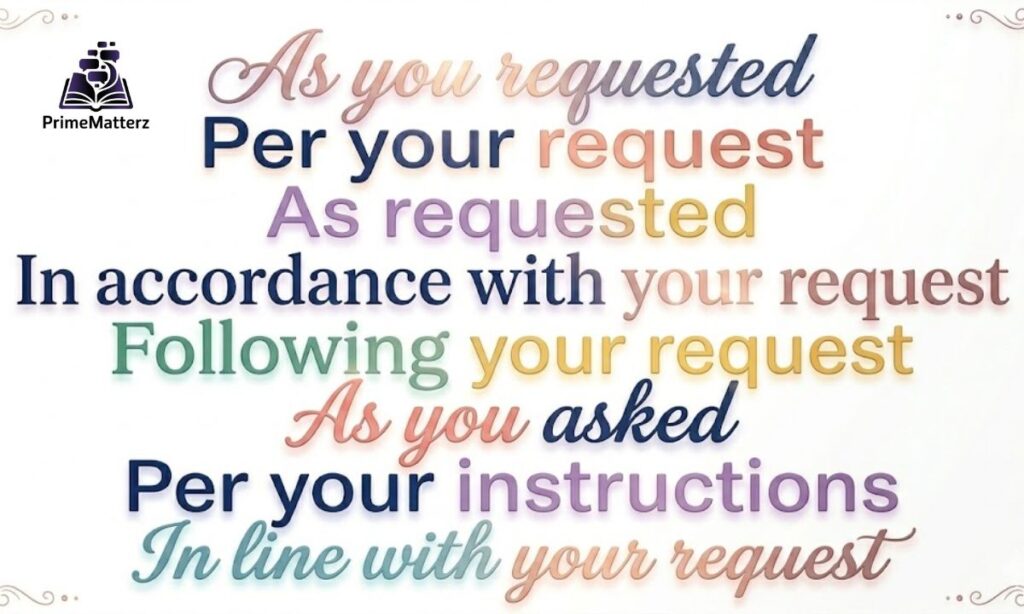
Choosing the right words changes how people see you at work and in daily life. Good communication builds strong relationships, shows confidence, and keeps your messages clear. While it is a very common phrase, finding other ways to say “as per your request” makes you sound more modern and professional. Using different phrases helps you match the exact tone you need for any business or casual situation.
This phrase is a formal way to show you are delivering exactly what someone asked you to do. Its literal meaning is simply stating that your current action matches their previous instructions or demands.
People use it constantly in business emails to quickly prove they followed the rules and completed a task. It is a safe, traditional response that works well when you need to send documents or official updates.
When Should You Use “As Per Your Request”?
You should use this phrase in workplace communication and emails when a manager asks for a specific file. It also works perfectly in customer service when a client demands a refund or a special account change.
In your personal life, it sounds too robotic for daily conversations with friends and family about normal things. It fits best when the situation is highly official and requires a strict, documented paper trail.
Is “As Per Your Request” Professional or Polite?
This phrase is highly professional and polite, but it has some limits depending on who you are talking to.
Pros:
It is very polite and shows instant respect for the other person’s authority.
It keeps workplace emails short, clear, and easy to read.
It works safely across almost all strict corporate situations.
Cons:
It can sound a bit robotic, outdated, or boring if you use it too much.
It might seem too cold when speaking to a friendly coworker or a long-term client.
It uses extra words (“as” and “per” together) that make it feel slightly clunky.
Grammar & Correct Usage of “As Per Your Request”
Is it grammatically correct? Yes, it is widely accepted in business English, though some grammar experts find it redundant.
Common grammar mistakes: People often wrongly say “As per requested” or “As your request.”
Correct sentence structures: Always place it at the beginning or end of a sentence, followed by a comma if at the start.
Formal vs informal usage: “As per your request” is strictly formal, while “As you asked” is much more informal.
Examples: “As per your request, I have attached the file” (Formal) or “Here is the file, as you asked” (Informal).
Common Mistakes When Using “As Per Your Request”
Overuse: Typing this exact phrase in every single email makes you look like a robot instead of a human.
Wrong context: Using it when a friend asks you to pass the salt at dinner seems incredibly weird and cold.
Tone issues: Saying it with a flat voice in person can sound passive-aggressive or annoyed instead of helpful.
Grammar errors: Adding an “ed” and saying “As per requested” sounds broken, confusing, and highly unprofessional.
How to Respond to “As Per Your Request”
1. “Thank you for sending this over so quickly.”
Meaning: Shows appreciation for their fast work and dedication.
Best use: Replying to a coworker who sent a file.
Example: “Thank you for sending this over so quickly. I will review it now.”
2. “I appreciate your prompt help with this.”
Meaning: Acknowledges their effort and speed in solving a problem.
Best use: Formal emails to customer service agents.
Example: “I appreciate your prompt help with this issue today.”
3. “This is exactly what I needed, thanks.”
Meaning: Confirms the task was done perfectly and correctly.
Best use: When a team member finishes a specific project.
Example: “This is exactly what I needed, thanks for your hard work.”
4. “Got it, I will take a look.”
Meaning: A fast way to confirm receipt of the information.
Best use: Quick instant messages or casual emails.
Example: “Got it, I will take a look before our meeting.”
5. “Perfect, thank you for handling this.”
Meaning: Shows satisfaction and officially closes the task.
Best use: When a manager replies to an employee.
Example: “Perfect, thank you for handling this for me.”
15+ Other Ways to Say “As Per Your Request”
As requested
Meaning: A shorter, cleaner version of the original phrase. It saves time and sounds very modern.
Person A: “Can you send me the final budget report?”
Person B: “As requested, I have attached the budget report.” Best Use: Daily workplace emails and quick updates. Worst Use: Highly emotional or personal conversations. Tone: Professional and concise.
Per your request
Meaning: Removes the redundant “as” to make the sentence flow better. It sounds sharp and highly efficient.
Person A: “Please cancel my monthly subscription immediately.”
Person B: “Per your request, your subscription is now canceled.” Best Use: Customer service emails and official notices. Worst Use: Chatting with your best friend. Tone: Formal and direct.
As you asked
Meaning: A friendly, natural way to deliver what someone wanted. It builds a warm, human connection.
Person A: “Could you grab me a coffee on your way in?”
Person B: “As you asked, here is your black coffee.” Best Use: Casual office chats and personal favors. Worst Use: Legal documents or strict corporate letters. Tone: Casual and friendly.
Following your instructions
Meaning: Shows you carefully obeyed their specific steps. It proves you are a reliable and detailed worker.
Person A: “Make sure to format the document in bold.”
Person B: “Following your instructions, the document is now bolded.” Best Use: When completing complex, multi-step tasks. Worst Use: Simple, one-word requests. Tone: Highly professional and respectful.
At your request
Meaning: Highlights that the action was done specifically for them. It makes the other person feel important.
Person A: “I need a special vegetarian meal for the event.”
Person B: “At your request, we ordered a vegetarian meal.” Best Use: Event planning and special accommodations. Worst Use: Routine, automated daily tasks. Tone: Polite and accommodating.
In accordance with your request
Meaning: A very strict, legal way to confirm an action. It creates a solid, undeniable paper trail.
Person A: “I demand a full copy of my medical records.”
Person B: “In accordance with your request, here are your records.” Best Use: Legal letters, banking, and medical fields. Worst Use: Texting a coworker about lunch. Tone: Very formal and legal.
As directed
Meaning: Confirms you followed orders from a higher authority. It shows deep respect for the chain of command.
Person A: “Ship these boxes to the New York office.”
Person B: “As directed, the boxes are shipped to New York.” Best Use: Replying to strict managers or military officers. Worst Use: Talking to an equal peer or friend. Tone: Formal and obedient.
Here is what you asked for
Meaning: A very direct, conversational way to hand something over. It sounds exactly like natural human speech.
Person A: “Do you have the photos from the party?”
Person B: “Here is what you asked for. Enjoy the photos!” Best Use: Sharing files with friends or close coworkers. Worst Use: Sending a resume to a new employer. Tone: Very casual and warm.
Based on your feedback
Meaning: Shows you listened to their opinions and made changes. It proves you value their personal input.
Person A: “The logo needs to be a little bit bigger.”
Person B: “Based on your feedback, I enlarged the logo.” Best Use: Design revisions and creative projects. Worst Use: When no feedback was actually given. Tone: Collaborative and professional.
As you suggested
Meaning: Gives them credit for a good idea. It makes the other person feel smart and respected.
Person A: “We should try calling the client directly.”
Person B: “As you suggested, I called the client today.” Best Use: Team brainstorming and strategy execution. Worst Use: When following a strict, mandatory rule. Tone: Respectful and collaborative.
In response to your request
Meaning: A clear way to start an official reply. It sets a serious, organized tone for the message.
Person A: “I am writing to ask for a deadline extension.”
Person B: “In response to your request, we grant the extension.” Best Use: Official company announcements and HR emails. Worst Use: Quick, informal instant messages. Tone: Formal and organized.
Like you asked
Meaning: A highly informal way to confirm a completed favor. It keeps the mood very light and relaxed.
Person A: “Can you leave the porch light on tonight?”
Person B: “Like you asked, the light is on.” Best Use: Texting family members or roommates. Worst Use: Communicating with a strict corporate client. Tone: Very casual.
To comply with your request
Meaning: Shows you are following rules to avoid trouble. It sounds very serious and legally binding.
Person A: “Remove my email address from your mailing list.”
Person B: “To comply with your request, you are unsubscribed.” Best Use: Privacy requests and legal compliance. Worst Use: Friendly, happy conversations. Tone: Strict and formal.
As per your guidance
Meaning: Thanks someone for their mentorship and advice. It shows you respect their wisdom and experience.
Person A: “You should focus on the marketing data first.”
Person B: “As per your guidance, I analyzed the marketing data.” Best Use: Replying to a mentor or senior advisor. Worst Use: Talking to someone with less experience than you. Tone: Respectful and polite.
Per your instructions
Meaning: A sharp, clear way to confirm you followed the steps. It leaves no room for confusion.
Person A: “Lock the safe and give the key to security.”
Person B: “Per your instructions, the safe is locked.” Best Use: Security, logistics, and strict procedures. Worst Use: Creative, open-ended brainstorming sessions. Tone: Formal and precise.
As we discussed
Meaning: Refers back to a previous meeting or phone call. It connects past conversations to current actions.
Person A: “Let’s lower the price by ten percent.”
Person B: “As we discussed, the new price is updated.” Best Use: Following up after a long meeting. Worst Use: When you never actually discussed the topic. Tone: Professional and collaborative.
Fulfilling your request
Meaning: Sounds like you are completing a special order. It adds a touch of high-end customer service.
Person A: “I would like extra towels in my hotel room.”
Person B: “Fulfilling your request, here are the extra towels.” Best Use: Hospitality and luxury customer service. Worst Use: Basic, boring office emails. Tone: Polite and accommodating.
As you wished
Meaning: A slightly dramatic, very polite way to grant a favor. It sounds almost like a classic movie line.
Person A: “Please do not tell anyone about my surprise party.”
Person B: “As you wished, I kept it a total secret.” Best Use: Personal favors and dramatic, fun moments. Worst Use: Serious financial or legal documents. Tone: Warm and slightly dramatic.
According to your instructions
Meaning: A very detailed way to prove you followed the manual. It protects you from making mistakes.
Person A: “Mix the chemicals exactly as the manual says.”
Person B: “According to your instructions, the mixture is ready.” Best Use: Science, engineering, and technical fields. Worst Use: Casual, everyday small talk. Tone: Highly formal and precise.
Here are the details you requested
Meaning: A friendly, helpful way to introduce a long list of facts. It sounds very natural and polite.
Person A: “Can you send me the schedule for next week?”
Person B: “Here are the details you requested for next week.” Best Use: Sending long reports or schedules. Worst Use: When sending a simple “yes” or “no” answer. Tone: Professional and helpful.
Formal vs Informal Alternatives
Formal Alternatives
Informal Alternatives
In accordance with your request
As you asked
Per your instructions
Like you asked
Following your instructions
Here is what you asked for
In response to your request
As you wished
To comply with your request
As you suggested
Which Alternative Should You Choose?
Workplace Use clear, polite phrases like “As requested” to keep projects moving smoothly. It shows you are engaged without wasting time on clunky words.
Email Choose “Per your request” to maintain a clean, professional written record. It sounds great in any corporate inbox and saves reading time.
Manager Say “Following your instructions” to show deep respect for their leadership and time. It proves you take their messages seriously and follow rules.
Customer Use “At your request” to make them feel heard and valued. It turns a basic transaction into a positive, high-end customer service moment.
Friend Say “Here is what you asked for” to keep the chat relaxed, fun, and totally natural. It fits perfectly in text messages and casual chats.
Family member Choose “Like you asked” to show warm, personal care and love. It makes your family feel appreciated without sounding like a robot.
Social media Use “As you asked” or “Here are the details” for fast, easy public replies. They are short enough for quick comments and sound very human.
Frequently Asked Questions
Is it rude to say “as per your request”?
It is not rude, but it can sound very cold, robotic, and outdated in modern emails.
Can I say “as requested” to my boss?
Yes, “as requested” is a perfect, clean, and highly professional choice for any manager.
How do I say this in a formal business email?
The best formal choice is “In accordance with your request” or “Per your instructions.”
What is a good reply when someone sends me a file?
You should say “Thank you for sending this over so quickly” to show appreciation.
Is “like you asked” too casual for work?
Yes, it is usually too casual for official emails, so use “as you asked” instead.
Final Thoughts
Finding other ways to say “as per your request” instantly upgrades your daily communication skills. Using the right phrase at the right time shows people that you truly respect their effort and time. Practice these simple alternatives today to build stronger, more professional relationships everywhere you go.