Choosing the right words when expressing gratitude can change how your message is received. Whether you’re writing a thank-you email, planning a workplace recognition event, or simply acknowledging a friend’s kindness, the phrase“token of appreciation” works — but it’s not always the best fit.
Knowing stronger, more specific alternatives helps you sound more genuine, professional, and human in every situation.
A token of appreciation is a small gift, gesture, or symbolic act given to acknowledge someone’s effort, help, or kindness. It’s less about monetary value and more about showing that you noticed and cared.
People use this phrase in workplaces, personal relationships, and formal settings when they want to express gratitude politely and respectfully. It signals thoughtfulness without overpromising.
When Should You Use “Token of Appreciation”?
This phrase works well in professional settings — employee recognition programs, client thank-you notes, award ceremonies, or formal emails where a polished tone is expected.
It also fits personal situations like thanking a teacher, neighbor, or volunteer. However, in casual conversations with close friends, it can feel a little stiff — that’s when a warmer alternative works better.
Is “Token of Appreciation” Professional or Polite?
Yes, it’s both. It’s widely accepted in corporate, academic, and social contexts. That said, like any phrase, it has its limits.
Pros:
Sounds respectful and professional
Works in both written and spoken communication
Universally understood in US and UK contexts
Flexible across formal and semi-formal situations
Cons:
Can sound generic when overused
May feel impersonal without a personal message attached
Slightly stiff in casual, everyday conversations
Doesn’t always convey deep emotional sincerity
Grammar & Correct Usage of “Token of Appreciation”
✅ “As a token of appreciation” — most common and grammatically correct
✅ “As token of our appreciation” — correct in formal/official speech
✅ “A small token of appreciation for your help” — natural and clear
❌ “A token of appreciations” — incorrect (appreciation is uncountable)
❌ “Token appreciation” — missing the article; sounds incomplete
Use it as an introductory phrase before presenting a gift or award
Works formally in emails, letters, and speeches; less fitting in texts
Common Mistakes When Using “Token of Appreciation”
Overusing it: Saying it for every small interaction makes it lose meaning
Wrong context: Using it in casual chats with friends sounds awkward and forced
No personal touch: The phrase alone without a specific reason feels hollow
Misphrasing: “A token of appreciate” or “token appreciations” are common grammar errors
Mismatched tone: Pairing it with very casual language creates a confusing signal
How to Respond to “Token of Appreciation”
1. “Thank you so much — this really means a lot.”
Meaning:Genuine acknowledgment. Best use: Any context. Example: “This token means more than you know — thank you so much.”
2. “I’m truly grateful — you didn’t have to do this.”
Meaning: Humble acceptance. Best use:Workplace or formal settings. Example: “I’m truly grateful for this recognition.”
3. “This made my day — thank you for thinking of me.”
Meaning: Warm, personal response. Best use: Among friends or colleagues. Example: “You really made my day with this gesture.”
4. “It was my pleasure — I’m glad I could help.”
Meaning: Deflects praise graciously. Best use:When receiving thanks for a favor. Example: “It was my pleasure to be part of the team.”
5. “I’ll treasure this — thank you for your kindness.”
Meaning:Emotional, sincere. Best use:For meaningful gifts or milestones. Example:“I’ll treasure this always — your kindness means everything.”
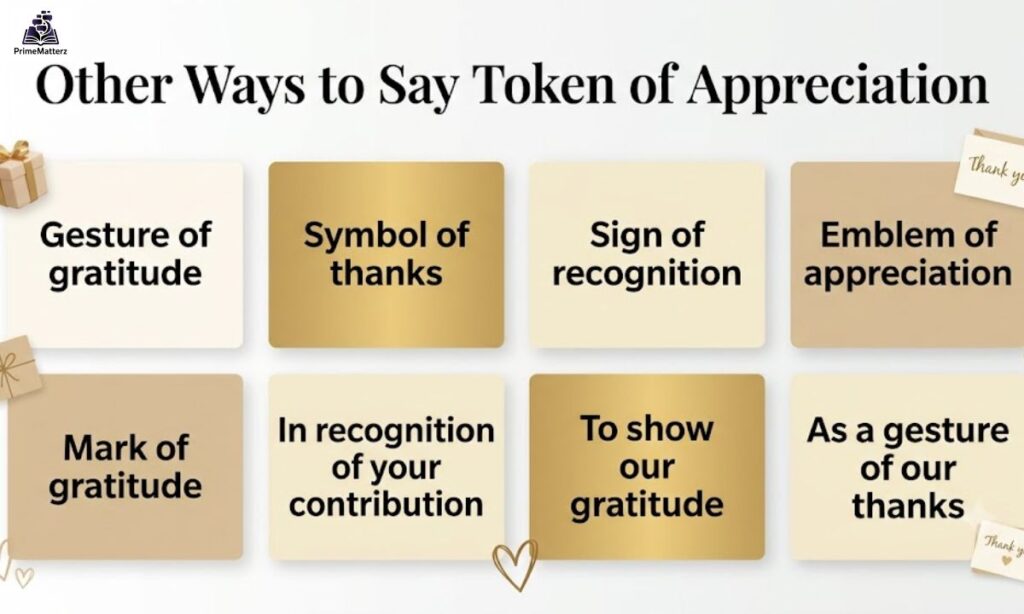
15+ Other Ways to Say “Token of Appreciation”
1. Gesture of Gratitude
Meaning: A thoughtful action or small gift that acknowledges someone’s effort. It emphasizes the act of giving rather than the item itself — making it feel more personal.
Example:
Person A: “We’d like to offer you a small gesture of gratitude for your support.”
Person B: “That’s so thoughtful — truly, thank you.”
Best Use: Team recognition, personal thank-you notes Worst Use: Large formal award ceremonies Tone: Warm, sincere
2. Recognition Award
Meaning: A formal acknowledgment of a specific achievement or contribution. It carries official weight and signals that someone’s work truly stood out.
Example:
Person A: “We’re presenting this recognition award for your outstanding leadership this year.”
Person B: “I’m honored — thank you for seeing my effort.”
Meaning: A physical item given specifically to say thank you. It’s direct and tangible, making gratitude feel real and intentional.
Example:
Person A: “Please accept this appreciation gift from the whole department.”
Person B: “This is so kind — I really wasn’t expecting it.”
Best Use: Work recognition, mentoring relationships Worst Use: When a note would be more appropriate Tone: Sincere, personal
4. Thoughtful Gift
Meaning: A carefully chosen present that shows you paid attention to the person’s tastes or needs. The word “thoughtful” does the emotional heavy lifting here.
Example:
Person A: “I got you this thoughtful gift because I remembered you love tea.”
Person B: “You actually remembered — that’s the sweetest thing.”
Best Use: Personal relationships, individual recognition Worst Use: Generic group gifting Tone: Warm, personal
5. Small Token
Meaning: A modest, humble gesture that doesn’t try to impress — just sincerely acknowledges. Useful when you want to downplay cost and highlight meaning.
Example:
Person A: “Just a small token to say I noticed how hard you worked this week.”
Person B: “That honestly means more than you know.”
Best Use: Casual team moments, informal thank-yous Worst Use: Major corporate achievements or milestones Tone: Casual, warm
6. Token of Gratitude
Meaning: A close cousin to “token of appreciation,” but this version emphasizes emotional warmth over formality. Feels slightly more personal.
Example:
Person A: “This is a token of gratitude for organizing the entire fundraiser.”
Person B: “Thank you — I’m glad it all came together.”
Best Use: Volunteer recognition, personal gifting Worst Use: Stiff corporate letters Tone: Warm, genuine
7. Thank You Gift
Meaning: Straightforward and friendly — a gift given directly to say thank you. No ambiguity, no formality required.
Example:
Person A: “I dropped off a thank you gift at your desk this morning.”
Person B: “Oh wow — you really didn’t have to, but thank you!”
Best Use: Clients, friends, colleagues after a favor Worst Use: Formal ceremonies where a specific title is expected Tone: Personal, warm
8. Expression of Thanks
Meaning: A broader phrase that can include words, gifts, or actions. It puts the emphasis on the act of expressing rather than a specific object.
Example:
Person A: “Please accept this as a sincere expression of thanks for your mentorship.”
Person B: “Your words alone already meant a great deal to me.”
Meaning: A keepsake that commemorates a contribution or milestone. The word “memento” adds a lasting, meaningful quality — it’s not just a gift, it’s a memory.
Example:
Person A: “We’d like you to have this recognition memento as you move on to your next chapter.”
Person B: “I’ll keep this on my desk forever — thank you all.”
Best Use: Retirements, farewells, major milestones Worst Use: Everyday casual appreciation Tone: Respectful, memorable
10. Appreciation Note
Meaning: A written expression of thanks — sometimes the most powerful gift of all. Simple, personal, and costs almost nothing.
Example:
Person A: “I left an appreciation note on your desk — just wanted you to know I see your effort.”
Person B: “Reading that note honestly made my whole week.”
Best Use: Daily workplace recognition, mentoring Worst Use: Large formal ceremonies Tone: Thoughtful, sincere
11. Gratitude Token
Meaning: A symbolic item offered as a heartfelt acknowledgment. The word “gratitude” adds emotional depth, making it feel more personal than a standard award.
Example:
Person A: “Please accept this small gratitude token for everything you’ve done.”
Person B: “This means a lot — thank you for thinking of me.”
Best Use: Volunteer appreciation, coaching relationships Worst Use: Informal jokes or casual office banter Tone: Thoughtful, sincere
12. Symbolic Gift
Meaning: A gift chosen for its meaning, not its price. This phrase shifts focus from cost to intention — perfect when the story behind the gift matters most.
Example:
Person A: “This symbolic gift represents how much your guidance shaped my career.”
Person B: “I didn’t expect this — I’m genuinely moved.”
Best Use: Retirement, personal milestones, long-term relationships Worst Use: Quick office shout-outs Tone: Thoughtful, respectful
13. Acknowledgment Gift
Meaning: A gift that formally recognizes someone’s contribution. It carries a slightly official tone, useful when you want to make the recognition feel documented and real.
Example:
Person A: “This acknowledgment gift is for exceeding every expectation this quarter.”
Person B: “Thank you — knowing the team noticed means a lot.”
Best Use: Performance recognition, workplace milestones Worst Use: Casual thank-yous between friends Tone: Professional, courteous
14. Token of Respect
Meaning: A gesture that honors someone’s character, leadership, or integrity — not just their output. It goes beyond thanking and moves toward admiring.
Example:
Person A: “This is a token of respect for the grace and patience you showed throughout that difficult project.”
Person B: “That’s one of the kindest things anyone has ever said to me.”
Meaning: An action — not necessarily a gift — that shows someone they are valued. It broadens appreciation beyond objects into behavior and effort.
Example:
Person A: “Covering your workload while you were out was my appreciative act — you would’ve done the same.”
Person B: “You didn’t have to do that — I’m genuinely grateful.”
Best Use: Professional recognition, team dynamics Worst Use: Formal award ceremonies Tone: Respectful, encouraging
16. Gratitude Offering
Meaning: A gift or gesture offered as a sign of thanks — the word “offering” adds a slightly ceremonial, generous feel to the act.
Example:
Person A: “We’d like to present this gratitude offering on behalf of the entire team.”
Person B: “Thank you all — this is incredibly thoughtful.”
Best Use: Team events, volunteer appreciation Worst Use: One-on-one casual conversations Tone: Thoughtful, appreciative
Formal vs Informal Alternatives
Formal Alternatives
Informal Alternatives
Recognition Award
Small Token
Acknowledgment Gift
Thank You Gift
Token of Respect
Appreciation Note
Symbolic Gift
Thoughtful Gift
Recognition Memento
Gratitude Token
Expression of Thanks
Thankful Gesture
Appreciation Gesture
Gratitude Offering
Token of Recognition
Small Recognition
Formal Recognition
Appreciative Act
Commemorative Gift
Token of Gratitude
Which Alternative Should You Choose?
Workplace or manager: Go with “Recognition Award” or “Acknowledgment Gift” — they feel official and respectful.
Email to a client: “Expression of Thanks” or “Appreciation Gift” keeps the tone professional yet warm.
Friend or family member: “Thoughtful Gift” or “Thank You Gift” sounds natural and genuine without any stiffness.
Social media shout-out: “Small Token” or “Gratitude Token” reads well in a caption and doesn’t feel over-formal.
Volunteering or community events: “Gratitude Offering” or “Recognition Memento” honors the emotional weight of unpaid contribution.
Match the phrase to the moment — the right words always make the gesture land better.
Frequently Asked Questions
What is the simplest alternative to “token of appreciation”?
“Thank you gift” is the most direct and universally understood replacement across all contexts.
Can I use these alternatives in a professional email?
Yes — phrases like “expression of thanks” and “acknowledgment gift” are completely appropriate in formal workplace communication.
Is “token of gratitude” different from “token of appreciation”?
They are nearly identical, but “token of gratitude” tends to feel slightly warmer and more emotionally personal.
Do these alternatives work in both US and UK English?
Yes — all 15+ alternatives listed here are widely understood and accepted in both American and British English.
Does the gift have to be physical to count as a token of appreciation?
No — a heartfelt note, a public shout-out, or a kind gesture can carry just as much meaning as a physical gift.
Final Thoughts
The phrase “token of appreciation” is timeless, but the alternatives in this guide give you more precision, warmth, and impact in every situation. Whether you’re writing an email, planning a team event, or simply thanking a friend, the right words turn a nice gesture into a genuinely memorable one.