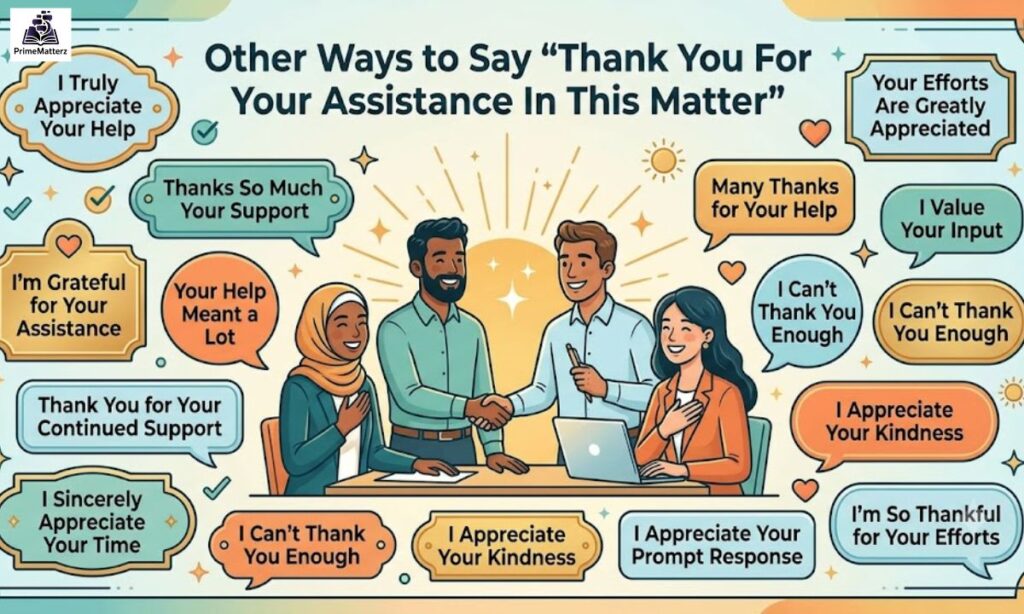
15+ Other Ways to Say “Thank You for Your Assistance in This Matter”
Hayat
June 09, 2026No comments
Choosing the right words in professional communication shapes how people see you and how seriously they take your message. “Thank you for your assistance in this matter” is a dependable phrase, but it can sound stiff or impersonal when used without thought.
Having a range of alternatives lets you match your tone to the situation — whether you are writing a formal client email, closing a support ticket, or following up after a tough project. This guide gives you 15+ practical substitutes, with real examples and clear guidance on when each one fits.
What Does “Thank You for Your Assistance in This Matter” Mean?
The phrase is a formal way of expressing gratitude to someone who helped you resolve a specific issue or task. “Assistance” signals professional support, and “this matter” refers to a particular situation being handled.
It is widely used in business emails, legal correspondence, and customer service responses. It signals respect and acknowledgment without being too personal or too casual.
When Should You Use It?
This phrase fits best in written professional communication — emails to clients, follow-up notes after a meeting, or formal letters responding to a complaint or inquiry. It is especially useful when you want to acknowledge someone’s effort without making the message overly warm or emotional.
And It also works well in customer service, HR communication, and administrative correspondence where a neutral, respectful tone is the standard. It is less suited to internal chat messages or conversations with close colleagues.
Is “Thank You for Your Assistance in This Matter” Professional or Polite?
The phrase is both — but with some trade-offs worth knowing.
Pros:
Clearly professional and suitable for formal written communication
Works across industries and job levels
Signals respect and acknowledgment
Safe to use with people you do not know well
Fits naturally as an email opener or closing line
Cons:
Can sound overly stiff or templated when overused
“This matter” is vague — it does not tell the reader which issue you mean
Less effective when a more specific or warmer phrase would build stronger rapport
May feel impersonal in ongoing working relationships where warmth is appropriate
Grammar and Correct Usage
Grammatically correct: Yes. It follows standard subject-verb-object structure and uses appropriate formal vocabulary.
“Assistance” vs “help”: Both are correct. “Assistance” is more formal; “help” is warmer and more direct.
“In this matter” is optional: You can drop it without changing the meaning. “Thank you for your assistance” is complete on its own.
Avoid adding “very much” without care: “Thank you very much for your assistance in this matter” is correct but can feel over-formal in shorter emails.
Correct structure: “Thank you for your assistance in this matter” — no comma needed unless it opens a longer sentence.
Informal equivalent: “Thanks so much for your help with this” — works for colleagues but not formal correspondence.
Common Mistakes When Using It
Using it as a default without thinking. When every email ends with this phrase, it stops meaning anything.
Pairing it with vague context. Saying “this matter” without naming the issue earlier in the email can confuse the reader.
Using it in casual settings. Telling a friend “thank you for your assistance in this matter” comes across as robotic or sarcastic.
Stacking it with other formal phrases. Opening and closing the same email with formal gratitude phrases makes the message feel hollow.
Using it too early. Thanking someone before they have actually helped can sound presumptuous.
How to Respond to “Thank You for Your Assistance in This Matter”
1. “Happy to help. Please reach out if you need anything else.”
Meaning: Warm and professional closure that invites future contact. Best use: Customer support or client email replies. Example — Person A: “Thank you for your assistance in this matter.” Person B: “Happy to help. Please reach out if you need anything else.”
2. “Of course — glad we could get that resolved.”
Meaning: Acknowledges the resolution without being overly formal in return. Best use: Internal workplace communication or follow-up emails. Example — Person A: “Thank you for your assistance in this matter.” Person B: “Of course — glad we could get that resolved.”
3. “It was a pleasure working through this with you.”
Meaning: Adds warmth while keeping a professional tone. Best use: After collaborative projects or client-facing problem-solving. Example — Person A: “Thank you for your assistance in this matter.” Person B: “It was a pleasure working through this with you.”
4. “Thank you for bringing this to our attention.”
Meaning: Redirects appreciation back to the sender and acknowledges their effort. Best use: Customer service or complaint resolution emails. Example — Person A: “Thank you for your assistance in this matter.” Person B: “Thank you for bringing this to our attention — we’re glad it’s now resolved.”
5. “Anytime. That’s what we’re here for.”
Meaning: Casual and confident, signals ongoing availability. Best use: Informal professional settings or internal team communication. Example — Person A: “Thank you for your assistance in this matter.” Person B: “Anytime. That’s what we’re here for.”
15+ Other Ways to Say “Thank You for Your Assistance in This Matter”
1. I Appreciate Your Help With This
Meaning: Warmer and more direct than the original. Replaces “assistance” with “help” to reduce stiffness while keeping the message professional.
Person A: “The contract issue has been resolved on our end.”
Person B: “I appreciate your help with this — it made a real difference.”
Best Use: Follow-up emails with colleagues, clients, or vendors you have an ongoing relationship with. Worst Use: Formal legal or compliance correspondence where more elevated language is expected. Tone: Professional, warm, direct.
2. Your Support Has Been Greatly Appreciated
Meaning: Shifts the emphasis to ongoing support rather than a single action. Useful when someone contributed effort over time, not just in one moment.
Person A: “We’ve been working with your team for three weeks on this rollout.”
Person B: “Your support throughout this process has been greatly appreciated.”
Best Use: Project close-outs, formal thank-you letters, end-of-engagement emails. Worst Use: Quick one-line email replies — it is too heavy for a short exchange. Tone: Formal, respectful, sincere.
3. Thank You for Your Help in Resolving This
Meaning: Adds specificity by referencing the resolution directly. Signals that the issue is closed and acknowledged.
Person A: “The refund has been processed as requested.”
Person B: “Thank you for your help in resolving this — I’ll look out for the payment.”
Best Use: Customer service, billing inquiries, or any email where a specific outcome was reached. Worst Use: When nothing has been resolved yet — it implies closure. Tone: Professional, clear, polite.
4. I’m Grateful for Your Prompt Attention to This
Meaning: Acknowledges both the help and the speed of the response. Rewards fast action specifically, which makes the thanks feel more meaningful.
Person A: “We’ve escalated the issue and have a fix ready within the hour.”
Person B: “I’m grateful for your prompt attention to this — it saved us significant time.”
Best Use: Urgent requests, IT support follow-ups, time-sensitive client communication. Worst Use: When the response was not actually fast — the specificity works against you. Tone: Formal, appreciative, precise.
5. Thank You for Taking the Time to Address This
Meaning: Recognizes the effort required to respond, not just the result. Shows you understand the other person has a full workload.
Person A: “I’ve reviewed the files and added my comments to the document.”
Person B: “Thank you for taking the time to address this — I know your schedule has been full.”
Best Use: Emails to busy managers, senior contacts, or external experts you do not interact with daily. Worst Use: Routine exchanges where time was not a factor — it can sound performative. Tone: Respectful, considerate, warm.
6. We Appreciate Your Assistance With This Matter
Meaning: The plural “we” makes it organizational rather than personal. Suitable when writing on behalf of a company or team.
Person A: “Your invoicing query has been reviewed and updated in our system.”
Person B: “We appreciate your assistance with this matter and will follow up if needed.”
Best Use: Company-to-client emails, formal institutional communication, HR or compliance responses. Worst Use: Personal one-on-one emails — “we” creates unintended distance. Tone: Formal, institutional, professional.
7. Thank You for Your Continued Support
Meaning: Works best when someone has helped repeatedly or over a sustained period. Implies a relationship, not just a single transaction.
Person A: “We’ve been your account team for two years now and are glad to keep assisting.”
Person B: “Thank you for your continued support — it genuinely makes our work easier.”
Best Use: Long-term client relationships, vendor partnerships, ongoing professional collaborations. Worst Use: First-time interactions — “continued” implies a history that does not exist yet. Tone: Warm, relational, professional.
8. I Truly Appreciate Your Efforts on This
Meaning: Acknowledges the work behind the help, not just the outcome. “Truly” adds sincerity without being excessive.
Person A: “I spent the afternoon tracking down the missing records and have attached them.”
Person B: “I truly appreciate your efforts on this — that could not have been easy to track down.”
Best Use: When someone clearly went out of their way or did extra work to help you. Worst Use: Simple, routine responses that required little effort — “efforts” would feel overblown. Tone: Sincere, warm, slightly personal.
9. Thank You for Your Guidance on This Matter
Meaning: Replaces “assistance” with “guidance,” which is more appropriate when someone gave you advice, direction, or expertise rather than hands-on help.
Person A: “Based on the compliance requirements, I’d recommend going with option B.”
Person B: “Thank you for your guidance on this matter — it gives us a clear path forward.”
Best Use: Legal, compliance, advisory, or mentorship contexts. Worst Use: When someone did practical work rather than advised — “guidance” implies direction, not action. Tone: Formal, respectful, professional.
10. Your Help Has Been Invaluable
Meaning: A stronger expression of gratitude that elevates the contribution to something genuinely essential. Conveys that the situation would have been worse without the person’s input.
Person A: “I’ve been helping your team navigate the audit process all month.”
Person B: “Your help has been invaluable — we could not have gotten through this without you.”
Best Use: Wrapping up high-stakes projects, formal acknowledgment letters, performance reviews. Worst Use: Minor or routine tasks — “invaluable” sets a high bar that should be reserved for genuine impact. Tone: Appreciative, sincere, slightly elevated.
11. I Want to Express My Sincere Gratitude
Meaning: More formal and deliberate than most alternatives. Best used when the circumstances are serious or the contribution was significant enough to warrant careful wording.
Person A: “We were able to complete the transaction on your behalf and close the account as requested.”
Person B: “I want to express my sincere gratitude for the care and speed with which this was handled.”
Best Use: Formal letters, legal communication, senior executive correspondence. Worst Use: Casual follow-up emails — it is heavy for everyday professional exchanges. Tone: Formal, sincere, elevated.
12. Thank You for Everything You’ve Done
Meaning: A broader expression that covers multiple contributions without itemizing them. Feels human and warm without being overly sentimental.
Person A: “We’ve liaised with three departments, tracked the escalation, and sent the final report.”
Person B: “Thank you for everything you’ve done — this was a complicated situation and you handled it well.”
Best Use: End-of-project emails, departure notes, situations where summarizing all contributions would take too long. Worst Use: Single-task acknowledgments — “everything” needs a broader context to land properly. Tone: Warm, human, genuine.
13. I’m Thankful for Your Quick Response
Meaning: Specifically thanks the person for speed. Works when timeliness was the most valuable part of their help.
Person A: “I saw your message come in at 7 AM and responded before the start of business.”
Person B: “I’m thankful for your quick response — it let us move forward without any delay.”
Best Use: Time-sensitive requests, urgent client emails, same-day turnarounds. Worst Use: When the response was not actually quick — this phrase only works when speed was real. Tone: Warm, practical, direct.
14. Please Accept My Thanks for Your Help
Meaning: A formal, slightly old-fashioned construction that carries weight in official correspondence. The phrase “please accept” signals high formality.
Person A: “We have completed the verification process and confirmed your account details are updated.”
Person B: “Please accept my thanks for your help in making this straightforward.”
Best Use: Formal letters, legal acknowledgments, communication with government bodies or formal institutions. Worst Use: Everyday business emails — it is too formal for standard workplace exchanges. Tone: Formal, respectful, traditional.
15. We’re Grateful for Your Cooperation
Meaning: Commonly used when someone complied with a process, provided information, or participated in something required. Slightly more neutral than other alternatives.
Person A: “All the documentation has been submitted as requested.”
Person B: “We’re grateful for your cooperation — your prompt submission has kept us on schedule.”
Best Use: Compliance emails, legal requests, formal administrative communication. Worst Use: Personal or emotional contexts — “cooperation” is process-focused and feels cold in relationship-driven situations. Tone: Formal, neutral, institutional.
16. Thank You for Making This So Easy
Meaning: Pays a specific compliment — the person did not just help, they made the process smooth. It doubles as a compliment on their competence or communication style.
Person A: “I’ll send the revised proposal over by end of day.”
Person B: “Thank you for making this so easy — the whole process has been seamless.”
Best Use: Client emails, vendor relationships, follow-ups after an unexpectedly smooth interaction. Worst Use: Formal institutional communication where casualness could undermine the message. Tone: Warm, conversational, appreciative.
Formal vs Informal Alternatives
Formal Alternatives
Informal Alternatives
I want to express my sincere gratitude
Thanks so much for your help with this
Please accept my thanks for your help
Thank you for making this so easy
We are grateful for your cooperation
I really appreciate everything you’ve done
Your support has been greatly appreciated
Your help meant a lot
I am grateful for your prompt attention to this
Thanks for jumping on this so quickly
Thank you for your guidance on this matter
Thanks for walking me through it
We appreciate your assistance with this matter
Couldn’t have done it without you
Your help has been invaluable
You really saved the day on this one
Thank you for your continued support
Thanks again for everything
I truly appreciate your efforts on this
Thanks for going the extra mile
Which Alternative Should You Choose?
At work or in a business email: “I appreciate your help with this” or “thank you for your help in resolving this” both strike the right balance — professional without being cold.
To a manager or senior colleague: Use “I’m grateful for your prompt attention to this” or “thank you for taking the time to address this.” Both show awareness of their position without sounding like flattery.
To a client: “Your support has been greatly appreciated” or “thank you for your continued support” work well, especially in longer or ongoing relationships.
In a customer service context: “Thank you for your help in resolving this” or “we’re grateful for your cooperation” fit the tone of support correspondence.
To a friend or close colleague: Drop the formality. “Thanks for making this so easy” or “I really appreciate everything you’ve done” feel genuine without sounding like a form letter.
For family: Skip business phrasing entirely and go with something personal. “Thank you for everything you’ve done” carries real warmth and does not need professional polish.
On social media or public posts: “Your help has been invaluable” or “thank you for everything you’ve done” read well publicly and still sound considered rather than generic.
Frequently Asked Questions
What does “Thank you for your assistance in this matter” mean?
It is a formal expression of gratitude for help received with a specific situation or issue.
Is “Thank you for your assistance in this matter” too formal for everyday emails?
It can feel stiff in casual workplace exchanges, so warmer alternatives like “I appreciate your help with this” often work better.
What is the difference between “help,” “assistance,” and “support” in thank-you phrases?
“Help” is the most direct and warm, “assistance” is more formal and professional, and “support” implies ongoing involvement rather than a single action.
Can I use these phrases as email closing lines?
Yes — most alternatives in this guide work naturally as closing sentences before your sign-off.
How do I make a formal thank-you sound more sincere?
Name the specific action you are grateful for rather than using a vague phrase like “this matter” — specificity is what separates genuine thanks from a template.
Final Thoughts
“Thank you for your assistance in this matter” does the job, but it rarely does it memorably. The alternatives in this guide give you more precision, more warmth, and more range — so your gratitude lands the way you actually mean it. Pick the phrase that fits the person, the context, and the tone you want to leave behind.