Saying the same thing every time makes you sound like you are running on autopilot. The phrase “I will keep you posted” is fine, but if you type it in every email and say it in every meeting, it starts to feel hollow.
Knowing other ways to say “I will keep you posted” helps you sound more thoughtful, match the tone of each conversation, and actually build trust — whether you are talking to a client, a colleague, or a close friend. Small word choices have real impact on how reliable and professional you come across.
“I will keep you posted” is a promise to share updates as they happen. When you say it, you are telling the other person: do not worry, I will not leave you in the dark. It is a way of managing expectations and showing that you value someone enough to loop them in when things develop.
The phrase comes from the idea of keeping someone informed — like posting updates on a board for others to read. People use it in work settings, personal conversations, and customer service situations.
It is versatile, widely understood, and generally trusted. The only real downside is that overuse can make it sound like filler rather than a genuine commitment.
When Should You Use “I Will Keep You Posted”?
This phrase works well whenever a situation is still unfolding and someone needs to know they will hear from you again. In professional settings, it is useful when a project is in progress, a decision is pending, or a client is waiting for news. It reassures people without overpromising.
In everyday life, you might use it with friends or family when plans are not yet confirmed or when you are waiting on information before giving a solid answer. It works in texts, emails, calls, and face-to-face conversations. The key thing is to actually follow through — the phrase only builds trust when you back it up with real updates.
Is “I Will Keep You Posted” Professional or Polite?
It is both, but it has limits. Here is a quick look at the pros and cons:
Pros
Easy to understand in any context
Works in formal, semi-formal, and casual situations
Signals reliability and consideration
Sets a clear expectation that more information is coming
Accepted in professional emails without sounding too stiff
Cons
Can feel vague if no timeline is attached
Overuse makes it sound like a reflex rather than a genuine promise
In very formal business correspondence, more precise alternatives often work better
Some people find it slightly informal compared to phrases like “I will keep you informed”
15+ Other Ways to Say “I Will Keep You Posted”
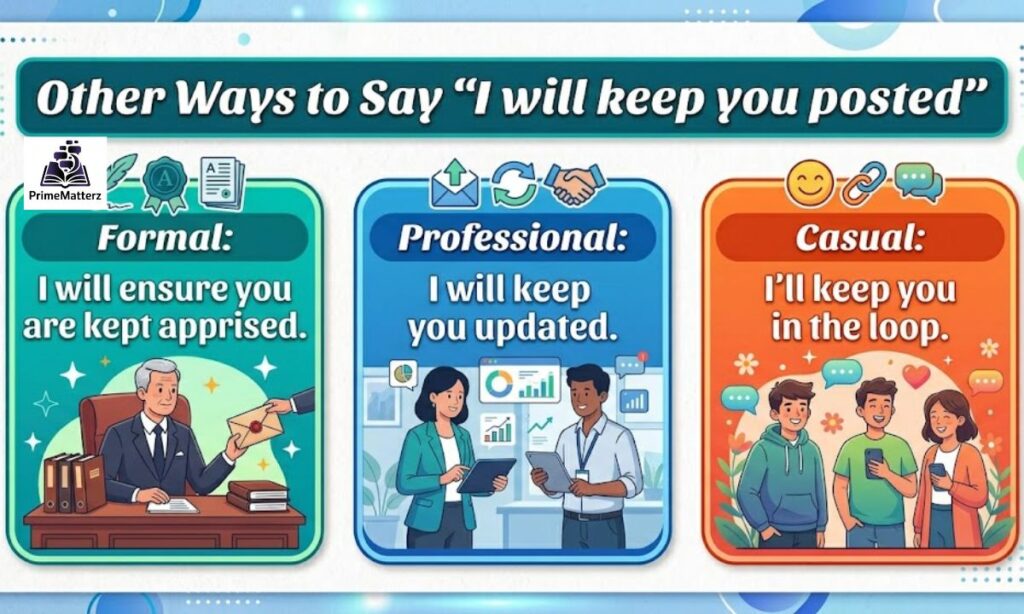
1. I’ll Keep You Updated
Meaning: I will share new information as the situation progresses.
Why It Works: This is the most natural swap for the original phrase. It sounds clean, modern, and appropriate across almost every context. “Updated” feels slightly more professional than “posted,” which gives it a small edge in formal settings.
Example: Person A: “Any news on the contract?” Person B: “Not yet, but I’ll keep you updated as soon as I hear back.”
Best Use: Work emails, project updates, client communication. Worst Use: Very casual texts where even this feels a bit stiff. Tone: Professional, reliable, neutral.
2. I’ll Keep You in the Loop
Meaning: You will be included in ongoing conversations and updates.
Why It Works: This phrase feels warmer and more inclusive than the original. It implies you are part of a circle of people who are in the know, which makes the other person feel valued. It works well in team settings.
Example: Person A: “Should I be worried about the timeline?” Person B: “No — I’ll keep you in the loop as things move forward.”
Best Use: Colleagues, team projects, close professional relationships. Worst Use: Very formal external emails — it can sound too casual for some clients. Tone: Friendly, collaborative, semi-formal.
3. I’ll Let You Know
Meaning: I will contact you when I have information.
Why It Works: Short and clear. “I’ll let you know” is the most commonly used alternative in everyday speech. It does not overcomplicate things, and most people respond well to its directness. It implies you are handling it and will report back.
Example: Person A: “Do you know if the meeting is confirmed?” Person B: “Not yet. I’ll let you know once I get confirmation.”
Best Use: Everyday conversations, quick replies, texts, verbal exchanges. Worst Use: Formal written communication where a more specific commitment is expected. Tone: Casual, direct, friendly.
4. I’ll Keep You Informed
Meaning: I will make sure you have all the relevant information as it becomes available.
Why It Works: This is a step up in formality from the original phrase. “Informed” sounds deliberate and professional. It tells the other person you take the responsibility of communicating seriously, which builds confidence in high-stakes situations.
Example: Person A: “We need to know the moment there’s a decision.” Person B: “Absolutely. I’ll keep you informed every step of the way.”
Best Use: Formal business emails, executive communication, client-facing messages. Worst Use: Casual texts to friends — it can feel unnecessarily stiff. Tone: Formal, professional, dependable.
5. I’ll Send You an Update
Meaning: I will follow up with specific information at a later point.
Why It Works: This phrase sets a clear action. You are not just promising to stay in touch — you are committing to sending something tangible. That specificity is reassuring, especially in professional contexts where vague promises frustrate people.
Example: Person A: “Can we expect to hear from you this week?” Person B: “Yes. I’ll send you an update by Thursday.”
Best Use: Project management, client emails, formal follow-ups. Worst Use: Very casual conversations where it sounds overly formal. Tone: Professional, action-oriented, clear.
6. I’ll Touch Base With You Soon
Meaning: I will check in with you in the near future.
Why It Works: “Touch base” is a widely understood business phrase that suggests a brief, purposeful check-in rather than a full update. It keeps the tone light while still showing you are committed to staying connected.
Example: Person A: “Just wanted to make sure we stay aligned on this.” Person B: “Of course. I’ll touch base with you early next week.”
Best Use: Follow-up emails, scheduling next steps, end-of-meeting closes. Worst Use: Very formal or serious communication — it can feel too casual. Tone: Semi-formal, approachable, professional.
7. I’ll Follow Up With You
Meaning: I will come back to you with more information or a next step.
Why It Works: “Follow up” is a strong, action-oriented phrase. It signals that you have an intent and a plan. In professional environments, it is one of the most trusted phrases you can use because it implies you will take the initiative rather than waiting to be asked.
Example: Person A: “We are still waiting on approval.” Person B: “Got it. I’ll follow up with you once we have a decision.”
Best Use: Business emails, after-meeting summaries, client service. Worst Use: Personal conversations where it can sound corporate. Tone: Professional, proactive, reliable.
8. I’ll Be in Touch
Meaning: I will contact you again when there is something to share.
Why It Works: A classic and comfortable phrase. It is warm without being too casual and professional without being cold. It closes a conversation naturally while still leaving the door open for future communication.
Example: Person A: “We are still reviewing your proposal.” Person B: “Take your time. I’ll be in touch.”
Best Use: Closing emails, ending meetings, networking follow-ups. Worst Use: Situations where someone needs a specific timeline or action — it can feel too vague. Tone: Warm, neutral, professional.
9. I’ll Share Any Updates as Soon as I Have Them
Meaning: The moment something changes or develops, you will pass it along.
Why It Works: This phrase adds a sense of urgency and immediacy. It tells the person you will not sit on information — you will share it the moment it arrives. That is a real trust-builder, especially in time-sensitive situations.
Example: Person A: “We are a bit anxious about the outcome.” Person B: “Completely understandable. I’ll share any updates as soon as I have them.”
Best Use: High-stakes situations, nervous clients, waiting-on-news contexts. Worst Use: Routine low-stakes exchanges where it sounds over the top. Tone: Reassuring, attentive, professional.
10. I’ll Give You a Heads-Up
Meaning: I will warn or inform you in advance before something happens.
Why It Works: This phrase is slightly different from the others — it implies early warning, not just an update. It tells the person you are being proactive, not reactive. It is great when you want to signal that you are thinking ahead on their behalf.
Example: Person A: “If the schedule changes, we need to know quickly.” Person B: “No problem. I’ll give you a heads-up the moment anything shifts.”
Best Use: Schedule changes, informal team communication, casual professional settings. Worst Use: Very formal correspondence — “heads-up” can sound too breezy. Tone: Casual, proactive, friendly.
11. I’ll Make Sure You’re Up to Speed
Meaning: I will bring you fully up to date so you are not behind on anything.
Why It Works: This phrase does a bit more than just promising updates. It shows care for the other person’s understanding, not just their awareness. It is especially useful after a gap in communication or when someone has missed something.
Example: Person A: “I was out last week — what did I miss?” Person B: “Don’t worry. I’ll make sure you’re up to speed before the meeting.”
Best Use: After absences, team catch-ups, onboarding situations. Worst Use: Formal external communication — the phrasing is a little informal. Tone: Helpful, team-oriented, warm.
12. You’ll Hear From Me Soon
Meaning: I will contact you again in the near future.
Why It Works: This phrase shifts focus to the other person, which is a subtle but effective move. Instead of saying what you will do, it tells them what they can expect. That framing feels more reassuring because it is about their experience, not just your intention.
Example: Person A: “We are waiting on your team’s decision.” Person B: “We are working through it. You’ll hear from me soon.”
Best Use: Closing professional conversations, email sign-offs, client reassurance. Worst Use: Situations where “soon” is ambiguous and needs a real date. Tone: Warm, professional, reassuring.
13. I’ll Notify You as Things Develop
Meaning: I will reach out each time a meaningful change or development occurs.
Why It Works: This is a more formal and specific version of “I’ll keep you posted.” It implies active monitoring on your part and a commitment to report back at each key stage. It works particularly well when multiple updates are expected over time.
Example: Person A: “This is a long process. How will we know when things move?” Person B: “I’ll notify you as things develop — you won’t need to chase us.”
Best Use: Long-term projects, legal or contractual updates, formal client communication. Worst Use: Quick casual exchanges where the formality feels excessive. Tone: Formal, structured, reliable.
14. I’ll Check In With You
Meaning: I will reach out to see where things stand and share what I know.
Why It Works: “Check in” is warm and human. It suggests that the update is not just transactional — you actually care about the other person and the progress of the situation. It is a great way to maintain a relationship across a longer process.
Example: Person A: “We are still figuring things out on our end.” Person B: “No rush — I’ll check in with you next week.”
Best Use: Ongoing projects, mentorship relationships, regular contact situations. Worst Use: Formal executive emails where it may sound too casual. Tone: Friendly, caring, semi-professional.
15. I’ll Report Back to You
Meaning: I will return with information after I have gathered or confirmed it.
Why It Works: This phrase positions you as someone who is actively doing something before coming back. It implies research, verification, or investigation — not just passive waiting. It works well when someone has asked you to look into something.
Example: Person A: “Can you find out what the status is on that order?” Person B: “Sure. I’ll report back to you this afternoon.”
Best Use: Task-based follow-ups, research assignments, internal team communication. Worst Use: Personal conversations — it sounds too formal and mission-like. Tone: Professional, action-oriented, structured.
16. I’ll Keep You Abreast of Any Changes
Meaning: I will inform you immediately whenever anything shifts or changes.
Why It Works: “Abreast” is a more formal, slightly old-fashioned word that carries real weight in high-level professional communication. It signals a thorough commitment to transparency. It is the kind of phrase that lands well in legal, executive, and high-stakes environments.
Example: Person A: “We need to know the moment anything changes.” Person B: “Of course. I’ll keep you abreast of any changes as they arise.”
Best Use: Formal business correspondence, executive emails, legal or regulatory contexts. Worst Use: Everyday casual conversation — it sounds out of place. Tone: Formal, precise, authoritative.
Professional Alternatives
Phrase
Formality Level
Best Situation
I’ll keep you informed
High
Executive emails, client communication
I’ll notify you as things develop
High
Long-term projects, legal updates
I’ll keep you abreast of any changes
High
Formal business or legal correspondence
I’ll send you an update
Medium-High
Project emails, client follow-ups
I’ll follow up with you
Medium-High
After-meeting emails, task-based follow-ups
I’ll report back to you
Medium-High
Research or investigation tasks
I’ll touch base with you soon
Medium
Scheduling next steps, informal work emails
I’ll share updates as soon as I have them
Medium
Time-sensitive professional situations
I’ll keep you updated
Medium
General work emails, project status
You’ll hear from me soon
Medium
Closing emails, reassurance messages
Casual Alternatives
For texts, social media messages, and conversations with people you know well, shorter and more natural phrases work best:
“I’ll let you know” — The go-to for everyday conversation. Simple and warm.
“I’ll keep you in the loop” — Works great with friends and close colleagues.
“I’ll give you a heads-up” — Perfect when something might be changing soon.
“I’ll check in with you” — Sounds caring and personal, great for family.
“I’ll hit you up when I know more” — Very casual, good for close friends via text.
“Stay tuned” — Quick and light, works well for social media updates.
“More details coming” — Great for group chats or casual team messages.
“I’ll fill you in later” — Casual, personal, works well with friends and family.
Email-Friendly Alternatives
Alternative
Best Email Situation
I’ll keep you informed
Formal client or executive emails
I’ll send you an update by [date]
When you can commit to a specific timeline
I’ll follow up with you shortly
Post-meeting or task-related emails
I’ll notify you as soon as there’s news
Waiting-on-outcome situations
I’ll keep you abreast of any changes
High-level formal business emails
I’ll touch base with you early next week
Scheduling a future check-in
You’ll hear from me once this is confirmed
After a decision or approval is pending
I’ll report back to you after my review
Research or investigation follow-ups
I’ll share the details as they become available
Long projects with rolling updates
Please expect an update from me by [day]
When a hard deadline adds clarity and trust
How to Choose the Best Alternative
Workplace Communication
Match the formality of your company culture — use “I’ll keep you informed” in formal industries and “I’ll keep you in the loop” in relaxed ones
Add a specific timeline whenever possible: “I’ll follow up by Friday” beats “I’ll follow up soon” every time
Use action-oriented phrases like “I’ll report back” or “I’ll send an update” when you have a clear task
Avoid vague phrases in writing — they create anxiety rather than reassurance
Customer Service
Prioritise phrases that feel warm and proactive: “I’ll share any updates as soon as I have them” works well
Give a timeline wherever you can — customers respond better to “you’ll hear from us within 24 hours” than “we’ll keep you posted”
Avoid overly casual phrases that undermine trust in formal service settings
Use “I’ll notify you” or “I’ll keep you informed” for written customer communication
Friends and Family
Keep it natural: “I’ll let you know” or “I’ll fill you in later” both land better than anything too formal
Match the energy of the conversation — if it is light, keep your response light
A quick “stay tuned” works well over text when you are in a hurry
Do not overthink it — warmth matters more than precision in personal conversations
Formal Situations
Reach for “I’ll keep you informed,” “I’ll notify you as things develop,” or “I’ll keep you abreast of any changes”
Pair the phrase with a specific action or timeline to add real weight
Avoid idioms like “in the loop” or “heads-up” in very formal written communication
When the stakes are high, precision and specificity build more trust than warmth alone
Common Mistakes to Avoid
Promising updates and then going silent. This is the biggest mistake. Saying “I’ll keep you posted” and then disappearing damages trust fast. Always follow through on what you promise.
Being too vague. “I’ll update you soon” sounds hollow without a timeframe. Add specifics whenever you can: “by end of day,” “next Monday,” or “within 48 hours.”
Using casual phrases in formal emails. Phrases like “I’ll fill you in” or “stay tuned” are fine for texts but can undermine your credibility in professional written communication.
Repeating the same phrase in every message. If every email you send ends with “I’ll keep you posted,” it starts to feel like a reflex rather than a real commitment. Vary your language.
Using overly formal phrases with friends. Telling a friend “I’ll notify you as things develop” sounds strange. Match the phrase to the relationship, not just the topic.
Attaching no ownership to the update. Saying “you’ll be notified” (passive voice) sounds less reliable than “I’ll notify you” (active voice). Take ownership of the commitment.
Forgetting to follow up with the actual update. All these phrases are only as good as the follow-through. Set a reminder if you need to — your reputation for being reliable is built on whether you actually follow through.
Frequently Asked Questions
Is “I will keep you posted” professional enough for a business email?
Yes, it is generally accepted in professional emails, though more formal alternatives like “I’ll keep you informed” can sound more polished in high-stakes correspondence.
What is the most formal alternative to “I will keep you posted”?
“I’ll keep you informed” and “I’ll notify you as things develop” are among the most formal and widely respected alternatives in business writing.
Can I use “I’ll keep you in the loop” in a work email?
Yes, but it works best with colleagues you know well — for external or very formal communication, a more precise phrase like “I’ll keep you updated” is a safer choice.
What is the difference between “I’ll follow up” and “I’ll keep you posted”?
“I’ll follow up” implies a specific action tied to a task, while “I’ll keep you posted” is a broader promise to share information as it comes — both are valid but suit slightly different situations.
Is it better to include a specific date when promising an update?
Almost always yes — adding a timeline like “I’ll follow up by Thursday” makes your commitment concrete and builds far more trust than an open-ended promise.
Final Thoughts
The phrase “I will keep you posted” does its job well, but knowing other ways to say it gives you the flexibility to match your words to the moment. Whether you are closing a client email, checking in with a teammate, or texting a friend who is waiting on news, the right phrase builds trust and keeps relationships strong. Choose the one that fits the situation, attach a timeline when you can, and most importantly — always follow through.