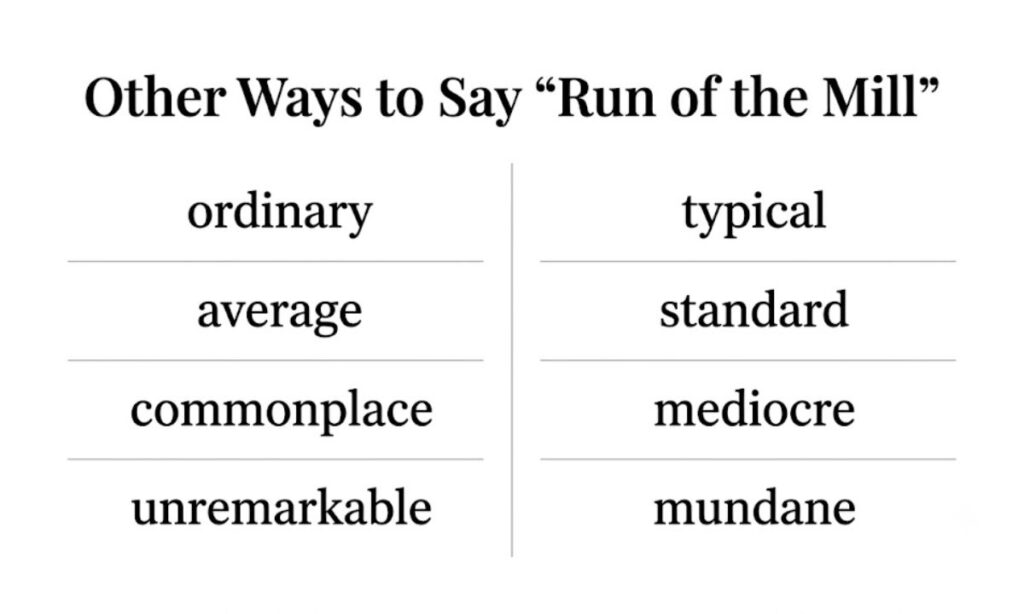
Your choice of words tells a lot about you. Whether it is an email, feedback, or product description, the right word helps you convey your message better and stronger. “Run-of-the-mill” is useful, but if you use it all the time, your writing may come across as lazy or flat. With better, sharper options comes real confidence and style in the way you talk.
“Run-of-the-mill” means being ordinary, average, or nothing special. It is used to describe something that does not stand out from the crowd. It’s not bad, but it’s not good either.
The phrase comes out of the old factory and mill culture. Goods that were “run of the mill” were taken directly from the production line without sorting or grading for quality. They were just ordinary output. Nothing chosen. Nothing special. The meaning stuck, and today people use it in everyday conversation to refer to anything run-of-the-mill.
Grammar and Correct Usage of “Run of the Mill”
“Run-of-the-mill” is an adjective phrase. It is almost always before a noun.
Correct: “It was a perfectly ordinary sort of presentation.
Incorrect: “The presentation was run-of-the-mill.” (Technically possible but sounds awkward in most cases)
Use hyphens when it precedes a noun: run-of-the-mill job. Skip hyphens when it follows a linking verb: the job was run-of-the-mill.
Good for casual and journalistic writing. Don’t use it in formal academic or legal writing, where cleaner alternatives like “ordinary” and “unremarkable” exist.
Neutral Alternatives — When Something Is Simply Average
These options work best when you want to describe something without adding judgment or negativity. They feel balanced and fair.
Ordinary
Meaning: Standard, with nothing unusual about it. A clean, direct replacement that works almost anywhere.
Example:
Person A: “What did you think of the hotel?”
Person B: “Honestly, it was pretty ordinary. Clean, but nothing exciting.”
Best Use: Reviews, casual conversation, general writing. Worst Use: When you need to express stronger disappointment. Tone: Neutral
Average
Meaning: Right in the middle — not bad, not good. This word is familiar and easy for any reader to understand immediately.
Example:
Person A: “How was the new employee’s performance this week?”
Person B: “Average. She gets the work done, but there’s no spark yet.”
Best Use: Performance reviews, academic writing, general feedback. Worst Use: Creative or emotional writing, where “average” can feel cold. Tone: Neutral, Professional
Unremarkable
Meaning: Nothing worth commenting on. It does not stand out for good or bad reasons.
Example:
Person A: “Was the neighborhood nice?”
Person B: “It was unremarkable — just rows of similar houses and quiet streets.”
Best Use: Travel writing, product descriptions, journalism. Worst Use: Personal compliments — it sounds dismissive. Tone: Neutral, Formal
Typical
Meaning: Exactly what you would expect. No surprises at all.
Example:
Person A: “How was the Monday morning meeting?”
Person B: “Typical. Updates, action items, and everyone half-asleep.”
Best Use: Describing patterns or repeated experiences. Worst Use: When you want to highlight specific qualities or flaws. Tone: Casual, Neutral
Commonplace
Meaning: So common it barely gets noticed anymore. Found everywhere.
Example:
Person A: “Is this kind of design still trending?”
Person B: “Not really — it’s become completely commonplace at this point.”
Best Use: Discussing trends, culture, design, or market analysis. Worst Use: Everyday small talk — it sounds slightly formal. Tone: Neutral, Slightly Formal
Mildly Critical Alternatives — When Average Is Not Quite Enough
Sometimes you want to be honest without being harsh. These words carry a small edge but stay respectful.
Mediocre
Meaning: Below what you hoped for, but not a total failure. It carries mild disappointment.
Example:
Person A: “Would you go back to that restaurant?”
Person B: “Probably not. The food was mediocre, and the service was slow.”
Best Use: Reviews, evaluations, honest feedback. Worst Use: Talking to someone directly about their work — it can sting. Tone: Honest, Slightly Critical
Uninspiring
Meaning: Technically fine, but it leaves you feeling nothing. No excitement, no creativity, no spark.
Example:
Person A: “What did you think of the pitch deck?”
Person B: “It covered all the facts, but it was uninspiring. Nothing grabbed me.”
Best Use: Creative feedback, marketing reviews, writing critiques. Worst Use: Describing someone’s personality to their face. Tone: Honest, Professional
Mundane
Meaning: Dull and routine. The kind of thing you forget the moment it ends.
Example:
Person A: “How was the conference?”
Person B: “Mundane. The same topics, the same speakers, the same PowerPoint templates.”
Best Use: Describing repetitive tasks, events, or experiences. Worst Use: Customer-facing writing — it sounds negative. Tone: Casual, Slightly Negative
Undistinguished
Meaning: Nothing sets it apart from everything else around it. It blends in completely.
Example:
Person A: “Did that candidate leave an impression?”
Person B: “Not really — the résumé was solid but undistinguished.”
Best Use: Hiring, talent evaluation, academic critique. Worst Use: Casual conversation — it sounds stiff. Tone: Formal, Professional
Forgettable
Meaning: You would not remember it even if you tried. It made zero lasting impression.
Example:
Person A: “How was the opening act?”
Person B: “Forgettable. By the time the main artist came on, I had already moved on.”
Best Use: Entertainment reviews, event feedback. Worst Use: Business communication with clients or partners. Tone: Casual, Honest
Informal and Colloquial Alternatives — For Everyday Conversation
These feel natural in spoken language, texts, and friendly writing. They are not for formal documents.
Nothing Special
Meaning: Exactly what it sounds like. It does not have any extra value or quality worth noting.
Example:
Person A: “How is the new coffee place on Third Street?”
Person B: “Nothing special. It tastes like every other chain you have been to.”
Best Use: Casual conversation, text messages, informal reviews. Worst Use: Professional emails or reports. Tone: Friendly, Casual
So-So
Meaning: Somewhere between okay and not great. A shoulder-shrug of a phrase.
Example:
Person A: “Did you enjoy the film?”
Person B: “It was so-so. I do not regret watching it, but I would not recommend it either.”
Best Use: Conversations with friends, informal surveys. Worst Use: Any professional setting — it sounds dismissive. Tone: Very Casual
Vanilla
Meaning: Safe, plain, and completely unadventurous. No bold choices made anywhere.
Example:
Person A: “What did you think of the new website redesign?”
Person B: “Very vanilla. Safe colors, safe layout — they played it way too safe.”
Best Use: Design feedback, creative critique, marketing discussions. Worst Use: Describing food or flavors where it means something literal. Tone: Casual, Creative Contexts
Bog-Standard
Meaning: A British-English informal phrase meaning completely standard with no extras.
Example:
Person A: “Is the equipment in the gym good?”
Person B: “It is bog-standard — treadmills, free weights, nothing fancy.”
Best Use: UK-audience writing, casual conversation. Worst Use: American-audience professional writing — many will not recognize it. Tone: Informal, British English
No Great Shakes
Meaning: Not impressive. Not terrible either, just nothing worth getting excited about.
Example:
Person A: “Is the new scheduling software worth switching to?”
Person B: “No great shakes, honestly—it does the job, but so did the old one.”
Best Use: Casual conversation, informal written reviews. Worst Use: Formal writing or international audiences. Tone: Casual, Colloquial
Formal and Professional Alternatives — For Work and Academic Writing
Use these when you need to sound polished and precise without relying on idioms.
Conventional
Meaning: Follows the expected standards without trying anything new or different.
Example:
Person A: “How would you describe their marketing approach?”
Person B: “Conventional. They rely on the same methods everyone else uses.”
Best Use: Business writing, strategic analysis, academic papers. Worst Use: Situations where you want to sound relaxed or friendly. Tone: Formal, Professional
Standard
Meaning: Meets the accepted baseline but does not exceed it in any way.
Example:
Person A: “Does the package include anything extra?”
Person B: “No, it is just the standard offering. Nothing added on.”
Best Use: Product descriptions, service listings, contracts. Worst Use: When describing creative work, it can feel like a put-down. Tone: Professional, Neutral
Routine
Meaning: Exactly as expected, following a regular and predictable pattern.
Example:
Person A: “Was the audit anything we should worry about?”
Person B: “Not at all — it was routine. Nothing unusual was flagged.”
Best Use: Business reports, process descriptions, professional updates. Worst Use: Creative or entertainment writing where you want energy. Tone: Professional, Calm
Pedestrian
Meaning: Lacks imagination or creativity. Technically correct but completely uninspired.
Example:
Person A: “What did the writing coach say about the first draft?”
Person B: “She called it pedestrian—accurate but not compelling.”
Best Use: Literary or creative critique and academic feedback. Worst Use: Daily conversation — most people find it condescending. Tone: Formal, Critical
Undifferentiated
Meaning: Impossible to tell apart from everything else in the same category.
Example:
Person A: “How does their product stand against competitors?”
Person B: “It is completely undifferentiated — same features, same price, same look.”
Best Use: Market analysis, business strategy, product comparison. Worst Use: Everyday speech — far too technical for small talk. Tone: Very Formal, Analytical
Frequently Asked Questions
Is “run-of-the-mill” negative?
It is usually neutral to mildly negative, suggesting something is average rather than truly bad.
What is a formal synonym for “run-of-the-mill”?
“Conventional,” “ordinary,” or “unremarkable” all work well in professional or academic writing.
Can I use “Run-of-the-mill” in a business email?
It is fine for internal emails but sounds too casual for client-facing or formal professional documents.
What is the difference between “mediocre” and “run-of-the-mill”?
“Mediocre” carries more disappointment, while “run of the mill” is more neutral and simply means average.
Which alternative sounds most positive?
“Typical” or “standard” are the most neutral options that carry the least negative charge of the group.
Final Thoughts
Choosing the right word changes how your message lands. Whether you need something casual like “so-so” or something polished like “undistinguished,” each of these phrases gives you a sharper, more precise way to say ordinary. Good word choice is not about sounding smart — it is about being understood clearly and quickly every time.