The words you choose in a quick reply shape how people see you. “Will do” is short, fast, and easy to type, but it can sound flat in an email or too casual with a manager. Picking the right alternative helps you sound confident, professional, and easy to work with, while keeping your message clear and warm at the same time.
“Will do” is a short way of agreeing to a task. It literally means “I will do this,” shortened into two words for speed and ease.
People use it because it’s quick, friendly, and gets the point across without extra typing. It works well in chat apps, texts, and casual workplace messages.
When Should You Use “Will Do”?
In the workplace, “will do” works well in Slack messages or quick chat replies to coworkers you know well. In emails, it can feel a little too short, especially when writing to a manager, client, or someone outside your team.
And in customer service, a fuller phrase usually sounds more polished. With friends and family, “will do” is perfectly natural. In daily conversations, it’s an easy, low-effort way to confirm you’ve heard someone and you’re on it.
Is “Will Do” Professional or Polite?
“Will do” isn’t rude, but it isn’t always the best fit for formal settings either. Whether it works depends on who you’re talking to and where the conversation is happening.
Pros
Quick and easy to type
Clearly shows agreement
Feels friendly and approachable
Works well in casual chats
Cons
Can feel too short in formal emails
May seem abrupt to someone you don’t know well
Doesn’t show extra warmth or detail
Can feel repetitive if overused
Grammar & Correct Usage of “Will Do”
It is grammatically correct as an informal, shortened reply. The full sentence would be “I will do that” or “I will do it.”
A common mistake is using it as a stand-alone sentence in very formal writing, like a job offer reply or a legal email.
Correct casual use: “Will do, thanks for the heads up!”
Correct formal alternative: “I will take care of this right away.”
Informally, it works fine on its own. Formally, it’s better to expand it into a full sentence.
Common Mistakes When Using “Will Do”
Overuse: Saying “will do” in every single reply can make your messages feel robotic.
Wrong context: Using it in a formal email to a client can feel too casual.
Tone issues: It can sound dismissive if the task is important or sensitive.
Grammar errors: Treating it as a complete formal sentence in official documents is incorrect.
How to Respond to “Will Do”
1. “Thanks, I appreciate it!” Meaning: Shows gratitude for someone agreeing to help. Best use: When a coworker confirms they’ll handle something for you. Example: “Can you send that file by 3?” / “Will do.” / “Thanks, I appreciate it!”
2. “Perfect, let me know once it’s done.” Meaning: Confirms agreement and asks for a follow-up. Best use: When you need to track task completion. Example: “Will do.” / “Perfect, let me know once it’s done.”
3. “Great, no rush though.” Meaning: Acknowledges the reply while easing time pressure. Best use: For low-priority tasks. Example: “Will do.” / “Great, no rush though.”
4. “Sounds good, thank you.” Meaning: A simple, polite acknowledgment. Best use: General workplace or email replies. Example: “Will do.” / “Sounds good, thank you.”
5. “Awesome, you’re a lifesaver.” Meaning: Shows extra appreciation for help. Best use: Casual conversations with close coworkers or friends. Example: “Will do.” / “Awesome, you’re a lifesaver.”
15+ Other Ways to Say “Will Do”
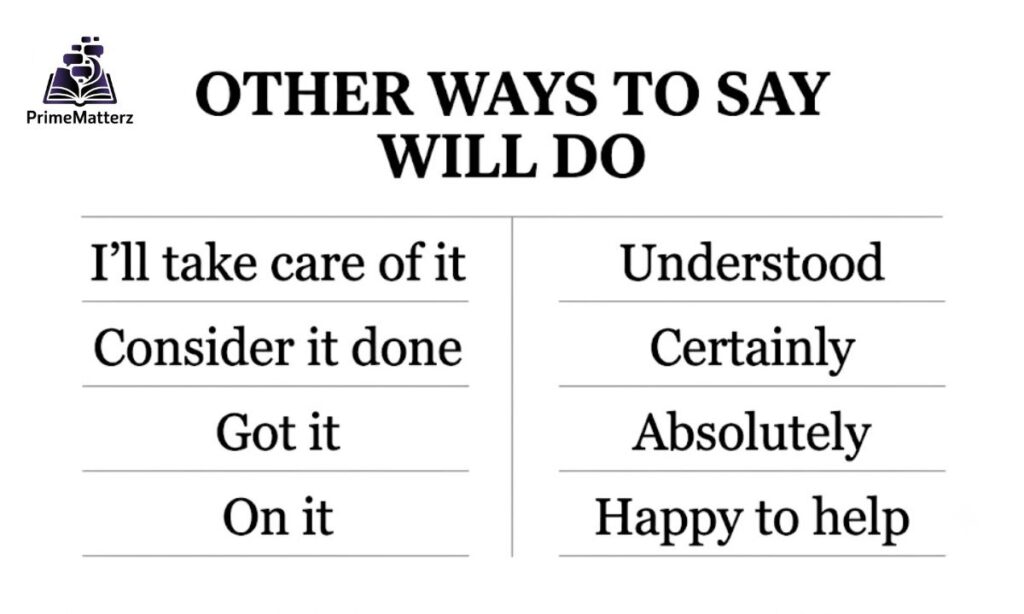
Consider It Done
Meaning: This phrase shows full confidence that the task will be completed without any issues. It reassures the other person they don’t need to follow up.
Example:
Person A: “Can you finish the report today?”
Person B: “Consider it done.”
Best Use: Workplace tasks where you want to show strong confidence. Worst Use: Very small, casual requests where it may sound overly dramatic. Tone: Confident, Professional
I’ll Take Care of It
Meaning: This phrase shows ownership and responsibility. It tells the person they can fully rely on you to handle the task.
Example:
Person A: “The printer is out of paper again.”
Person B: “I’ll take care of it.”
Best Use: Office tasks, team responsibilities, and customer issues. Worst Use: Extremely minor favors among close friends. Tone: Professional, Reassuring
On It
Meaning: A quick, energetic way to show you’re starting the task right away. It feels active and immediate.
Example:
Person A: “We need this fixed before the call.”
Person B: “On it.”
Best Use: Fast-paced workplaces, urgent chat messages. Worst Use: Formal emails to senior leadership. Tone: Casual, Energetic
Got It
Meaning: A simple way to confirm you understood and accepted the task. It focuses more on acknowledgment than action.
Example:
Person A: “Please update the spreadsheet by noon.”
Person B: “Got it.”
Best Use: Quick replies in chat or email threads. Worst Use: Situations needing a stronger commitment statement. Tone: Neutral, Friendly
Absolutely
Meaning: This word shows strong willingness and enthusiasm to help. It adds warmth to a simple agreement.
Example:
Person A: “Could you call the client back?”
Person B: “Absolutely, I’ll do it now.”
Best Use: Customer service, client communication. Worst Use: Very casual texts among friends, where it may feel formal. Tone: Warm, Professional
Sure Thing
Meaning: A relaxed, friendly way to agree to help someone. It feels light and easygoing.
Example:
Person A: “Can you grab coffee on your way in?”
Person B: “Sure thing.”
Best Use: Friends, family, casual coworker chats. Worst Use: Formal business emails. Tone: Casual, Friendly
I’ll Handle It
Meaning: This phrase signals that you’re taking full responsibility, often used when someone needs reassurance that a problem is being managed.
Meaning: This phrase reassures the other person that the request wasn’t difficult or inconvenient for you.
Example:
Person A: “Sorry to ask again, but can you resend that file?”
Person B: “No problem.”
Best Use: Everyday conversations, repeated small requests. Worst Use: High-stakes business replies, where it may sound too casual. Tone: Friendly, Reassuring
Understood
Meaning: A clear, neutral way to confirm you’ve grasped instructions, often used in professional or technical settings.
Example:
Person A: “Please follow the new formatting guide.”
Person B: “Understood.”
Best Use: Workplace instructions, formal communication. Worst Use: Casual conversations with friends. Tone: Neutral, Professional
Glad To
Meaning: A short, warm phrase showing you’re pleased to help, often used in polite spoken conversation.
Example:
Person A: “Could you show the new hire around?”
Person B: “Glad to.”
Best Use: In-person workplace conversations, mentoring situations. Worst Use: Formal written emails. Tone: Warm, Friendly
Copy That
Meaning: A direct, efficient way to confirm a message was received and understood, borrowed from radio communication.
At the workplace, lean toward phrases like “I’ll take care of it” or “Consider it done” to show ownership. In email, “Certainly” or “Of course” sound polished and respectful.
Talking to a manager, “Understood” or “I’ll make sure it’s done” works well, since it shows reliability without sounding overly casual. With a customer, “Happy to help” or “Absolutely” adds warmth and builds trust.
While with a friend, “Sure thing” or “You got it” feels natural and relaxed. With a family member, almost any casual option works fine, including “Will do” itself. On social media, short and friendly phrases like “Got it” or “On it” fit the fast pace of the platform.
Frequently Asked Questions
Is “will do” professional?
It’s acceptable in casual workplace chats, but a fuller phrase like “I’ll take care of it” sounds more professional in emails.
What does “will do” mean in a reply?
It means you agree to complete the task that was just mentioned.
What is a more polite way to say “will do”?
“Certainly” or “Of course” are more polite, formal alternatives.
Is “got it” better than “will do”?
“Got it” focuses on understanding, while “will do” focuses on commitment to action, so the better choice depends on context.
Can “will do” sound rude or too short?
It can feel abrupt in formal or sensitive situations, so a warmer phrase like “Happy to help” often works better.
Final Thoughts
“Will do” is a handy, quick phrase, but it isn’t the only option for showing agreement. Switching between formal and casual alternatives helps you match your tone to the moment, sound more thoughtful, and build stronger communication in every conversation.