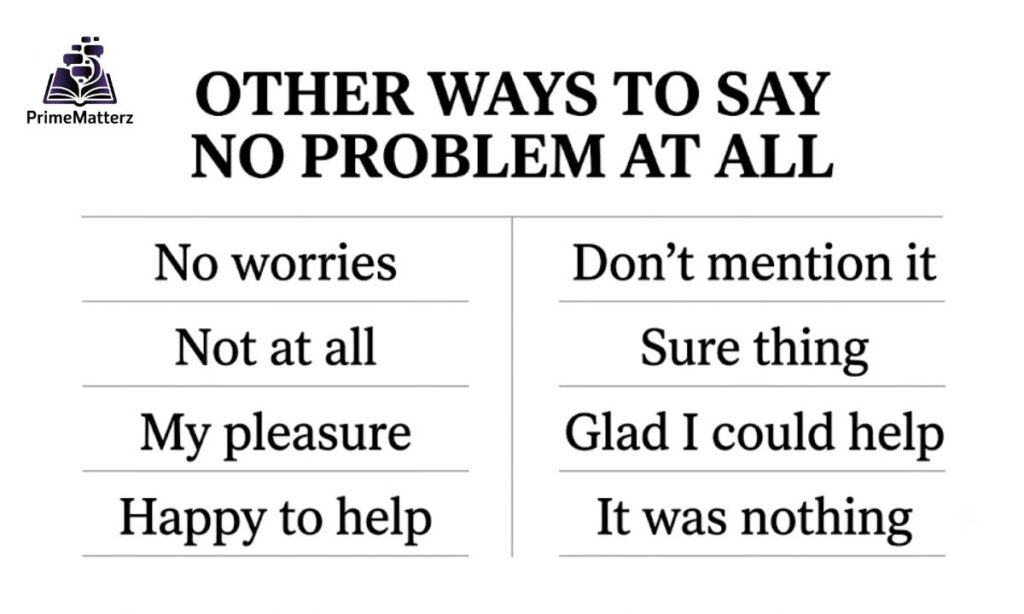
The words you choose after someone says “thank you” shape how people see you. A flat or overused reply can sound careless, while the right phrase builds trust, warmth, and professionalism.
“No problem at all” is friendly, but it is not always the best fit for every email, meeting, or conversation. Knowing other ways to say “no problem at all” gives you more control over your tone, helps you sound confident, and keeps your relationships and communication feeling fresh.
“No problem at all” is a casual way of telling someone that helping them caused no trouble, inconvenience, or extra effort. It is most often used as a response to “thank you” or as reassurance after someone apologizes for asking for help.
People use this phrase because it feels light and approachable. It removes any awkwardness and lets the other person know they did not burden you in any way.
When Should You Use “No Problem at All”?
In the workplace, this phrase works well in quick chats with coworkers, but it can feel too informal in client emails or reports to senior leadership. A more polished alternative often reads better in writing.
With friends and family, “no problem at all” feels natural and warm. In customer service, it is common, but many brands now prefer phrases like “happy to help” because they sound more positive and service-driven.
Is “No Problem at All” Professional or Polite?
This phrase sits in a gray area. It is polite in tone, but its formality depends heavily on the setting and the relationship between speakers.
Pros
Sounds friendly and approachable
Easy to understand across cultures
Removes guilt or awkwardness from the requester
Works well in spoken conversation
Cons
Can sound too casual in formal emails
Overused in customer service scripts
May feel dismissive if said too quickly
Not ideal for senior executives or new clients
Grammar & Correct Usage of “No Problem at All”
It is grammatically correct as a standalone response, though it is technically a sentence fragment rather than a full sentence.
A common mistake is pairing it with an apology that does not need one, such as replying to a simple favor with overly dramatic reassurance.
Correct structure: “No problem at all, happy to do it.”
Informal version: “No problem at all!”
Formal version: “It was truly no trouble at all.”
Example: Person A says, “Thanks for covering my shift.” Person B replies, “No problem at all, I had the time anyway.”
Common Mistakes When Using “No Problem at All”
Overuse: Repeating it in every reply makes it lose meaning and sound robotic.
Wrong context: Using it in formal business proposals or legal communication feels out of place.
Tone issues: Saying it too fast or without warmth can come across as dismissive instead of kind.
Grammar errors: Adding unnecessary words like “no problem at all so” creates awkward, run-on phrasing.
How to Respond to “No Problem at All”
1. “Thanks, I appreciate that.” Meaning: A simple acknowledgment of kindness. Best use: Casual conversations with coworkers or friends. Example: “No problem at all.” → “Thanks, I appreciate that.”
2. “That means a lot to me.” Meaning: Shows genuine gratitude beyond a simple thanks. Best use: Personal or emotional situations. Example: “No problem at all, happy to help.” → “That means a lot to me.”
3. “You’re a lifesaver.” Meaning: Highlights how much the help mattered. Best use: When someone solved a real problem for you. Example: “No problem at all.” → “You’re a lifesaver, seriously.”
4. “I owe you one.” Meaning: Signals you intend to return the favor. Best use: Friendly, informal relationships. Example: “No problem at all.” → “I owe you one for this.”
5. “Noted, thank you.” Meaning: A short, professional acknowledgment. Best use: Workplace emails or quick replies. Example: “No problem at all.” → “Noted, thank you.”
15+ Other Ways to Say “No Problem at All”
1. Not a Problem
Meaning: A slightly more polished version that keeps the same reassuring tone without sounding too casual. It works well when you want warmth without losing professionalism. Example:
Person A: “Sorry for the late reply.”
Person B: “Not a problem, I understand you were busy.” Best Use: Workplace chats and emails. Worst Use: Very formal written reports. Tone: Neutral, Friendly
2. My Pleasure
Meaning: Shows that helping was genuinely enjoyable, not just acceptable. It adds a layer of warmth and personal investment. Example:
Person A: “Thank you for staying late.”
Person B: “My pleasure, I wanted to help finish it.” Best Use: Customer service and hospitality settings. Worst Use: Casual texts with close friends, where it can feel stiff. Tone: Formal, Respectful
3. Happy to Help
Meaning: Expresses willingness and positivity rather than just dismissing the inconvenience. It signals that you welcome future requests too. Example:
Person A: “Thanks for fixing my laptop.”
Person B: “Happy to help, anytime you need it.” Best Use: Workplace and customer support replies. Worst Use: Sarcastic or joking conversations, where sincerity is lost. Tone: Warm, Professional
4. Don’t Mention It
Meaning: A relaxed way of brushing off thanks, suggesting the help was so small it does not need acknowledgment. It feels modest and easygoing. Example:
Person A: “Thanks for grabbing my mail.”
Person B: “Don’t mention it, happens all the time.” Best Use: Friends, neighbors, and casual settings. Worst Use: Formal client communication. Tone: Casual, Friendly
5. No Worries
Meaning: Reassures the other person that there is nothing to feel guilty about. It is short, light, and widely used across English-speaking regions. Example:
Person A: “Sorry I forgot to reply.”
Person B: “No worries, I figured you were busy.” Best Use: Texts, social media, and informal chats. Worst Use: Legal or executive-level communication. Tone: Casual, Relaxed
6. Glad I Could Help
Meaning: Focuses on your own satisfaction in assisting someone, which makes the interaction feel more personal. It adds a positive emotional note. Example:
Person A: “Thanks for explaining that report.”
Person B: “Glad I could help, let me know if anything’s unclear.” Best Use: Workplace mentoring or teaching moments. Worst Use: Quick, low-stakes favors where it may feel overstated. Tone: Warm, Professional
7. It Was Nothing
Meaning: Minimizes the effort involved, signaling modesty rather than expecting praise. It works best when the task truly was simple. Example:
Person A: “Thanks for carrying that box.”
Person B: “It was nothing, glad to help out.” Best Use: Physical favors or quick tasks. Worst Use: Situations where real effort was involved, since it can feel dismissive. Tone: Casual, Modest
8. Anytime
Meaning: Suggests open availability for future help, building trust and reliability in a relationship. It is short but carries long-term meaning. Example:
Person A: “Thanks for picking me up.”
Person B: “Anytime, just give me a call.” Best Use: Close friends, family, and trusted coworkers. Worst Use: First-time interactions with strangers or clients. Tone: Friendly, Warm
9. Of Course
Meaning: Implies that helping was an obvious choice, not something requiring extra thought. It reassures the other person that asking was completely reasonable. Example:
Person A: “Could you double-check this for me? Thanks.”
Person B: “Of course, I’ll have it back by noon.” Best Use: Professional emails and customer service. Worst Use: Deep emotional conversations, where it may feel too brief. Tone: Professional, Neutral
10. You’re Most Welcome
Meaning: A more formal and elegant version of “you’re welcome” that adds extra politeness. It works well when addressing clients or senior colleagues. Example:
Person A: “Thank you so much for your patience.”
Person B: “You’re most welcome, I appreciate yours too.” Best Use: Formal emails and customer-facing roles. Worst Use: Texting close friends, where it feels overly formal. Tone: Formal, Polite
11. At Your Service
Meaning: Conveys a strong willingness to help, almost like a professional commitment. It works well in hospitality or service-driven industries. Example:
Person A: “Thanks for setting up the room.”
Person B: “At your service, let me know if you need anything else.” Best Use: Hotels, events, and client services. Worst Use: Everyday casual conversations, where it sounds exaggerated. Tone: Formal, Respectful
12. Sure Thing
Meaning: A quick, upbeat way to confirm that helping was easy and no trouble at all. It keeps things light and approachable. Example:
Person A: “Thanks for sending that file.”
Person B: “Sure thing, glad it got to you in time.” Best Use: Informal workplace chats and texts. Worst Use: Formal client emails or official documents. Tone: Casual, Friendly
13. You Got It
Meaning: Confirms the task was simple and reassures the other person with confidence and ease. It feels energetic and approachable. Example:
Person A: “Thanks for printing those copies.”
Person B: “You got it, they’re on your desk.” Best Use: Quick workplace exchanges. Worst Use: Serious or sensitive conversations. Tone: Casual, Confident
14. No Big Deal
Meaning: Downplays the effort involved, signaling that the favor was small and easy to handle. It reduces any guilt the other person may feel. Example:
Person A: “Sorry to ask again.”
Person B: “No big deal, I don’t mind at all.” Best Use: Friends, family, and informal settings. Worst Use: Professional emails, where it can sound careless. Tone: Casual, Relaxed
15. Not at All
Meaning: A short, polite way to dismiss any sense of inconvenience. It works well as a brief, respectful response. Example:
Person A: “I hope I didn’t take up too much of your time.”
Person B: “Not at all, I had plenty of time today.” Best Use: Polite conversations with acquaintances or clients. Worst Use: Very informal texts, where it can feel slightly stiff. Tone: Polite, Neutral
16. All Good
Meaning: A modern, relaxed phrase that reassures someone everything is fine without needing further explanation. It feels effortless and friendly. Example:
Person A: “Sorry for the mix-up.”
Person B: “All good, these things happen.” Best Use: Casual texts and conversations with peers. Worst Use: Formal business writing. Tone: Casual, Relaxed
17. Much Obliged
Meaning: A traditional, formal phrase that expresses appreciation while also reassuring the other person. It carries a slightly old-fashioned charm. Example:
Person A: “Thanks for your help with the move.”
Person B: “Much obliged, I’ll return the favor soon.” Best Use: Formal or traditional settings. Worst Use: Everyday casual chats, where it may sound unusual. Tone: Formal, Respectful
18. The Pleasure’s Mine
Meaning: Emphasizes that you personally enjoyed helping, adding warmth and sincerity to the response. It feels gracious and thoughtful. Example:
Person A: “Thank you for mentoring me this year.”
Person B: “The pleasure’s mine, you’ve grown so much.” Best Use: Meaningful, personal exchanges. Worst Use: Quick, low-effort favors. Tone: Warm, Formal
Formal vs Informal Alternatives
Formal Alternatives
Informal Alternatives
Not a problem
No worries
My pleasure
Sure thing
You’re most welcome
You got it
At your service
No big deal
Of course
All good
Much obliged
Anytime
The pleasure’s mine
It was nothing
Glad I could help
Don’t mention it
Not at all
No biggie
It was truly no trouble
Happy to
Which Alternative Should You Choose?
Workplace: Use “happy to help” or “of course” to sound positive and professional without being stiff.
Email: Choose “not a problem” or “glad to assist” for a polished, written tone.
Manager: “Of course” or “you’re most welcome” shows respect while staying confident.
Customer: “Happy to help” or “my pleasure” builds trust and a positive service experience.
Friend: “No worries” or “anytime” feels natural and warm.
Family member: “Don’t mention it” or “no big deal” fits the relaxed tone of close relationships.
Social media: Short phrases like “anytime!” or “no worries 😊” match the casual style of online replies.
Frequently Asked Questions
Is “no problem at all” rude?
No, it is not rude, but it can sound too casual in formal or professional settings.
What is more polite than “no problem”?
“You’re most welcome” or “it was truly no trouble” sound more polite and formal.
What is a formal response to “thank you”?
“My pleasure” or “of course” are strong formal responses to thank you.
Can I say “my pleasure” instead of “no problem at all”?
Yes, “my pleasure” works well as a warmer, more formal substitute in most situations.
Is “no worries” appropriate in business writing?
It is best avoided in formal business writing since it leans too casual for professional documents.
Final Thoughts
Choosing the right way to say “no problem at all” helps you sound more thoughtful, professional, and approachable in every conversation.
The right phrase depends on your audience, setting, and relationship with the other person. With these alternatives, you can respond naturally in any situation, whether at work, in writing, or with people close to you.