The words you choose shape how people see you. Whether you’re writing a work email, following up with a client, or texting a friend, the phrase “feel free to reach out” can start to sound robotic if you use it too often.
Knowing other ways to say “feel free to reach out” helps you sound more natural, more human, and more appropriate for any situation.
“Feel free to reach out” is a polite way to invite someone to contact you. It tells the other person they are welcome to get in touch whenever they need help, have questions, or want to follow up.
People use it because it sounds open and low-pressure. It’s a soft, friendly closing that works in emails, messages, and even face-to-face conversations.
When Should You Use “Feel Free to Reach Out”?
This phrase works well in professional settings — especially in business emails, client communication, and customer support. It signals that you are available and approachable without sounding too eager or informal.
It also works in casual settings with friends or family, though it can sometimes feel a bit stiff in those cases. Choosing the right variation based on your relationship and context always makes your message land better.
Is “Feel Free to Reach Out” Professional or Polite?
It is both — but it depends on how often you use it.
Pros:
Sounds warm and welcoming
Works in both formal and semi-formal settings
Easy to understand for non-native speakers
Sets a low-pressure tone for the reader
Cons:
Overused in professional emails — can feel generic
May sound impersonal in close relationships
Can seem copy-pasted in customer service messages
Loses impact when used at the end of every email
Grammar & Correct Usage of “Feel Free to Reach Out”
Is it grammatically correct? Yes, completely.
Common grammar mistake: Writing “feel free to reaching out” — incorrect. Always use the base form: “reach out,” not “reaching out.”
Correct structure: “Please feel free to reach out if you have any questions.”
Formal usage: “Do not hesitate to reach out should you require further assistance.”
Informal usage: “Feel free to reach out anytime!”
Example (correct): “Feel free to reach out if you need anything.”
Example (incorrect): “Feel free to reaching out for help.”
Common Mistakes When Using “Feel Free to Reach Out”
Overuse: Ending every single email with this phrase makes it invisible. Readers stop noticing it.
Wrong context: Saying it to a close friend can sound cold and overly formal.
Tone issues: In a tense or urgent situation, this phrase may feel too casual or dismissive.
Grammar errors: Using “reaching out” instead of “reach out” is the most common mistake.
No follow-through: Saying it but not actually being available creates distrust.
How to Respond to “Feel Free to Reach Out”
1. “Thanks, I will!”
Meaning: Simple, positive acknowledgment.
Best use: Casual or semi-professional exchanges.
Example: “Feel free to reach out if needed.” → “Thanks, I will!”
2. “I appreciate that. I’ll be in touch if anything comes up.”
Meaning: Gracious and professional.
Best use: Work emails or networking conversations.
Example: “Feel free to reach out anytime.” → “I appreciate that. I’ll be in touch if anything comes up.”
3. “Good to know. I’ll keep that in mind.”
Meaning: Acknowledges the offer without committing.
Best use: When you’re not sure if you’ll need help.
Example: “Feel free to reach out.” → “Good to know. I’ll keep that in mind.”
4. “Same goes for you — let me know if I can help.”
Meaning: Turns the offer into a mutual one.
Best use: Networking, peer relationships, team communication.
Example: “Feel free to reach out.” → “Same goes for you — let me know if I can help.”
5. “Will do, thanks for the offer.”
Meaning: Brief and warm.
Best use: Quick email replies or casual text conversations.
Example: “Feel free to reach out whenever.” → “Will do, thanks for the offer.”
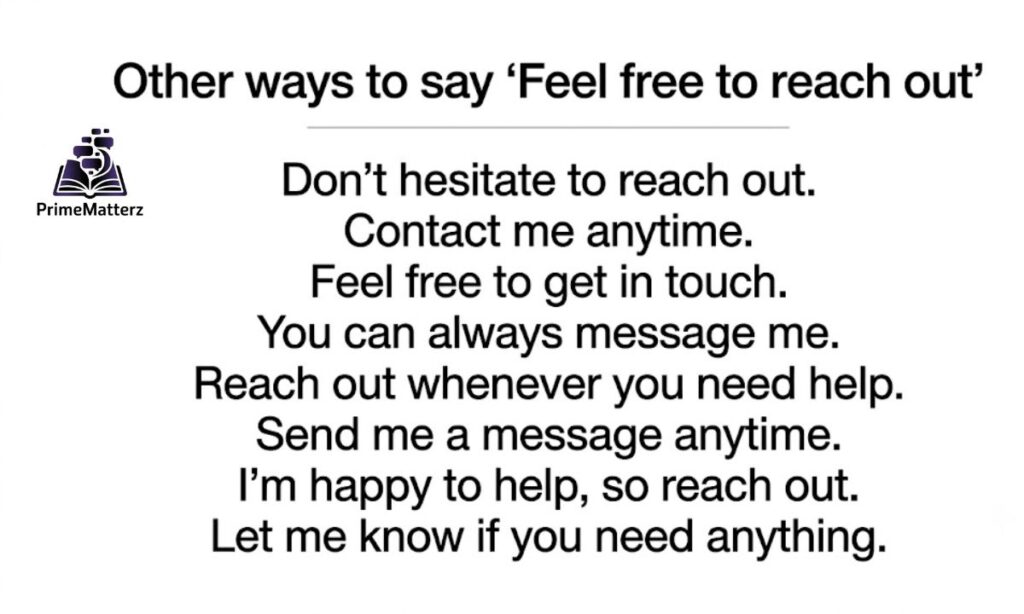
15+ Other Ways to Say “Feel Free to Reach Out”
1. Don’t Hesitate to Contact Me
Meaning: Encourages the person to get in touch without overthinking it. It removes the fear of bothering you, which makes the invitation feel more genuine and reassuring.
Example:
Person A: “I’m not sure if my question is important enough to email about.”
Person B: “Don’t hesitate to contact me — no question is too small.”
Best Use: Professional emails, customer service follow-ups. Worst Use: Texting a close friend — sounds too formal. Tone: Professional, Reassuring
2. Please Don’t Hesitate to Reach Out
Meaning: A slightly stronger version that directly removes any social hesitation. It reassures the person that their message is welcome and won’t be a burden.
Example:
Person A: “I’ll try not to bother you with small things.”
Person B: “Please don’t hesitate to reach out — I’m always happy to help.”
Best Use: Formal emails, manager-to-employee communication. Worst Use: Casual social messages. Tone: Formal, Warm
3. I’m Here If You Need Anything
Meaning: A warm and human phrase that signals emotional availability, not just professional availability. It works well when you want to sound caring rather than corporate.
Example:
Person A: “Thanks for all your help with the project.”
Person B: “Of course! I’m here if you need anything going forward.”
Best Use: Supportive conversations, client wrap-ups, personal messages. Worst Use: Cold outreach or formal business proposals. Tone: Warm, Friendly, Supportive
4. Let Me Know If You Have Any Questions
Meaning: A practical, task-focused invitation. It signals that you expect follow-up questions and are ready for them. It stays on topic and feels efficient.
Example:
Person A: “I’ve reviewed the document you sent over.”
Person B: “Great — let me know if you have any questions.”
Best Use: After sharing information, project updates, or instructions. Worst Use: When no specific information was shared. Tone: Neutral, Professional
5. My Door Is Always Open
Meaning: A classic expression of availability. It creates an image of openness and makes the listener feel welcome to approach you at any time without an appointment or formality.
Example:
Person A: “I wasn’t sure if I should bring this up.”
Person B: “Please do — my door is always open.”
Best Use: Leadership communication, mentoring, manager-to-team messages. Worst Use: Written communication where the phrase can seem too clichéd. Tone: Welcoming, Approachable, Slightly Informal
6. You Can Always Get in Touch With Me
Meaning: A direct and confident way to stay available. It tells the person they have ongoing permission to contact you, not just once, but anytime they need.
Example:
Person A: “What if something comes up next week?”
Person B: “You can always get in touch with me — just send me a message.”
Best Use: Ongoing client relationships, colleague communication. Worst Use: Formal business letters where brevity is expected. Tone: Friendly, Confident, Casual-Professional
7. I’d Love to Hear From You
Meaning: This phrase adds genuine enthusiasm to your invitation. It makes the other person feel valued and tells them their message won’t just be tolerated — it will be welcomed.
Example:
Person A: “I’ll think about your offer.”
Person B: “Take your time! I’d love to hear from you whenever you’re ready.”
Best Use: Networking follow-ups, sales outreach, personal connections. Worst Use: Internal office memos or cold professional introductions. Tone: Enthusiastic, Warm, Inviting
8. Drop Me a Line Anytime
Meaning: A relaxed, conversational phrase that keeps communication light. It signals that the other person can reach out without any pressure or formality attached.
Example:
Person A: “Thanks for meeting with me today.”
Person B: “Anytime! Drop me a line if you ever want to connect again.”
Best Use: Casual professional emails, networking messages, friendly follow-ups. Worst Use: Formal business communications or legal correspondence. Tone: Casual, Friendly, Relaxed
9. Feel Free to Get in Touch
Meaning: A close sibling to the original phrase, but “get in touch” feels slightly more versatile. It works across all channels — phone, email, chat — and doesn’t lock down the method of contact.
Example:
Person A: “I’ll review the contract tonight.”
Person B: “Sounds good — feel free to get in touch once you’ve had a chance to look it over.”
Best Use: All professional contexts, email sign-offs. Worst Use: Very close personal relationships where casual language is expected. Tone: Professional, Neutral, Polite
10. I’m Just an Email Away
Meaning: This phrase combines availability with a specific channel. It reassures the reader that reaching you is easy and direct — no complicated process, no waiting.
Example:
Person A: “I hope I’m not bothering you with this.”
Person B: “Not at all — I’m just an email away.”
Best Use: Customer support messages, onboarding emails, new client introductions. Worst Use: Face-to-face conversations where it sounds awkward. Tone: Accessible, Reassuring, Professional
11. If You Have Any Concerns, Please Let Me Know
Meaning: This phrase is ideal when the conversation involves potential problems or sensitive topics. It shows that you are not just open to questions, but specifically open to concerns and feedback.
Example:
Person A: “I hope the new process doesn’t cause too many issues.”
Person B: “If you have any concerns, please let me know — we can adjust.”
Best Use: Change management, project transitions, customer feedback situations. Worst Use: Casual conversations where it sounds too heavy. Tone: Responsible, Professional, Attentive
12. Reach Out Anytime
Meaning: A stripped-down, no-fuss version that gets straight to the point. “Anytime” adds a sense of unlimited availability that’s both reassuring and efficient.
Example:
Person A: “Thanks for the walkthrough.”
Person B: “Happy to help — reach out anytime!”
Best Use: Short email sign-offs, quick follow-up messages, chat messages. Worst Use: Long formal letters where it may seem too brief. Tone: Casual, Friendly, Direct
13. Happy to Help If You Need Anything
Meaning: This phrase adds a layer of willingness — not just “I’m available,” but “I actually want to help.” It makes the reader feel like reaching out is doing you a favor, not the other way around.
Example:
Person A: “I’ll try to figure it out on my own first.”
Person B: “Of course — but I’m happy to help if you need anything.”
Best Use: Customer service, onboarding, team support messages. Worst Use: Situations where you want to sound strictly professional. Tone: Helpful, Warm, Approachable
14. Don’t Be a Stranger
Meaning: A friendly, informal phrase that encourages continued communication beyond a single interaction. It implies an ongoing relationship rather than just one transaction.
Example:
Person A: “It was great catching up!”
Person B: “It really was — don’t be a stranger!”
Best Use: Reconnecting with former colleagues, closing a friendly call. Worst Use: Formal business emails, first-time client interactions. Tone: Warm, Informal, Personal
15. I Welcome Your Questions
Meaning: A confident and structured phrase that positions you as someone prepared and ready for dialogue. It works especially well in teaching, coaching, or advisory contexts.
Example:
Person A: “I’m not sure I fully understood that last section.”
Person B: “No worries — I welcome your questions at any time.”
Best Use: Educational content, presentations, formal reports. Worst Use: Casual, conversational messages. Tone: Formal, Confident, Open
16. You’re Welcome to Message Me
Meaning: This phrase explicitly grants permission — which can be comforting for people who are hesitant to reach out. It removes the social barrier of wondering whether it’s okay to contact someone.
Example:
Person A: “I wasn’t sure if I should message you directly.”
Person B: “Please do — you’re welcome to message me whenever.”
Best Use: New client introductions, team onboarding, mentoring relationships. Worst Use: Professional proposals or formal documentation. Tone: Welcoming, Inclusive, Friendly
Formal vs Informal Alternatives
Formal Alternatives
Informal Alternatives
Please don’t hesitate to contact me
Drop me a line anytime
I welcome your questions
Don’t be a stranger
Should you require assistance, please reach out
I’m here if you need anything
If you have any concerns, please let me know
Reach out anytime
Feel free to get in touch at your earliest convenience
Happy to help if you need anything
I remain available for any further queries
You can always get in touch with me
Do not hesitate to contact our team
My door is always open
Please feel free to correspond with me
I’d love to hear from you
For further assistance, please contact us
You’re welcome to message me
I am available should you wish to discuss further
Just drop me a message
Which Alternative Should You Choose?
Workplace / Manager: Use “Please don’t hesitate to reach out” or “If you have any concerns, please let me know.” Both are professional and respectful.
Email sign-offs: “Feel free to get in touch” and “Let me know if you have any questions” are clean, safe choices that work across contexts.
Customer service: Try “I’m just an email away” or “Happy to help if you need anything.” These feel personal while staying professional.
Friends or family: Go with “I’m here if you need anything” or “Don’t be a stranger.” These feel natural and warm without sounding stiff.
Social media / networking: Use “I’d love to hear from you” or “Drop me a line anytime.” Both are conversational and inviting.
New connections: “You’re welcome to message me” works perfectly — it removes hesitation and opens the door clearly.
Frequently Asked Questions
Is “feel free to reach out” too overused in emails?
Yes, in high-volume professional communication, it has become one of the most common email closers, which makes it easy to overlook.
What is a more formal way to say “feel free to reach out”?
“Please do not hesitate to contact me should you require further assistance” is a strong formal alternative.
Can I use “feel free to reach out” in a cover letter?
Yes, it works well as a closing line, though “I welcome the opportunity to discuss this further” sounds more polished in that context.
Is “don’t hesitate to reach out” the same as “feel free to reach out”?
They carry the same meaning but slightly different tones — “don’t hesitate” is a bit more urgent and reassuring, while “feel free” is more relaxed.
Which alternative works best for customer service emails?
“I’m happy to help if you need anything” or “I’m just an email away” both work well because they feel personal and low-friction.
Final Thoughts
“Feel free to reach out” is a solid phrase — but real communication shines when it feels personal and specific to the moment. Whether you’re writing to a client, a colleague, or a friend, picking the right phrase shows that you actually thought about what you wanted to say. Small word choices build stronger connections over time.