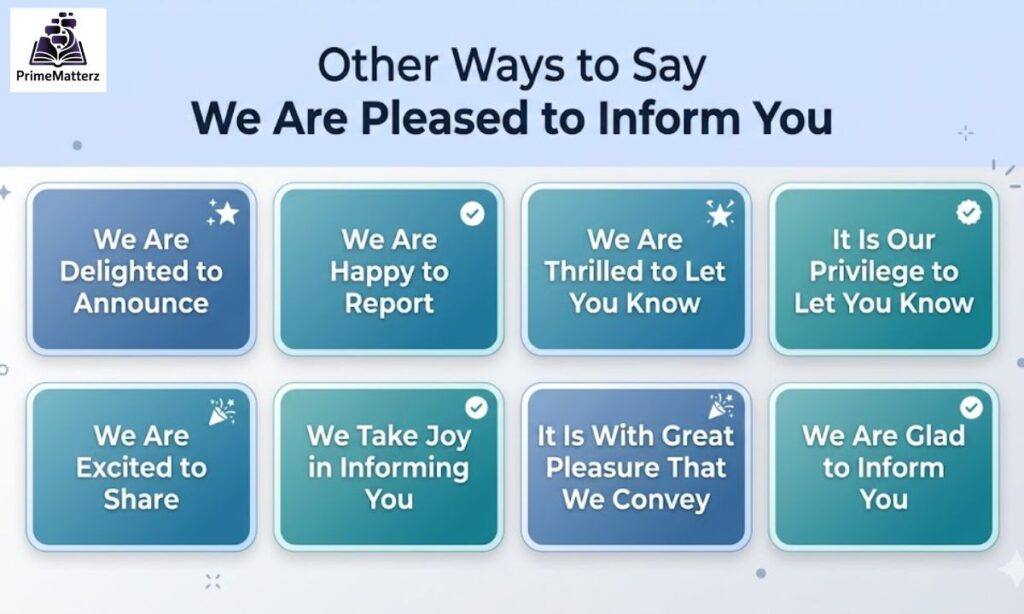
15+ Other Ways to Say “We Are Pleased to Inform You”
Hayat
June 17, 2026No comments
The words you choose in professional communication shape how people feel before they even read your message. Whether you’re writing a job offer, a client update, or a team announcement, your opening phrase sets the entire tone.
If you rely on “we are pleased to inform you” every time, it starts to feel robotic and impersonal. This guide gives you 15+ fresh, practical alternatives — with real examples, tone guides, and clear usage tips — so your good news always lands the right way.
It is a formal, polite phrase used in business and official correspondence to introduce positive news. It signals respect for the recipient and sets a professional tone before delivering important information.
People use it in job offer letters, approval emails, service announcements, and formal notifications. It communicates goodwill and shows the sender values the relationship with the reader.
When Should You Use “We Are Pleased to Inform You”?
In workplace emails and formal business letters, this phrase works well when delivering significant news — like hiring decisions, application results, or contract approvals. It creates the right level of professionalism for high-stakes communication.
It is less suitable for casual team messages, internal chats, or friendly emails where a warmer, more natural opening would feel more appropriate. Always match the weight of your phrase to the weight of your message.
Is “We Are Pleased to Inform You” Professional or Polite?
Yes — it is both. But like any phrase used too often, it can start to feel stiff or outdated.
Pros:
Clearly professional and widely accepted
Sets a positive, respectful tone immediately
Works across industries — HR, legal, corporate, customer service
Universally understood by any recipient
Signals that good news follows
Cons:
Can feel overly formal or cold in modern workplaces
Overused in templates and automated emails
Lacks warmth or personality
May feel impersonal when writing to someone you know well
Does not reflect genuine enthusiasm when the news is genuinely exciting
Grammar & Correct Usage of “We Are Pleased to Inform You”
✅ Correct: “We are pleased to inform you that your application has been approved.”
✅ Can be shortened: “We’re pleased to inform you…” is acceptable in semi-formal emails
❌ Incorrect: “We are pleased to inform you about your application is approved.” — do not use “about” before a clause; use “that”
❌ Avoid: “We are pleased to inform you of that your offer…” — never use both “of” and “that” together
Formal usage: keep “we are” uncontracted in official letters
Informal usage: contraction “we’re” is fine in professional emails to known contacts
Always follow the phrase with “that” before the main clause: “We are pleased to inform you that the position is yours.”
Common Mistakes When Using “We Are Pleased to Inform You”
Overuse: Using it in every email, including routine or minor updates, strips it of meaning
Wrong context: Opening a casual internal message with it makes the tone feel stiff and awkward
Missing “that”: Writing “We are pleased to inform you the result…” without “that” is grammatically weak
Mismatched tone: Using it in a text message or chat platform sounds out of place
False formality: Using it in an automated bulk email makes recipients feel like a number, not a person
Pairing with negative news: Never use this phrase when delivering mixed or bad news — it creates a jarring disconnect
How to Respond to “We Are Pleased to Inform You”
1. “Thank you so much — this is wonderful news.” Meaning: Expresses genuine gratitude and positive emotion. Best use: Responding to a job offer or acceptance notification.
Example:“We are pleased to inform you that you’ve been selected.” / “Thank you so much — this is wonderful news. I’m looking forward to next steps.”
2. “I appreciate you letting me know so promptly.” Meaning: Acknowledges the sender’s professionalism and timeliness. Best use: Responding to a formal approval or decision email.
Example:“We are pleased to inform you that your request has been approved.” / “I appreciate you letting me know so promptly. I’ll proceed accordingly.”
3. “This is great to hear — please share any details I need to review.” Meaning: Shows enthusiasm and signals readiness to act. Best use: Business approvals, contract confirmations, or project green lights. Example:“
We are pleased to inform you that the board has approved your proposal.” / “This is great to hear — please share any details I need to review.”
4. “I’m honored and excited to move forward.” Meaning: Conveys both humility and enthusiasm — ideal for personal milestones. Best use: Job offers, awards, scholarship acceptances.
Example: “We are pleased to inform you that you’ve been awarded the scholarship.” / “I’m honored and excited to move forward with the next steps.”
5. “Noted with thanks — I’ll be in touch shortly.” Meaning: Professional, brief acknowledgment — useful when details need to follow. Best use: Corporate or formal contexts where a short reply is appropriate.
Example:“We are pleased to inform you that your account upgrade is now active.” / “Noted with thanks — I’ll be in touch shortly if I have any questions.”
15+ Other Ways to Say “We Are Pleased to Inform You”
1. We Are Delighted to Inform You
Meaning: Adds warmth without losing professionalism. “Delighted” feels more genuine and less formulaic than “pleased,” showing real enthusiasm for the good news being shared.
Example:
Person A: “We are delighted to inform you that your loan application has been approved.”
Person B: “That’s fantastic — thank you for the quick update.”
Best Use: Job offers, approval letters, client communications. Worst Use: Internal routine updates or mass notifications. Tone: Formal, warm.
2. We’re Happy to Let You Know
Meaning: A friendlier, more modern alternative that sounds human rather than corporate. It keeps the positive intent while shedding unnecessary stiffness.
Example:
Person A: “We’re happy to let you know that your order has been dispatched and will arrive tomorrow.”
Person B: “Perfect — I’ll make sure someone is home to receive it.”
Best Use: Customer service emails, retail communications, team announcements. Worst Use: Legal or highly formal correspondence. Tone: Semi-formal, friendly.
3. We’re Thrilled to Share
Meaning: Brings genuine excitement to the announcement. This phrase signals that the sender is emotionally invested in the good news, not just reporting it mechanically.
Example:
Person A: “We’re thrilled to share that our company has just crossed one million customers.”
Person B: “What an incredible milestone — congratulations to the whole team!”
Best Use: Company achievements, product launches, milestone announcements. Worst Use: Formal legal or compliance notifications. Tone: Enthusiastic, professional.
4. It’s Our Pleasure to Inform You
Meaning: A courteous, service-oriented phrase that puts the emphasis on the sender’s goodwill. It sounds respectful and gracious without being over the top.
Example:
Person A: “It’s our pleasure to inform you that your membership renewal has been successfully processed.”
Person B: “Thank you — I appreciate the confirmation.”
Best Use: Customer service, membership or subscription communications. Worst Use: Peer-to-peer internal emails where it may feel excessive. Tone: Formal, respectful, service-focused.
5. We’re Excited to Announce
Meaning: Perfect for public-facing communications and team-wide updates. It builds anticipation and makes the reader feel they’re hearing something worth paying attention to.
Example:
Person A: “We’re excited to announce the launch of our new mobile app, available starting Monday.”
Person B: “I’ve been waiting for this — downloading it right away!”
Best Use: Product launches, event announcements, new hire introductions. Worst Use: Sensitive or confidential one-on-one notifications. Tone: Enthusiastic, professional, modern.
6. We’re Glad to Report
Meaning: Works especially well for progress updates and results-driven communication. It implies that things went well and the sender is relieved and satisfied to share the outcome.
Example:
Person A: “We’re glad to report that the audit found no compliance issues in your department.”
Person B: “That’s a relief — thank you for completing the review so thoroughly.”
Best Use: Status reports, audit results, project completions. Worst Use: Personal or emotionally significant announcements. Tone: Professional, reassuring, neutral-positive.
7. It Gives Us Great Pleasure to Inform You
Meaning: A highly formal, ceremonial phrase reserved for significant occasions. It adds weight and gravity to the announcement and signals that the news is of genuine importance.
Example:
Person A: “It gives us great pleasure to inform you that you have been selected as this year’s Distinguished Alumni Award recipient.”
Person B: “I am truly honored — thank you for this recognition.”
Best Use: Awards, honors, senior-level appointments, formal ceremonies. Worst Use: Everyday emails or casual team updates. Tone: Highly formal, ceremonial.
8. We’re Pleased to Share With You
Meaning: Slightly warmer than the original — “share” implies a collaborative, personal touch rather than a one-way notification. It invites connection rather than just delivering information.
Example:
Person A: “We’re pleased to share with you the results of this quarter’s employee satisfaction survey.”
Person B: “Thank you — I’ll review this with the team at Friday’s meeting.”
Best Use: Internal reports, stakeholder updates, team communications. Worst Use: Quick operational messages where brevity matters more. Tone: Professional, collaborative.
9. We Have Great News to Share
Meaning: Gets straight to the excitement without any formal preamble. It’s conversational, upbeat, and immediately signals that something good is coming.
Example:
Person A: “We have great news to share — your funding application has been fully approved.”
Person B: “This is amazing news! When can we schedule a kickoff call?”
Best Use: Internal team emails, startup communications, nonprofit announcements. Worst Use: Formal official correspondence or legal documents. Tone: Friendly, upbeat, semi-formal.
10. We’re Honored to Announce
Meaning: Adds a layer of humility and sincerity. It tells the recipient that the sender genuinely values the moment and doesn’t take it lightly.
Example:
Person A: “We’re honored to announce that Dr. Reyes has joined our board of directors.”
Person B: “Wonderful news — her expertise will be a tremendous asset.”
Best Use: Leadership appointments, partnership announcements, formal recognitions. Worst Use: Routine service or operational updates. Tone: Formal, respectful, sincere.
11. Happy to Announce
Meaning: A short, energetic opener that skips corporate language entirely and leads with genuine positivity. It works when the sender and recipient have an established, comfortable relationship.
Example:
Person A: “Happy to announce that the team hit 120% of its quarterly target!”
Person B: “That’s fantastic — well done to everyone involved!”
Best Use: Team emails, Slack announcements, internal newsletters. Worst Use: Formal HR letters, client-facing official documents. Tone: Casual, energetic, friendly.
12. We’re Proud to Inform You
Meaning: Adds a sense of ownership and achievement. It signals that the sender is not just reporting facts but genuinely invested in the outcome being announced.
Example:
Person A: “We’re proud to inform you that your student has been named valedictorian of the graduating class.”
Person B: “We couldn’t be more proud — thank you for sharing this.”
Best Use: Educational notifications, achievement letters, recognition communications. Worst Use: Neutral business transactions without a personal or achievement angle. Tone: Warm, proud, professional.
13. We’re Eager to Let You Know
Meaning: Conveys enthusiasm and forward momentum — the sender couldn’t wait to share this news. It adds energy and personalizes the announcement.
Example:
Person A: “We’re eager to let you know that your interview went extremely well and we’d like to move forward.”
Person B: “I’m so glad to hear that — I’m very excited about the opportunity.”
Best Use: Recruitment communications, positive follow-up emails, client wins. Worst Use: Formal announcements where excitement may seem out of place. Tone: Enthusiastic, professional.
14. It Is With Great Pleasure That We Inform You
Meaning: The most formal alternative on this list — its structure mirrors legal and official correspondence. It carries a ceremonial quality ideal for high-stakes announcements.
Example:
Person A: “It is with great pleasure that we inform you of your selection as a Fellow of the Academy.”
Person B: “I am deeply grateful for this recognition and the trust it represents.”
Best Use: Academic honors, fellowships, government or official body communications. Worst Use: Any informal or digital-first communication environment. Tone: Highly formal, ceremonial, official.
15. We’re Delighted to Share
Meaning: A warmer, more modern variation of the classic formal phrase. It blends professionalism with approachability — ideal for companies that want to maintain formality while sounding human.
Example:
Person A: “We’re delighted to share that your project has been shortlisted for the National Innovation Award.”
Person B: “That’s brilliant news — thank you for the update.”
Best Use: Award notifications, partnership updates, client relationship emails. Worst Use: Mass automated emails where the warmth feels manufactured. Tone: Warm, professional.
16. Excited to Let You Know
Meaning: Direct, personal, and full of genuine energy. Dropping “we are” makes it feel conversational and less corporate — great when you want to connect as a person, not just a company.
Example:
Person A: “Excited to let you know — your design proposal was selected by the client!”
Person B: “That’s made my whole day. Thank you for telling me right away.”
Best Use: Direct messages, internal team updates, colleague-to-colleague emails. Worst Use: Formal letters, legal notices, or communications to senior stakeholders. Tone: Casual, enthusiastic, direct.
17. It’s Our Privilege to Inform You
Meaning: Puts the emphasis on the sender’s gratitude for being the one delivering such news. It feels gracious and elevates both the message and the recipient.
Example:
Person A: “It’s our privilege to inform you that you have been selected as the commencement speaker.”
Person B: “I am deeply touched and would be honored to accept.”
Best Use: Academic, ceremonial, or high-honor communications. Worst Use: Everyday business emails or quick internal messages. Tone: Formal, gracious, respectful.
18. We’re Happy to Report
Meaning: A practical, results-oriented phrase that works well when sharing outcomes, data, or performance updates. It implies things turned out well and the sender is satisfied.
Example:
Person A: “We’re happy to report that all critical system issues have been fully resolved.”
Person B: “Great — I’ll let the stakeholders know the platform is stable again.”
Best Use: IT updates, operational reports, client status emails. Worst Use: Personal or emotionally meaningful one-on-one announcements. Tone: Professional, reassuring, semi-formal.
19. We Are Glad to Inform You
Meaning: A softer, gentler version of the original — “glad” feels less corporate than “pleased” and slightly more sincere. It works well when you want warmth without dropping professionalism.
Example:
Person A: “We are glad to inform you that your warranty claim has been approved and a replacement is on its way.”
Person B: “That’s a relief — thank you for sorting that out so quickly.”
Best Use: Customer service, complaint resolutions, support follow-ups. Worst Use: High-formality legal or official communications. Tone: Friendly, professional, warm.
20. It’s Our Joy to Tell You
Meaning: The most emotionally expressive phrase on this list — it wraps the announcement in genuine human warmth. Reserved for moments where you truly want the recipient to feel celebrated.
Example:
Person A: “It’s our joy to tell you that after years of dedication, you’ve been promoted to Senior Director.”
Person B: “Words can’t express how much this means — thank you for believing in me.”
Best Use: Promotions, personal milestones, long-awaited good news. Worst Use: Routine business updates, formal legal communications. Tone: Warm, celebratory, heartfelt.
Formal vs Informal Alternatives
Formal Alternatives
Informal Alternatives
It is with great pleasure that we inform you
Happy to announce
It’s our privilege to inform you
Excited to let you know
It gives us great pleasure to inform you
We have great news to share
We are honored to announce
We’re thrilled to share
It’s our pleasure to inform you
We’re eager to let you know
We are delighted to inform you
We’re happy to let you know
It’s our joy to tell you
Glad to inform you
We are pleased to present
We’re happy to report
We’re pleased to share with you
We’re excited to announce
We are proud to inform you
Just wanted to let you know
Which Alternative Should You Choose?
Workplace / general professional: “We’re pleased to share with you” or “We’re glad to inform you” strike the right balance — professional without sounding stiff or outdated.
Email to a manager: Use “We are delighted to inform you” or “It’s our pleasure to inform you” — these show respect for the hierarchy and keep the tone appropriately formal.
Email to a customer: “We’re happy to let you know” or “We’re glad to inform you” work best — they sound helpful and human, not like a system-generated message.
Friend or family member: Drop the formality entirely. “I’m so happy to tell you” or “Excited to let you know” feel natural and genuine in personal relationships.
Social media announcement: Go with “We’re thrilled to share” or “We’re excited to announce” — these phrases build excitement, invite engagement, and work well in public-facing content.
Senior leadership or board-level communication: Stick with “It is with great pleasure that we inform you” or “We are honored to announce” — the weight of the phrase matches the gravity of the audience.
Frequently Asked Questions
Is “We Are Pleased to Inform You” too old-fashioned?
It still works in formal settings, but modern alternatives like “We’re happy to let you know” feel more natural in today’s workplace emails.
What is the most formal alternative to “We Are Pleased to Inform You”?
“It is with great pleasure that we inform you” is the most formal option, best suited for official, ceremonial, or legal communications.
Can I use these phrases in a job offer letter?
Yes — “We are delighted to inform you” or “It’s our pleasure to inform you” are both excellent openers for job offer letters.
What phrase works best for customer service emails?
“We’re happy to let you know” or “We’re glad to inform you” sound helpful and warm without being too casual or too stiff.
Is it okay to use “Excited to let you know” in a professional email?
Yes — it works well in semi-formal contexts like internal team emails or messages to colleagues, but avoid it in formal client or legal correspondence.
Final Thoughts
The right opening phrase does more than deliver information — it shapes how the reader feels from the very first line. Whether you choose a warm “We’re thrilled to share” or a dignified “It is with great pleasure that we inform you,” matching your tone to your audience will always make your message land better.
Keep these alternatives handy and your professional communication will consistently feel fresh, genuine, and effective.