15+ Better Ways to Say “Thank You for the Information”
Hayat
June 02, 2026No comments
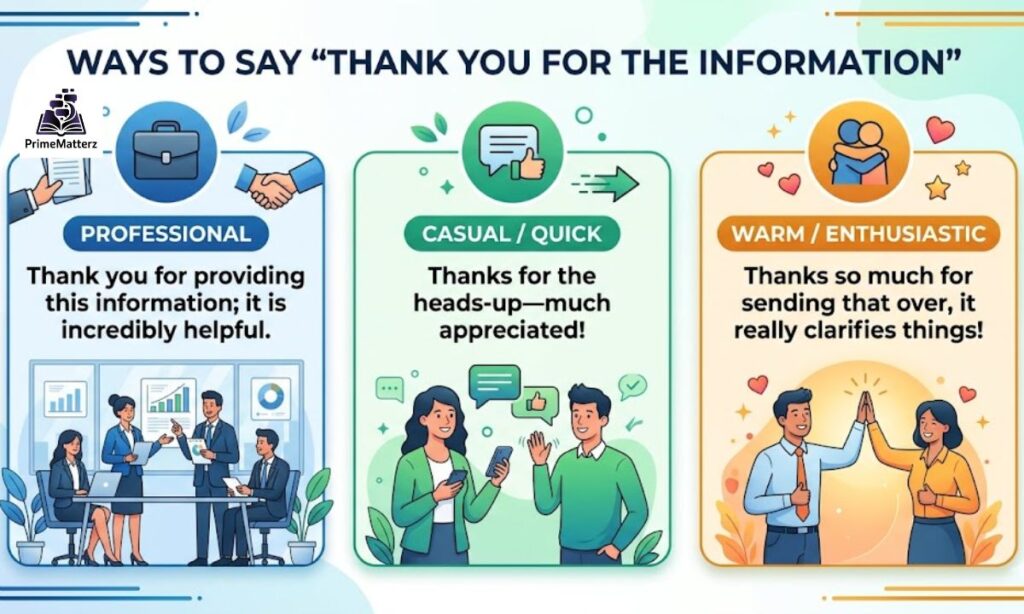
Saying“thank you for the information” gets the job done, but it does not always get the point across. The words you choose in emails, meetings, and messages tell people a lot about you, whether you are professional, thoughtful, and worth dealing with again.
A stronger, more specific phrase shows you actually absorbed what was shared and that you valued the effort behind it. This guide gives you 15+ practical alternatives with real examples, clear guidance, and honest notes on when each one works and when it falls flat.
“Thank you for the information” is a polite acknowledgment that someone shared useful details with you. It signals that you received what they said, that you appreciate it, and that their effort was not wasted. People use it in emails, meetings, calls, and everyday conversation to close the loop on an exchange.
It is a solid, neutral phrase. But it can also feel automatic, like something you type without thinking. When someone takes time to explain something, research something, or pass along something useful, a more thoughtful response tends to land better and strengthen the relationship.
When Should You Use “Thank You for the Information”?
This phrase works in almost any context where someone shares details, data, updates, or explanations. In professional settings, it fits well in emails after a colleague sends research, after a client briefs you, or after a support team resolves a query. It is safe, clear, and widely understood.
In casual settings, though, it can feel a little stiff. If a friend texts you directions or a family member explains something over the phone, a warmer or more relaxed version usually fits better. The key is knowing your audience and matching the tone of your response to the moment and the relationship.
Is “Thank You for the Information” Professional or Polite?
Yes, it is both. It is one of the safest ways to acknowledge what someone shared. But safe does not always mean effective.
Pros
Universally understood and appropriate in almost every context
Neutral enough to use with people you do not know well
Short and easy to include at the start or end of any message
Does not risk sounding over-the-top or insincere
Works across industries, cultures, and communication styles
Cons
Can feel generic, especially in repeat correspondence
Does not show whether the information was actually useful to you
Offers no emotional signal, so it can come across as cold
Overusing it in long email threads makes it feel like filler
Misses a chance to reinforce your professionalism or build rapport
15+ Other Ways to Say “Thank You for the Information”
1. I Really Appreciate You Sharing This
Meaning: A warm, genuine way to acknowledge that the other person went out of their way to pass something along.
Why It Works: The word “sharing” implies the person did not have to tell you but chose to. That small shift shows you noticed their effort, not just the content.
Example: Person A: “I pulled together the quarterly figures for your review.” Person B: “I really appreciate you sharing this. It gives me exactly what I needed.”
Best Use: Emails from colleagues, updates from managers, or when someone volunteers information without being asked.
Worst Use: Very formal, legal, or official correspondence where warmer language might feel out of place.
Tone: Warm, genuine, professional
2. This Is Really Helpful, Thank You
Meaning: You are saying not just that you received the information, but that it actually made a difference.
Why It Works: Telling someone their contribution was helpful validates their effort. It gives the thank-you a reason behind it, which makes it feel more sincere.
Example: Person A: “Here are the steps to reset your account access.” Person B: “This is really helpful, thank you. I will go through it now.”
Best Use: Customer service exchanges, technical explanations, or any situation where someone solved a problem for you.
Worst Use: When you have not actually read or used the information yet, as it can come across as hollow.
Tone: Appreciative, straightforward, friendly
3. Thanks for Keeping Me in the Loop
Meaning: A casual, collegial phrase that shows you value being kept informed on an ongoing basis.
Why It Works: It signals that you see yourself as part of a team and that being updated matters to you. It also nudges the other person to keep doing it.
Example: Person A: “Just wanted to let you know the client approved the proposal.” Person B: “Great news. Thanks for keeping me in the loop.”
Best Use: Team updates, project progress, office news, or any ongoing situation where regular communication is expected.
Worst Use: One-time formal exchanges or situations where “in the loop” sounds too casual.
Tone: Casual, collegial, relaxed
4. I Appreciate the Heads-Up
Meaning: Specifically suited for situations where someone warned you about something or gave you advance notice.
Why It Works: “Heads-up” implies timing matters and the person’s information helped you prepare or avoid something. That specificity makes the gratitude feel earned.
Example: Person A: “The system will be down for maintenance Friday afternoon.” Person B: “I appreciate the heads-up. I will move my deadline to Thursday.”
Best Use: Warnings, scheduling changes, upcoming issues, or anything time-sensitive that required advance notice.
Worst Use: Situations where no advance notice was needed, as the phrase would not quite make sense.
Tone: Casual, practical, appreciative
5. Thank You for the Clarification
Meaning: A focused phrase used specifically when someone cleared up a point that was confusing or unclear.
Why It Works: It tells the person they did more than just share information. They resolved a specific question or misunderstanding, and you are acknowledging that directly.
Example: Person A: “To clarify, the deadline is end of business Friday, not Monday.” Person B: “Thank you for the clarification. I will adjust the timeline accordingly.”
Best Use: Follow-up emails, situations where there was a misunderstanding, or when policy or instructions needed to be made clearer.
Worst Use: When there was no confusion to clear up. Using it then implies there was a problem when there was not.
Tone: Professional, respectful, clear
6. I Found This Very Useful
Meaning: Direct feedback that the information had real practical value for you.
Why It Works: It goes a step further than a basic thank-you by confirming that the information was not just received, it was used. That feedback encourages the other person to keep communicating well.
Example: Person A: “I attached a breakdown of the new billing process.” Person B: “I found this very useful. It answers several questions I had.”
Best Use: Reports, instructions, guides, or any situation where someone put effort into preparing information for you.
Worst Use: Extremely brief or low-effort exchanges where calling it “very useful” might feel like an overstatement.
Tone: Direct, appreciative, professional
7. I Appreciate You Taking the Time to Explain
Meaning: Acknowledges not just the information itself but the effort and patience required to explain it.
Why It Works: This phrase respects the other person’s time, which is something most people genuinely value. It works especially well after a detailed explanation or a long conversation.
Example: Person A: “Let me walk you through how the new reporting system works.” Person B: “I appreciate you taking the time to explain. That makes a lot more sense now.”
Best Use: After training sessions, onboarding calls, mentorship conversations, or lengthy explanations of complex topics.
Worst Use: For short, simple replies where “taking the time” would feel exaggerated.
Tone: Respectful, sincere, professional
8. That Clears Things Up Nicely
Meaning: A friendly, conversational way to say that the explanation resolved your confusion or answered your question.
Why It Works: It is immediate and human. It tells the other person their response did exactly what it was supposed to do, without making the exchange feel formal or heavy.
Example: Person A: “The payment is processed on the 15th, not the 1st of the month.” Person B: “That clears things up nicely. I was confused about that. Thanks.”
Best Use: Casual work conversations, team chats, quick email replies, or anywhere the tone is already relaxed.
Worst Use: Formal correspondence, legal or compliance communications, or high-stakes professional situations.
Tone: Casual, friendly, easy
9. I Grateful for the Update
Meaning: A straightforward way to say thank you specifically for a status update or new development.
Why It Works: It connects the gratitude directly to the act of being updated, which signals that ongoing communication is valued. It also encourages more of it.
Example: Person A: “The shipment has been delayed by two days due to weather.” Person B: “I am grateful for the update. I will let the client know.”
Best Use: Project updates, delivery tracking, changes in plans, or any situation where someone took the initiative to keep you informed.
Worst Use: First-time explanations where “update” would not technically apply.
Tone: Professional, warm, direct
10. Good to Know, Thanks for Telling Me
Meaning: A relaxed, natural response that works well when someone shares useful but non-urgent information.
Why It Works: It is conversational and easy. It does not overcomplicate a simple exchange and feels like something a real person would actually say.
Example: Person A: “By the way, the meeting room has been moved to the third floor.” Person B: “Good to know, thanks for telling me.”
Best Use: Office conversations, quick Slack or Teams messages, casual emails, or text messages.
Worst Use: Formal reports, client-facing communications, or professional emails where this would seem too breezy.
Tone: Casual, natural, friendly
11. I Will Keep That in Mind
Meaning: Not just a thank-you but a commitment. You are acknowledging the information and signaling that it will actually influence your actions.
Why It Works: It shows the information landed and will be used. That small extra step makes the person feel like sharing it was worthwhile.
Example: Person A: “The client prefers to be reached by email, not phone.” Person B: “I will keep that in mind. Thanks for the tip.”
Best Use: Advice, preferences, soft warnings, or any information that will guide future behavior or decisions.
Worst Use: Data, reports, or complex information that requires more than just “keeping in mind.”
Tone: Attentive, professional, practical
12. Much Appreciated
Meaning: A short, punchy way to express genuine thanks without any fuss.
Why It Works: Sometimes less is more. This phrase is clean and direct. It works especially well in back-and-forth email threads where you do not want to slow the conversation down.
Example: Person A: “I forwarded the updated contract to your inbox.” Person B: “Much appreciated.”
Best Use: Brief email exchanges, Slack replies, or any situation where a short acknowledgment is enough.
Worst Use: Situations where a more thoughtful, detailed response is clearly expected, such as after someone spent real time preparing something for you.
Tone: Professional, efficient, clean
13. Thank You for Bringing This to My Attention
Meaning: Specifically suited for situations where someone flagged something you were not aware of.
Why It Works: It acknowledges that the person did you a specific service by raising something on your radar. It is more intentional than a generic thank-you.
Example: Person A: “I noticed there is a discrepancy in the invoices from last quarter.” Person B: “Thank you for bringing this to my attention. I will look into it right away.”
Best Use: Issues, errors, risks, concerns, or any situation where someone is surfacing a problem or something that needs action.
Worst Use: Routine information sharing where nothing was specifically flagged or flagged to your attention.
Tone: Formal, responsible, professional
14. I Appreciate Your Thoroughness
Meaning: A phrase that recognizes not just the information but the detail and care that went into gathering or presenting it.
Why It Works: It compliments the person’s process, not just their output. That kind of recognition feels meaningful and specific.
Example: Person A: “I included a full breakdown with sources attached.” Person B: “I appreciate your thoroughness. This is exactly what I needed.”
Best Use: Detailed reports, research summaries, well-organized briefs, or any situation where someone clearly put in extra effort.
Worst Use: Quick, casual exchanges where calling someone “thorough” would feel oddly formal.
Tone: Respectful, professional, specific
15. That Is Really Good to Know
Meaning: A warm, natural response that acknowledges information had genuine value to you.
Why It Works: It mirrors how real people actually speak. It does not sound scripted, and it invites continued conversation without making things awkward.
Example: Person A: “The new vendor offers a 10 percent discount for bulk orders.” Person B: “That is really good to know. I will factor that into the budget.”
Best Use: General information updates, new details you were not expecting, or conversations where the tone is already warm and informal.
Worst Use: Formal, written-only communications with people you do not have an established relationship with.
Tone: Natural, warm, conversational
16. Thank You for the Insight
Meaning: Used when the information offered a deeper understanding, perspective, or angle you had not considered.
Why It Works: “Insight” implies the value went beyond just facts. It tells the person they gave you something to think about, which is a meaningful compliment.
Example: Person A: “Based on our past campaigns, shorter subject lines consistently get higher open rates.” Person B: “Thank you for the insight. I will apply that going forward.”
Best Use: Strategic conversations, mentorship, expert advice, or any situation where someone offered more than just data.
Worst Use: Basic factual exchanges where “insight” would be an overstatement.
Tone: Thoughtful, professional, sincere
17. I Value This Information
Meaning: A clean, professional phrase that puts emphasis on the worth of what was shared.
Why It Works: The word “value” does real work here. It moves the response beyond politeness and signals that the information matters and will be used.
Example: Person A: “Here are the results from the user testing session.” Person B: “I value this information. It will shape our next design decisions.”
Best Use: Research, data reports, strategic updates, or any situation where the information feeds directly into a decision.
Worst Use: Casual or lightweight exchanges where “I value this” would feel overdressed.
Tone: Professional, sincere, direct
18. Thanks, That Answers My Question
Meaning: Direct and satisfying. It tells the person they hit the mark and solved exactly what you were wondering.
Why It Works: It closes the loop cleanly. The other person knows the exchange was successful, which makes the communication feel complete and efficient.
Example: Person A: “Yes, the trial period is 30 days with no credit card required.” Person B: “Thanks, that answers my question.”
Best Use: Q&A-style conversations, support tickets, quick clarifications, or follow-up emails where a specific question was raised.
Worst Use: Ongoing or open-ended exchanges where more conversation is expected.
Tone: Efficient, clear, casual
19. I Am Glad You Mentioned That
Meaning: Signals that the information was timely or particularly relevant to something you were already thinking about.
Why It Works: It makes the other person feel perceptive. It also sounds natural and warm without being over the top.
Example: Person A: “By the way, the meeting time was shifted to 3 PM.” Person B: “I am glad you mentioned that. I almost missed the update.”
Best Use: Timely information, things that might have slipped through the cracks, or anything that would have caused a problem if not shared.
Worst Use: Situations where the information was expected or routine, where “I am glad you mentioned that” might imply things are more disorganized than they are.
Tone: Warm, conversational, appreciative
20. I Will Take That on Board
Meaning: A professional, action-oriented phrase that tells someone their information has been absorbed and will influence what happens next.
Why It Works: It reassures the person that sharing the information was not a one-way dead end. It signals that you are thoughtful and responsive.
Example: Person A: “The stakeholders prefer written summaries over slide decks.” Person B: “I will take that on board for the next presentation. Thanks.”
Best Use: Feedback, preferences, recommendations, or any information that should change how you approach something.
Worst Use: Purely factual data or neutral information where “taking something on board” would not quite apply.
Tone: Professional, action-focused, respectful
Professional Alternatives
Phrase
Formality Level
Best Situation
Thank you for the clarification
High
Resolving a misunderstanding or unclear policy
I appreciate your thoroughness
High
Detailed reports or well-prepared briefings
Thank you for bringing this to my attention
High
Flagging errors, risks, or concerns
I appreciate you taking the time to explain
High
Training, onboarding, or complex explanations
I value this information
High
Strategic decisions or data-driven work
I will take that on board
Medium-High
Feedback, recommendations, or preferences
I am grateful for the update
Medium-High
Project status, changes in plans
Thank you for the insight
Medium-High
Expert advice or strategic perspective
Much appreciated
Medium
Quick email replies or brief acknowledgments
I found this very useful
Medium
Reports, guides, or prepared information
Casual Alternatives
These work well in texts, casual emails, social media replies, and conversations with friends or family:
“Good to know, thanks for telling me” — natural and zero-effort to say or type
“Thanks for the heads-up” — perfect when someone warned you or gave advance notice
“Thanks, that answers my question” — clean and final, great for quick exchanges
“That clears things up nicely” — friendly and conversational
“Thanks for keeping me in the loop” — ideal for ongoing group or team chats
“I am glad you mentioned that” — warm and personal, works well in real conversation
“I will keep that in mind” — shows the information actually registered
Email-Friendly Alternatives
Alternative
Best Email Situation
I really appreciate you sharing this
Colleague sends a report or research
Thank you for the clarification
Following up after a confusing instruction
I appreciate your thoroughness
Recipient prepared detailed documentation
Thank you for bringing this to my attention
Someone flagged an error or risk
I am grateful for the update
Project status email or progress report
I found this very useful
After receiving instructions or a guide
Thank you for the insight
Strategic advice or expert perspective shared
I will take that on board
Feedback from a manager or client
Much appreciated
Short acknowledgment in a quick email thread
I appreciate you taking the time to explain
After a complex explanation or walkthrough
How to Choose the Best Alternative
Workplace Communication
Match the formality to your relationship with the recipient
Use phrases like “I appreciate your thoroughness” for managers or senior stakeholders
Keep it efficient with colleagues: “Much appreciated” or “Thanks for keeping me in the loop”
Avoid overly casual language in written communications that may be forwarded
Customer Service
Always acknowledge both the information and the effort behind it
Phrases like “Thank you for the clarification” or “This is really helpful, thank you” work well
Close the loop clearly so the customer knows their question was answered
Avoid anything that sounds dismissive or too brief in high-stakes situations
Friends and Family
Keep it natural and conversational
“Good to know” or “Glad you mentioned that” fits perfectly in everyday exchanges
Match the energy of the conversation, not a formal email template
A short, warm response is always better than a stiff or overly formal one
Formal Situations
Use phrases that acknowledge both the content and the person’s effort
Stick to “Thank you for bringing this to my attention” or “I value this information” for legal or official contexts
Avoid slang or contractions in formal written correspondence
Be specific: name what was shared and briefly explain how it helps you
Common Mistakes to Avoid
Using the same phrase in every email. “Thank you for the information” in every reply starts to feel automated. Mix it up based on context, and your messages will feel more genuine.
Choosing a phrase that does not fit the situation. Saying “Thanks for the heads-up” when someone shared a detailed research report undersells their effort. Match your response to the weight of what was shared.
Being vague about why you are grateful. “Thanks for this” tells the other person nothing. Even one short sentence explaining how the information helps makes your gratitude feel real.
Going too formal with close colleagues. Responding to a Slack message with “I appreciate your thoroughness” can come across as sarcastic or oddly stiff. Read the room.
Skipping the follow-through. Saying “I will keep that in mind” or “I will take that on board” and then clearly not doing so will damage your credibility over time.
Over-thanking in long threads. Adding “thank you for the information” to every reply in a 10-message chain starts to feel like padding. Use it when it genuinely adds something.
Using “I am much obliged” with younger or informal audiences. This phrase reads as outdated to many people and can unintentionally create distance instead of warmth.
Frequently Asked Questions
Is “thank you for the information” too formal for casual emails?
It depends on your audience, but for casual or internal team emails, a simpler phrase like “thanks for keeping me in the loop” usually feels more natural.
What is the most professional way to say thank you for the information?
Phrases like “Thank you for bringing this to my attention” or “I appreciate your thoroughness” are strong choices for formal or high-stakes professional communication.
Can I just say “noted” instead of “thank you for the information”?
“Noted” is fine for very brief internal replies, but it can come across as cold or dismissive in client-facing or emotionally significant exchanges.
How do I make a thank-you for information sound more genuine?
Add one specific sentence about how the information helps you, such as “This gives me exactly what I need to move forward,” and your response will instantly sound more sincere.
Is it okay to thank someone for information in a text message?
Yes, and something like “Good to know, thanks for telling me” or “Glad you mentioned that” works much better in texts than formal phrases.
Final Thoughts
“Thank you for the information” is perfectly fine, but it rarely leaves an impression. The right alternative, one that matches the moment, the relationship, and the weight of what was shared, tells the other person that you actually heard them and that their effort mattered.
That is not just good manners. It is good communication, and it is one of the easiest ways to build trust and credibility in every exchange you have.