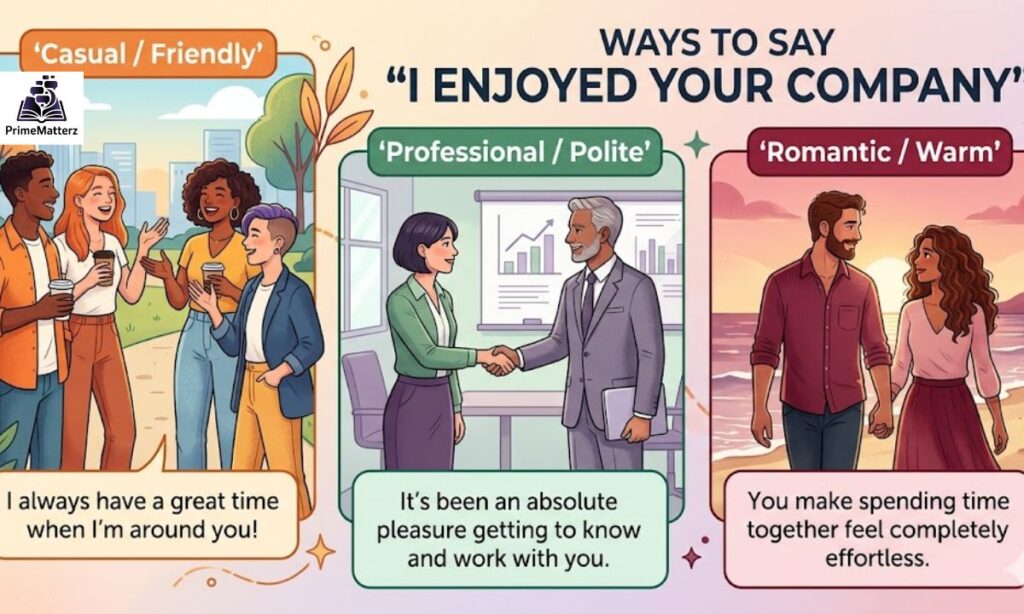
Knowing how to express that you had a good time with someone is more important than most people realize. The words you choose shape how others see you, whether in a job interview follow-up, a text to a friend, or a note to a client.
If “I enjoyed your company” feels a little stiff or repetitive, this guide gives you 15+ fresh alternatives, with real examples and clear guidance on when and where to use each one.
“I enjoyed your company” is a polite, sincere way of telling someone that their presence made your time together better. It goes beyond just saying you had fun. It puts the focus on the other person and acknowledges that they specifically contributed to the experience.
People use it after meetings, dinners, dates, events, or any shared time. It works in professional and personal settings, though it leans slightly formal. That is exactly why so many people look for alternatives that feel a bit more natural or better matched to the moment.
When Should You Use “I Enjoyed Your Company”?
This phrase fits well in professional settings where you want to sound warm but still polished. Think post-meeting emails, thank-you notes to clients, or messages to a new colleague after a work lunch. It signals appreciation without getting too personal.
In casual situations, though, it can sound a little stiff. If you are texting a friend or talking to a family member, something more relaxed usually works better. The key is matching your words to the relationship and the setting. The sections below give you plenty of options for both.
Is “I Enjoyed Your Company” Professional or Polite?
Yes, it is both. But like any phrase, it has strengths and limits.
Pros
Easy to understand and hard to misread
Works across most professional and social contexts
Feels genuine without being overly emotional
Appropriate in emails, cards, and face-to-face conversation
Safe choice when you are unsure of the right tone
Cons
Can sound a bit formal or dated in casual conversation
Feels generic if used too often with the same person
Does not stand out, so it may not leave a lasting impression
In a text message, it might come across as stiff or robotic
Misses an opportunity to say something more specific and personal
15+ Other Ways to Say “I Enjoyed Your Company”
1. It Was a Pleasure Spending Time With You
Meaning: A polished, sincere way to say you valued the time together.
Why It Works: This phrase feels warm and professional at the same time. It acknowledges the other person’s presence without making the moment awkward or overly sentimental.
Example: Person A: “Thanks for coming to the event tonight.” Person B: “It was a pleasure spending time with you. I hope we can do it again.”
Best Use: Post-meeting emails, client follow-ups, or messages after a formal event.
Worst Use: Quick texts between close friends where it would feel overly stiff.
Tone: Formal, warm, respectful
2. I Had a Great Time With You
Meaning: A natural, friendly way to say the experience was genuinely fun.
Why It Works: This phrase feels easy and real. It does not sound scripted, and it works well in both written and spoken conversation.
Example: Person A: “Thanks for hanging out today.” Person B: “Absolutely. I had a great time with you.”
Best Use: Texting a friend, wrapping up a casual lunch, or messaging someone after a social event.
Worst Use: Formal client emails where a more polished phrase would serve you better.
Tone: Casual, friendly, genuine
3. I Really Loved Catching Up With You
Meaning: Perfect for reconnecting with someone you have not seen in a while.
Why It Works: It signals that you missed the person and that the reunion was meaningful, not just pleasant.
Example: Person A: “It was so good to see you after all this time.” Person B: “Same here. I really loved catching up with you.”
Best Use: Reunions, old friendships, family visits, or reconnecting with former colleagues.
Worst Use: First-time meetings where “catching up” does not apply.
Tone: Warm, affectionate, personal
4. Your Presence Made the Day Better
Meaning: You are telling someone that they personally lifted the experience.
Why It Works: This one goes beyond saying the time was fun. It puts the spotlight directly on the person and makes them feel genuinely valued.
Example: Person A: “I am glad I could make it to the event.” Person B: “Your presence made the day better. Seriously.”
Best Use: After a meaningful gathering, a difficult day where someone supported you, or an event that almost did not happen.
Worst Use: Formal business settings where it might come across as overly familiar.
Tone: Sincere, warm, personal
5. I Always Enjoy Our Conversations
Meaning: This phrase highlights not just the time spent but the quality of the dialogue.
Why It Works: It tells the other person that what they say matters to you, which is a meaningful compliment.
Example: Person A: “I feel like we talk for hours every time.” Person B: “I know. I always enjoy our conversations.”
Best Use: With close friends, mentors, interesting colleagues, or anyone you connect with deeply.
Worst Use: One-time encounters where saying “always” would not ring true.
Tone: Friendly, thoughtful, genuine
6. It Was Wonderful to See You
Meaning: A classic phrase that expresses happiness at being reunited or spending time with someone.
Why It Works: It is simple, warm, and works in almost any context. Hard to get wrong.
Example: Person A: “I am so glad you could make the trip.” Person B: “It was wonderful to see you. Let us not wait so long next time.”
Best Use: After visits, events, or any time seeing someone felt special.
Worst Use: Overly formal written reports or corporate settings.
Tone: Warm, classic, versatile
7. I Thoroughly Enjoyed Our Time Together
Meaning: A more formal, expressive way to say the time was genuinely fulfilling.
Why It Works: The word “thoroughly” adds depth. It tells the other person the enjoyment was complete, not just surface-level.
Example: Person A: “Thank you for joining us for the workshop.” Person B: “I thoroughly enjoyed our time together. The discussion was incredibly valuable.”
Best Use: Professional emails, post-conference messages, or formal follow-ups.
Worst Use: Casual texts or messages to close friends where it would feel overdressed.
Tone: Formal, polished, professional
8. You Are Such Good Company
Meaning: A direct compliment that tells the person they are genuinely enjoyable to be around.
Why It Works: It focuses entirely on the person, not just the event. That makes it feel more personal and memorable.
Example: Person A: “I hope dinner was worth the drive.” Person B: “Every minute. You are such good company.”
Best Use: Casual and semi-casual settings, dates, dinners with friends or family.
Worst Use: Formal professional settings where it might feel too personal.
Tone: Friendly, genuine, warm
9. I Loved Every Minute of It
Meaning: An enthusiastic expression that shows you were fully present and happy during the time together.
Why It Works: The energy in this phrase is contagious. It tells the person the time was not just okay, it was great from start to finish.
Example: Person A: “I hope the trip was worth it.” Person B: “I loved every minute of it. Thank you for making it happen.”
Best Use: After trips, parties, special occasions, or any experience that genuinely stood out.
Worst Use: Routine meetings or low-key interactions where this level of enthusiasm might seem excessive.
Tone: Enthusiastic, warm, expressive
10. It Was So Good to Have You Around
Meaning: A relaxed, heartfelt way to say someone’s presence was appreciated.
Why It Works: This phrase feels natural in spoken conversation and comes across as completely genuine without trying too hard.
Example: Person A: “Thanks for coming to visit this weekend.” Person B: “Of course. It was so good to have you around.”
Best Use: Hosting situations, family visits, friends staying over, or welcoming someone to a group setting.
Worst Use: Remote or written-only interactions where “around” might feel out of place.
Tone: Casual, warm, genuine
11. I Am Really Glad We Got to Spend Time Together
Meaning: Expresses relief and gratitude that the time happened, implying it meant something.
Why It Works: The word “glad” adds an emotional layer. It suggests you value the relationship and are happy the moment came together.
Example: Person A: “I know your schedule has been packed lately.” Person B: “It has, but I am really glad we got to spend time together.”
Best Use: When time together was hard to arrange, or when reconnecting after a long gap.
Worst Use: Situations where the “I am glad it happened” framing would feel like a low bar.
Tone: Sincere, personal, thoughtful
12. Time Always Flies When We Are Together
Meaning: A lighthearted way of saying the person is so engaging that time feels short in their presence.
Why It Works: It is a compliment wrapped in a casual observation. The other person understands they held your attention the entire time.
Example: Person A: “I cannot believe it is already midnight.” Person B: “Time always flies when we are together.”
Best Use: Longer hangouts, trips, evenings with close friends, or anyone you genuinely lose track of time with.
Worst Use: Short, formal interactions where the sentiment would not hold up.
Tone: Playful, warm, casual
13. I Value the Time We Spend Together
Meaning: A more reflective, sincere phrase that signals this relationship matters to you.
Why It Works: It moves beyond a single encounter and says that quality time with this person is something you hold in high regard.
Example: Person A: “I hope we can do this more often.” Person B: “I hope so too. I really value the time we spend together.”
Best Use: Close friendships, long-term relationships, meaningful mentorships, or conversations with people who matter to you.
Worst Use: Very casual one-off interactions where the phrase would feel too intense.
Tone: Sincere, meaningful, personal
14. That Was Really Good for the Soul
Meaning: An expressive way to say the time together was genuinely restorative and meaningful.
Why It Works: It goes beyond enjoyment and hints at real emotional impact. It tells the person they made a difference.
Example: Person A: “I feel like we have not had a proper catch-up in ages.” Person B: “Exactly. That was really good for the soul.”
Best Use: After emotionally meaningful conversations, reunions with people you trust deeply, or any time spent that left you feeling refreshed.
Worst Use: Professional or formal settings where it might sound too personal.
Tone: Warm, sincere, emotionally expressive
15. I am So Glad You Were There
Meaning: Event-specific appreciation that tells the person their presence mattered.
Why It Works: It connects the emotion directly to the moment, making the compliment feel specific and real rather than generic.
Example: Person A: “I am happy I could make it to the dinner.” Person B: “Me too. I am so glad you were there.”
Best Use: Events, celebrations, gatherings, or any moment where someone showed up and made things better.
Worst Use: One-on-one hangouts where “there” might sound a little vague or odd.
Tone: Grateful, personal, sincere
16. I Really Appreciate You Making the Time
Meaning: Acknowledges the effort the other person made to be present, not just the enjoyment of their company.
Why It Works: People are busy. Saying this tells them you noticed and respected their effort, which makes the gratitude feel even more genuine.
Example: Person A: “I know it was a long drive to get here.” Person B: “I really appreciate you making the time. It meant a lot.”
Best Use: Professional lunches, mentorship meetings, reunions, or any time someone went out of their way to show up.
Worst Use: Situations where the other person did not actually go to any effort.
Tone: Grateful, respectful, sincere
Professional Alternatives
Phrase
Formality Level
Best Situation
It was a pleasure spending time with you
High
Post-meeting emails, client follow-ups
I thoroughly enjoyed our time together
High
Formal gatherings, professional events
I really appreciate you making the time
High
Business lunches, mentorship meetings
It was wonderful to see you
Medium-High
Conferences, professional events
I value the time we spend together
Medium-High
Long-term professional relationships
I always enjoy our conversations
Medium
Colleagues you work with regularly
I am really glad we got to spend time together
Medium
Team outings, work dinners
I had a great time with you
Medium
Casual team events or client lunches
I am so glad you were there
Medium
Work events or team celebrations
I look forward to doing this again
Medium-High
Any professional follow-up
Casual Alternatives
These work great with friends, family, and in text messages or social media:
“I loved every minute of it” — great after a fun outing or trip
“You are such good company” — direct and personal, best for close friends
“Time flies when we are together” — perfect for late nights or long hangouts
“I loved catching up with you” — ideal for reconnecting with someone you have missed
“That was good for the soul” — when the time was genuinely meaningful or restorative
“It was so good to have you around” — relaxed and warm for visits or hosting
“I had the best time” — enthusiastic and simple, works in person or via text
Email-Friendly Alternatives
Alternative
Best Email Situation
It was a pleasure spending time with you
Post-meeting thank-you note
I thoroughly enjoyed our time together
Following a formal dinner or event
I really appreciate you making the time
After someone went out of their way to meet
I am so glad we got to connect
Following a networking event or intro call
I always enjoy our conversations
Regular check-in with a valued contact
I look forward to continuing our conversation
When you want to signal a follow-up
It was wonderful to reconnect
After a gap in communication
I value the time we spend together
Longer professional relationship check-in
Your insights made the time even more worthwhile
After a productive discussion
It was a great opportunity to connect
Post-networking or conference email
How to Choose the Best Alternative
Workplace Communication
Match the formality to your company culture
Use polished phrases like “It was a pleasure spending time with you” for clients
Stick to warmer, simpler options like “I always enjoy our conversations” with close colleagues
Avoid anything that sounds too emotionally heavy in a professional context
Customer Service
Keep it warm but professional at all times
Phrases like “I appreciate you making the time” work well
Avoid overly casual language that might undercut your credibility
Always leave the door open for future interaction
Friends and Family
Go with whatever feels natural in the moment
More specific phrases like “That was good for the soul” land better than generic ones
Match the energy of the occasion: relaxed for hangouts, more sincere for meaningful moments
Texting allows for shorter, punchy options like “I loved every minute”
Formal Situations
Lean on classic, timeless phrases
Keep it concise but genuine
Avoid slang or overly emotional language
Always connect the appreciation to the specific occasion or shared experience
Common Mistakes to Avoid
Using the same phrase every time. Saying “I enjoyed your company” after every single interaction starts to sound like a script. Switch it up based on the moment.
Choosing a phrase that is too formal for the setting. Telling a close friend “I thoroughly enjoyed our time together” after grabbing tacos will probably get a raised eyebrow.
Going too casual in professional emails. Dropping “I loved every minute” into a client follow-up is risky unless your relationship with that client is genuinely informal.
Being vague when you could be specific. “Your insights made the time worthwhile” is far more memorable than “I enjoyed your company.” Specificity feels more sincere.
Skipping it entirely. A lot of people do not say anything after spending time with someone. Even a brief, genuine acknowledgment goes a long way.
Overusing the word “amazing.” Phrases like “It was amazing spending time with you” get used so often they have lost most of their impact.
Misreading the tone. Not every situation calls for a warm, emotional sign-off. Read the room. Sometimes a simple “Let us do it again soon” is perfect.
Frequently Asked Questions
Is “I enjoyed your company” too formal for texting?
It can feel a bit stiff in a text message. A more natural option like “I had a great time with you” or “I loved catching up” usually lands better.
Can I use these phrases in a professional email?
Yes. Phrases like “It was a pleasure spending time with you” or “I appreciate you making the time” are great for professional follow-ups.
What is the best way to tell someone you enjoy their presence without being awkward?
Keep it specific and brief. Something like “You are such good company” or “I always enjoy our conversations” feels genuine without putting anyone on the spot.
Are there romantic alternatives in this list?
Some phrases like “Your presence made the day better” and “Time flies when we are together” work well in romantic contexts, depending on your delivery and relationship.
How do I end an email after saying I enjoyed someone’s company?
Follow the phrase with a forward-looking line, something like “I look forward to connecting again soon,” then close with your sign-off.
Final Thoughts
The right words after spending time with someone can strengthen a relationship, close a deal, or just make someone’s day a little brighter. “I enjoyed your company” is a solid, reliable choice, but now you have 15+ alternatives that go further, feel more personal, and fit more naturally into every situation. Pick the one that matches the moment, say it like you mean it, and you will leave a far stronger impression than a generic goodbye ever could.