
You wrote a sentence then paused. Should it be “there has” or “there have”? It’s one of those little grammar decisions that confuses even the surest of writers. The good news is that the rule is easier than it seems once you know where to look.
What “There Has Been” and “There Have Been” Actually Mean
Both are used to express something which began in the past and is still important today. Grammar books call this the present perfect and “there” is called a dummy subject. It does not mean a place. It’s basically putting the sentence up so you can say that something exists or something happened.
This structure will be used to introduce events, changes, problems or trends. “There has been a delay” and “there have been multiple delays” serve the same function. They just represent varying quantities of what you are discussing.
The Core Rule: Singular vs. Plural
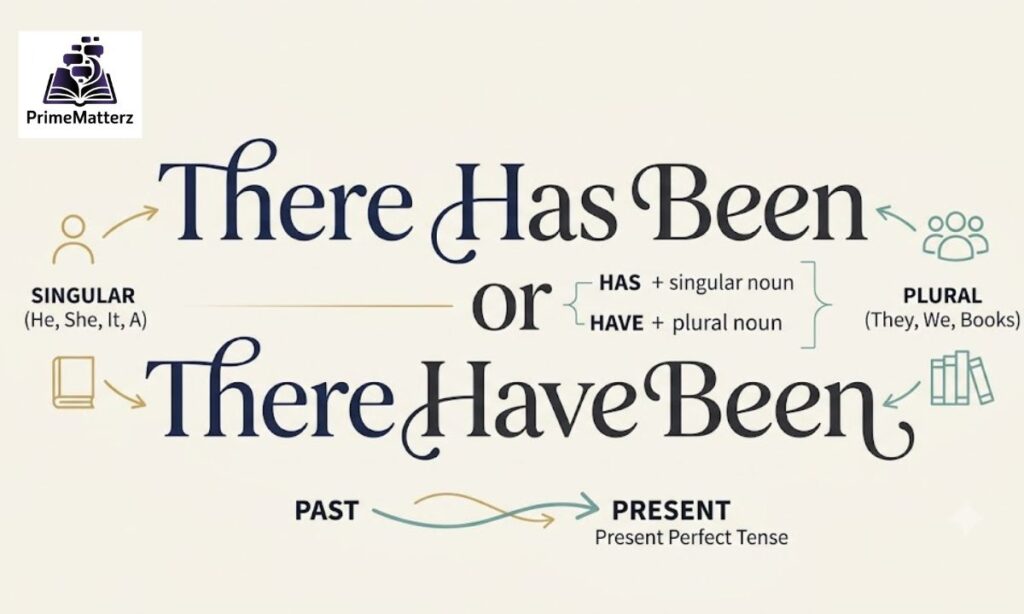
The choice between “has” and “have” comes down to one question: what noun comes right after “been”? That noun decides everything. “There” itself has no say in the matter.
When to Use “There Has Been”
Use “has been” when the noun that follows is singular or uncountable. A single event, one change, or a general concept like confusion or progress all fall into this category.
- There has been a delay in the shipment.
- There has been some confusion about the schedule.
- There has been progress on the new policy.
When to Use “There Have Been”
Use “have been” when the noun that follows is plural. More than one event, complaint, or update means “have,” every time.
- There have been several complaints this week.
- There have been many updates since launch.
- There have been three attempts to fix the bug.
Here’s the pattern in one line: check the noun, not the word “there.”
| Structure | Noun Type | Example |
| There has been | Singular | There has been an error. |
| There has been | Uncountable | There has been some damage. |
| There have been | Plural | There have been two errors. |
Common Mistakes People Make
Even fluent speakers slip up here, usually for one of two reasons.
Mistaking “There” for the Subject
Because “there” starts the sentence, it’s easy to assume it controls the verb. It doesn’t. The real subject is whatever noun shows up after “been,” and that’s what “has” or “have” has to agree with.
Compare these two:
- There has been one update. (singular noun: update)
- There have been several updates. (plural noun: updates)
Same sentence starter, different ending, different verb. Once you spot the pattern, it stops feeling tricky.
Mixing Up Tenses
The second common error is the use of the present perfect and the simple past. These two tenses are identical in form but different in meaning.
“There has been a power cut” denotes something recent and still relevant, perhaps the lights are still out. ”
“There was a power cut yesterday night,” says something completed and done with. Neither is incorrect. They only ask different questions.
Present Perfect with “There”: Timing and Context
This structure shows up constantly when people talk about recent changes or situations still in progress.
Talking About Recent or Ongoing Situations
Words like “recently,” “lately,” and “so far” pair naturally with this structure, since they signal something connected to the present moment.
- There has been a change in leadership recently.
- There have been many updates lately.
- There has been little progress so far.
Formal vs. Informal Usage
In news stories, corporate reports, and academic writing, you’ll see “there has been” and “there have been” all over the place. They are a reliable approach to describe trends, events and changes without identifying a particular individual.
The news story can say that remote work has increased. A quarterly report might say that three products have been launched this year. Both sound natural, as this is such a good format for formal writing.
Must Read: Imbed vs. Embed: Which Spelling Should You Use?
Real-World Example Sets
Seeing the phrase used in different settings makes the rule stick faster than memorizing it in isolation.
Everyday Conversation Examples
- There has been a mistake on your bill.
- There have been several emails about this issue.
- There has been a change of plans for tonight.
- There have been a few missed calls from your dentist.
Academic and Business Writing Examples
- There has been a significant increase in sales this quarter.
- There have been multiple studies on this topic.
- There has been a noticeable shift in consumer behavior.
- There have been ongoing discussions about the merger.
Quick Grammar Check
Try filling in the blank before checking the answer.
- There ___ many changes this year. (have been)
- There ___ a misunderstanding. (has been)
- There ___ two complaints so far. (have been)
- There ___ some progress on the project. (has been)
Fix the Sentence
- Wrong: There has been many changes this month.
- Right: There have been many changes this month.
- Wrong: There have been a delay in processing.
- Right: There has been a delay in processing.
The fix always traces back to the same question: singular or plural noun after “been”?
How This Compares to Other Time Structures
“There has been” and “there have been” aren’t the only options for introducing something. Depending on the timing, you might need a different tense entirely.
| Structure | Tense | Time Frame | Example |
| There was / There were | Simple past | Finished, no present link | There was a storm last week. |
| There has been / There have been | Present perfect | Started in the past, still relevant | There has been a storm all week. |
| There will be | Future | Expected or planned | There will be a storm tomorrow. |
Simple past closes the door on the event. Present perfect keeps it open, connecting it to now. Future just hasn’t happened yet.
A Fast Way to Check Yourself
If you’re ever unsure, try this trick: mentally replace “there has/have been” with a simple subject and verb, and see if it still makes sense.
- “A problem has been happening” instead of “there has been a problem” confirms singular.
- “Problems have been happening” instead of “there have been problems” confirms plural.
This quick swap exposes the real subject instantly, which makes the has/have choice almost automatic.
Summary Checklist
Before you hit publish or send that email, run through this short list:
- Find the noun right after “been.”
- Singular or uncountable noun? Use “has been.”
- Plural noun? Use “have been.”
- Talking about something finished with no present connection? Switch to “was/were.”
- Talking about the future? Switch to “will be.”
Frequently Asked Questions
Is it correct to say “there has been” or “there have been”?
Both are correct, and the right one depends on whether the noun after “been” is singular or plural.
How do I know when to use “has been” vs. “have been” with “there”?
Check the noun that follows “been,” since that noun controls the verb, not the word “there.”
Why is “there have been” used with plural nouns?
Because verbs must agree with their subject, and the plural noun after “been” is the true subject of the sentence.
Can I say “there has been many problems”?
No, that’s incorrect; “problems” is plural, so the correct form is “there have been many problems.”
What’s the difference between “there was” and “there has been”?
“There was” describes something finished in the past, while “there has been” describes something that started in the past and still connects to now.
Conclusion
Choosing between “there has been” and “there have been” boils down to one easy habit: look at the word following “been,” and match your verb to it. Once that check becomes habitual, this grammar point is no longer a guessing game, it’s something you get right without thinking about it.