Choosing the right words in professional and personal conversations makes a real difference. When you say “moving forward” too often, it starts to sound automatic and hollow.
This guide gives you 15+ fresh, practical alternatives to “moving forward” — with real examples, tone guides, and tips to help you communicate with more clarity and confidence.
“Moving forward” means continuing toward a goal or leaving something behind to focus on what comes next. It signals progress, direction, and a shift in focus — away from the past and toward what lies ahead.
People use it in meetings, emails, and conversations to show they are ready to act, resolve a situation, or start fresh. It became popular in business and professional settings as a polite, forward-looking phrase.
When Should You Use “Moving Forward”?
In workplaces, “moving forward” fits naturally after resolving a problem or wrapping up a discussion — it signals a clean transition. It also works well in emails and project updates when you want to set expectations for next steps.
In casual settings with friends or family, lighter phrases often feel more natural than “moving forward,” which can sound stiff. In daily conversations, matching your language to your audience always gives better results.
Is “Moving Forward” Professional or Polite?
It can be both — but only when used in the right amount. Overuse is the main problem with this phrase.
Pros:
Clear and easy to understand
Signals action and progress
Works in formal and semi-formal settings
Professionally accepted across industries
Cons:
Overused in business writing and meetings
Can sound like corporate filler
May feel dismissive if used after a sensitive issue
Loses impact when repeated too often
Grammar & Correct Usage of “Moving Forward”
✅ Grammatically correct as an adverbial phrase modifying a future action
✅ Can open a sentence:“Moving forward, we will meet weekly.”
✅ Can follow a clause:“Let’s resolve this issue and, moving forward, avoid similar delays.”
❌ Avoid:“We are moving forward the plan” — this changes the meaning (advancing a date)
❌ Don’t use it when you mean something specific — replace with the actual action when possible
Formal usage: pairs well with “henceforth,” “from this point forward”
Informal usage: pairs well with “going forward,” “from now on”
Common Mistakes When Using “Moving Forward”
Overuse: Saying it in every other sentence drains it of meaning
Wrong context: Using it after an emotional issue without acknowledging feelings can sound cold
Vague language: It doesn’t say what is moving forward — always pair it with a specific action
Tone mismatch: Too formal for casual texts; too vague for detailed reports
Grammar confusion: Don’t confuse “moving forward” (progressing) with “moving forward” (rescheduling to an earlier time)
How to Respond to “Moving Forward”
1. “Agreed — let’s set a timeline.” Meaning: Confirms alignment and adds structure. Best use: Team meetings after a decision is made. Example: “Moving forward, we’ll focus on client retention.” / “Agreed — let’s set a timeline for next week.”
2. “That works for me. What’s the first step?” Meaning: Shows readiness and prompts action. Best use: Project kickoffs or follow-up conversations. Example: “Moving forward, I’d like you to lead the report.” / “That works for me. What’s the first step?”
3. “Sounds good — I’ll note that for the team.” Meaning: Confirms understanding and accountability. Best use: Email replies or Slack follow-ups. Example: “Moving forward, all updates go through the shared folder.” / “Sounds good — I’ll note that for the team.”
4. “Let me know if anything changes in the meantime.” Meaning: Keeps the door open for flexibility. Best use: When a plan is tentative or evolving. Example: “Moving forward, the launch stays on Friday.” / “Let me know if anything changes in the meantime.”
5. “Understood. I’ll adjust my approach accordingly.” Meaning: Shows professionalism and personal ownership. Best use: After feedback or a course correction. Example: “Moving forward, please submit reports by Monday.” / “Understood. I’ll adjust my approach accordingly.”
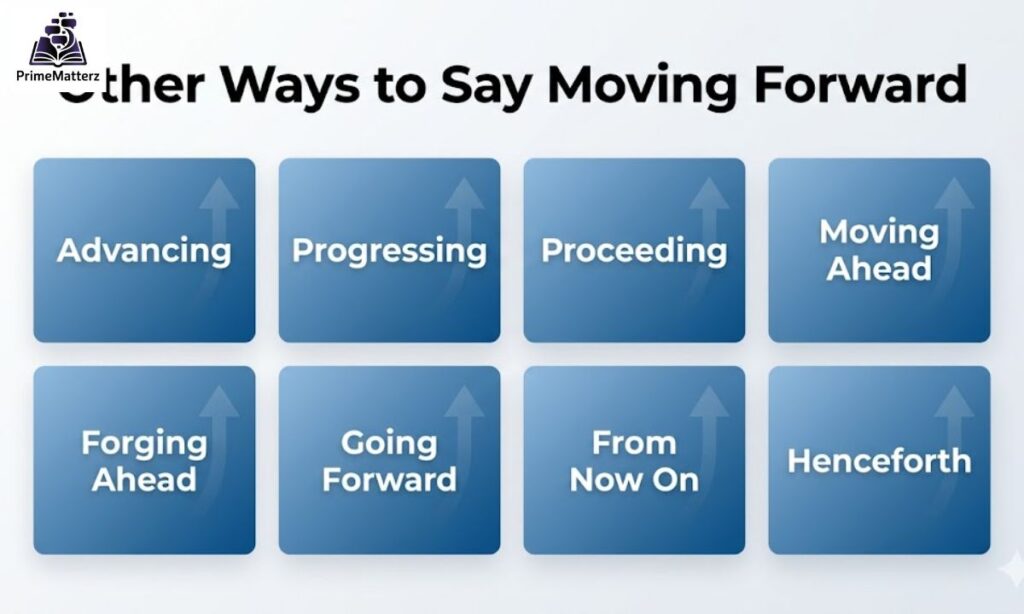
15+ Other Ways to Say “Moving Forward”
1. Going Forward
Meaning: One of the closest alternatives — signals continuation and future focus without sounding overly formal. It keeps things light but professional.
Example:
Person A: “We had some delays this quarter.”
Person B: “Going forward, let’s build in two extra review days.”
Best Use: Team emails, casual project updates, verbal discussions. Worst Use: Legal documents or highly formal reports. Tone: Neutral, professional.
2. From This Point Forward
Meaning: A more deliberate and firm phrase — it draws a clear line between past and future. It conveys commitment and a sense of finality.
Example:
Person A: “There’s been some confusion about approval processes.”
Person B: “From this point forward, all approvals go through the manager.”
Best Use: Policy updates, HR communications, formal announcements. Worst Use: Casual team chats or personal conversations. Tone: Formal, authoritative.
3. As We Progress
Meaning: Suggests a journey rather than a break — ideal when change is gradual and ongoing rather than immediate.
Example:
Person A: “Will this new system affect our workflow?”
Person B: “As we progress, we’ll adjust the process based on what we learn.”
Best Use: Long-term projects, product development, continuous improvement discussions. Worst Use: Situations requiring immediate action or urgency. Tone: Professional, collaborative.
4. In the Coming Days / In the Weeks Ahead
Meaning: Puts a time frame around future actions, making plans feel more concrete and measurable.
Example:
Person A: “When will we see the new dashboard?”
Person B: “In the coming days, the team will push the first update.”
Best Use: Project timelines, client updates, release announcements. Worst Use: Open-ended goals without a timeline. Tone: Professional, clear, action-oriented.
5. Henceforth
Meaning: A formal, almost legal-sounding word that makes a sharp statement about what changes from a specific moment on.
Example:
Person A: “The old submission format caused a lot of errors.”
Person B: “Henceforth, all submissions must follow the new template.”
Best Use: Official documents, policy memos, legal notices. Worst Use: Everyday emails or team conversations — sounds overly stiff. Tone: Highly formal.
6. Looking Ahead
Meaning: Shifts focus to the future with a forward-thinking, positive energy. It works well to open a new topic or section.
Example:
Person A: “Q3 was tough for the whole department.”
Person B: “Looking ahead, I’m optimistic about the changes we’re implementing.”
Best Use: Strategy meetings, year-end reviews, presentations. Worst Use: Immediate action plans where specifics are needed. Tone: Positive, professional, visionary.
7. From Now On
Meaning: Simple, direct, and easy to understand. It signals a clear change in behavior or process without any corporate tone.
Example:
Person A: “We keep missing the Thursday deadline.”
Person B: “From now on, let’s move the internal deadline to Tuesday.”
Best Use: Team discussions, internal emails, performance conversations. Worst Use: Formal reports or executive-level communications. Tone: Casual to semi-professional.
8. Charting a New Course
Meaning: An expressive phrase for moments of significant change — it implies intentional direction and leadership.
Example:
Person A: “We’ve been struggling with the old model for too long.”
Person B: “We’re charting a new course — one built around the customer experience.”
Best Use: Strategic pivots, leadership addresses, company rebranding. Worst Use: Minor process changes or routine updates. Tone: Inspirational, leadership-focused.
9. Transitioning to the Next Phase
Meaning: Works well in project management or product contexts — it gives a sense of structure and stages.
Example:
Person A: “Are we done with the testing phase?”
Person B: “Yes — we’re transitioning to the next phase, which is beta launch.”
Best Use: Project updates, software development, product launches. Worst Use: Emotional or interpersonal conversations. Tone: Technical, structured.
10. Making Headway
Meaning: Emphasizes visible, real progress — great when you want to show momentum rather than just intention.
Example:
Person A: “Has there been any progress on the backlog?”
Person B: “We’re finally making headway — five tickets closed this week alone.”
Best Use: Status updates, sprint reviews, manager check-ins. Worst Use: Future planning discussions without current progress. Tone: Energetic, professional, results-focused.
11. Forging Ahead
Meaning: Implies determination and resilience — it’s ideal when there have been challenges and the team is pushing through anyway.
Example:
Person A: “The first campaign didn’t land as expected.”
Person B: “We’re forging ahead with what we’ve learned and refining the strategy.”
Best Use: Post-setback communications, motivational contexts. Worst Use: Routine updates or neutral announcements. Tone: Motivating, slightly formal.
12. With an Eye Toward the Future
Meaning: A thoughtful phrase that shows long-term thinking while still being grounded in the present moment.
Example:
Person A: “How are you approaching the expansion?”
Person B: “With an eye toward the future, we’re investing in scalable infrastructure now.”
Meaning: Conversational but firm — it clearly marks a before and after without sounding overly corporate.
Example:
Person A: “There’s been confusion about who handles client escalations.”
Person B: “From here on out, that goes straight to the senior account manager.”
Best Use: Internal policy updates, team meetings, quick emails. Worst Use: Formal client-facing documents or executive reports. Tone: Casual, direct.
14. Pressing Onward
Meaning: Suggests continued effort in the face of difficulty — it’s motivating and shows perseverance.
Example:
Person A: “We lost two key team members this month.”
Person B: “It’s been hard, but we’re pressing onward and keeping the launch on track.”
Best Use: Difficult team situations, project recovery communications. Worst Use: Routine project updates without any adversity. Tone: Resilient, slightly formal.
15. In Upcoming Steps
Meaning: Practical and action-oriented — it sets up a sequence and tells people what to expect next.
Example:
Person A: “What happens after the contract is signed?”
Person B: “In upcoming steps, we’ll schedule onboarding and introduce your account team.”
Best Use: Client emails, process documentation, follow-up messages. Worst Use: Casual conversations or spontaneous discussions. Tone: Professional, organized.
16. As We Move Ahead
Meaning: A gentle, collaborative phrase that keeps the tone warm while still maintaining forward focus.
Example:
Person A: “We’ve had a rough few weeks adjusting to the new system.”
Person B: “As we move ahead, I want to make sure everyone feels supported in the transition.”
Best Use: Team leadership conversations, change management, HR communications. Worst Use: Urgent or time-critical communications that need a sharper tone. Tone: Empathetic, professional, warm.
Formal vs Informal Alternatives
Formal Alternatives
Informal Alternatives
Henceforth
From now on
From this point forward
Going forward
Henceforward
From here on out
With an eye toward the future
Looking ahead
Transitioning to the next phase
As we move ahead
In the period ahead
Making headway
Charting a new course
Pressing onward
As we progress
Moving ahead
From this moment forward
In the coming days
Forging ahead
In upcoming steps
Which Alternative Should You Choose?
The right phrase depends entirely on who you’re talking to and what you need to say.
Workplace / manager: Choose “from this point forward” or “henceforth” when setting a new rule or expectation. For general updates, “going forward” or “as we progress” strikes the right balance.
Email: Keep it clean and direct. “In upcoming steps” or “as we move ahead” works well at the start of a follow-up. “Looking ahead” is a good opener for a strategy email.
Customer: Use warmer language like “as we move ahead” or “in the coming days” — it sounds reassuring rather than corporate.
Friend or family: Skip the formal options altogether. “From now on” or “from here on out” sounds natural and honest without the office feel.
Social media: Go with something visual and engaging like “charting a new course” or “making headway” — these create energy and invite responses.
Frequently Asked Questions
Why does “moving forward” sound overused?
It appears so often in business communication that it has lost its impact — using varied alternatives keeps your language fresh and engaging.
What is the most formal alternative to “moving forward”?
“Henceforth” and “from this point forward” are the most formal choices, appropriate for legal and official documents.
Can I use these alternatives in job interviews?
Yes — phrases like “going forward,” “as we progress,” and “looking ahead” sound confident and professional without being robotic.
Are there one-word alternatives to “moving forward”?
Yes — “henceforth,” “onward,” and “henceforward” all work as single-word options with a more formal register.
How many alternatives should I learn to use naturally?
Focus on 3–5 that fit your typical context — variety matters, but consistency and naturalness matter more.
Final Thoughts
Strong communication isn’t about using big words — it’s about using the right ones at the right time. Whether you choose “henceforth” in a boardroom or “from now on” in a team chat, varying your language makes your message more memorable and your voice more credible. Pick the phrases that fit your tone, own them, and watch how much cleaner your communication becomes.